Yomi — what kind of place is it in Japanese mythology
Yomi (黄泉) is the land of the dead, a dark underworld as depicted in Japanese mythology: it is where Izanagi went to retrieve his deceased wife Izanami and from which he fled in horror upon seeing her decomposed body. The passage between the world of the living and Yomi, according to legend, is forever blocked by a massive boulder at the border of Yomotsuhirasaka.
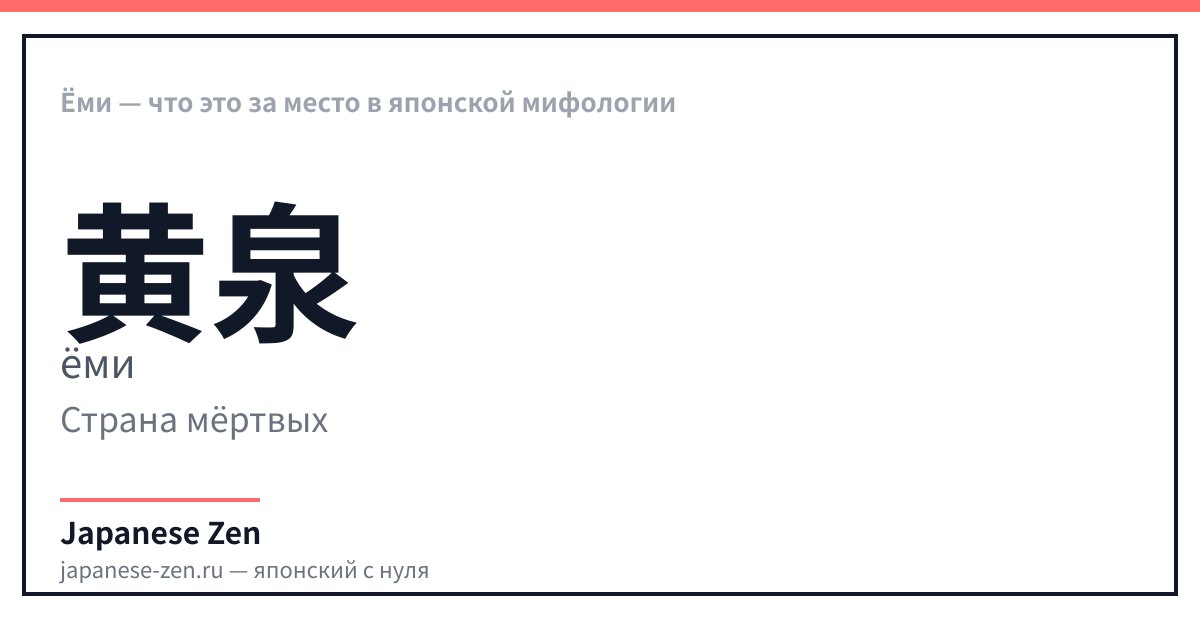
Yomi is honest in its own way: sinners are not sent there for judgment; all the dead simply end up there indiscriminately — it is an underworld storage, not a hall of justice.
What is Yomi and how is it structured
Yomi is the underground land of the dead in early Shinto myth, where the deceased go regardless of how they lived their lives: there is no judgment, no division into sinners and righteous, as in the Buddhist hell Jigoku. The main known story about Yomi is Izanagi's journey to retrieve his deceased wife Izanami, which ended in his terrified flight when he saw her decomposed body.
- Status: underground realm of the dead, without division into heaven and hell.
- Ruler: Izanami after her death.
- Border with the world of the living: Yomotsuhirasaka pass, blocked by a massive boulder.
- Related concept: kegare (穢れ) — spiritual impurity that must be washed away after contact with death.
Who actually descended into Yomi
In the myth, only one character actually 'goes' there voluntarily: Izanagi, to bring back his wife. Otherwise, Shinto tradition provides no pilgrimages or ritual visits to Yomi — it is not a place of power, but a warning about the irreversibility of death.
黄泉 — 'yellow springs'
| Japanese | Reading | Translation |
|---|---|---|
| 黄泉 | yomi · yomi | Land of the dead |
| 黄泉比良坂 | Yomotsuhirasaka · Yomotsuhirasaka | Border between the world of the living and Yomi |
| 穢れ | kegare · kegare | Spiritual impurity, defilement |
| 泉 | izumi · izumi | Spring, source |
| 地獄 | jigoku · jigoku | Buddhist hell (for comparison) |
Why the land of the dead is called springs
黄泉 is read よみ (yomi). The combination of characters itself — 'yellow springs' — is borrowed from the Chinese Taoist tradition of designating the afterlife, superimposed on the native Japanese word yomi, which, according to one version, derives from 'yoru' (night) and 'miru' (to see) — 'seen at night', the dark side of the world.
泉 — значение: spring, fountain — онъёми: セン — кунъёми: いずみ — 9 штрих(ов). 泉 — 'spring, source': on top is 'white' 白, below is water 水 — an image of pure water gushing from underground. The second character in the writing of 'Yomi'.
Write 泉 along the guides and learn the stroke order.
Yomi in anime and games
- 'Naruto' — the 'Izanami' technique is based on the myth of Izanagi and Yomi, although the series does not directly depict the land of the dead itself.
- Many role-playing games use Yomi as the name of the underworld or a final location, referencing the myth without a precise retelling of the plot.
- The theme of the forbidden gaze — 'do not look at what is hidden' — regularly appears in horror anime as a direct parallel to the story of Izanagi.
- Fate/Grand Order mentions Yomi in the context of the Japanese mythological arc of the story.
FAQ
- What is Yomi?
- The underground land of the dead in early Shinto myth, where all the deceased go without division into sinners and righteous. The main story about it is Izanagi's failed journey to retrieve his wife.
- Why is Yomi needed in mythology?
- It explains the origin of death and its irreversibility: Izanagi's attempt to bring his wife back from Yomi ends in failure and forever separates the world of the living and the dead with a boulder at the border of the worlds.
- What do the characters 黄泉 mean?
- 黄泉 (yomi): the characters 'yellow springs' are borrowed from the Chinese tradition, and the reading yomi itself, according to one version, is associated with the words 'night' and 'to see'.
- How is Yomi different from the Buddhist hell?
- In Yomi there is no judgment of the soul and no division into sinners and righteous — all the dead go there indiscriminately. The Buddhist Jigoku, for comparison, is a much later and more structured system of punishments.
- Can one return from Yomi?
- According to the myth, practically no: Izanami could not return after eating the food of the dead, and Izanagi's attempt to take her back ended in his flight and the permanent severing of the connection between the worlds.
- Is the myth of Yomi cited in anime?
- There are few direct adaptations, but the motif of the 'forbidden gaze' from the myth of Izanagi is regularly cited in horror stories, and the name Yomi is sometimes used for afterlife locations in games.
Sources
Updated: 2026-08-29