Japanese Kanji for Love: 愛 — How to Write, Read, and When Not to Use It
The Japanese kanji for love is 愛, read as 'ai' (onyomi アイ), 13 strokes. 'Love in Japanese' as a word is 愛 (ai), 'I love you' is 愛してる (aishiteru). In Chinese, the same character is simplified to 爱, so the 'Chinese kanji for love' and the Japanese one look different. In everyday speech, Japanese people more often say 好き (suki) and 大好き (daisuki) instead of 愛してる.
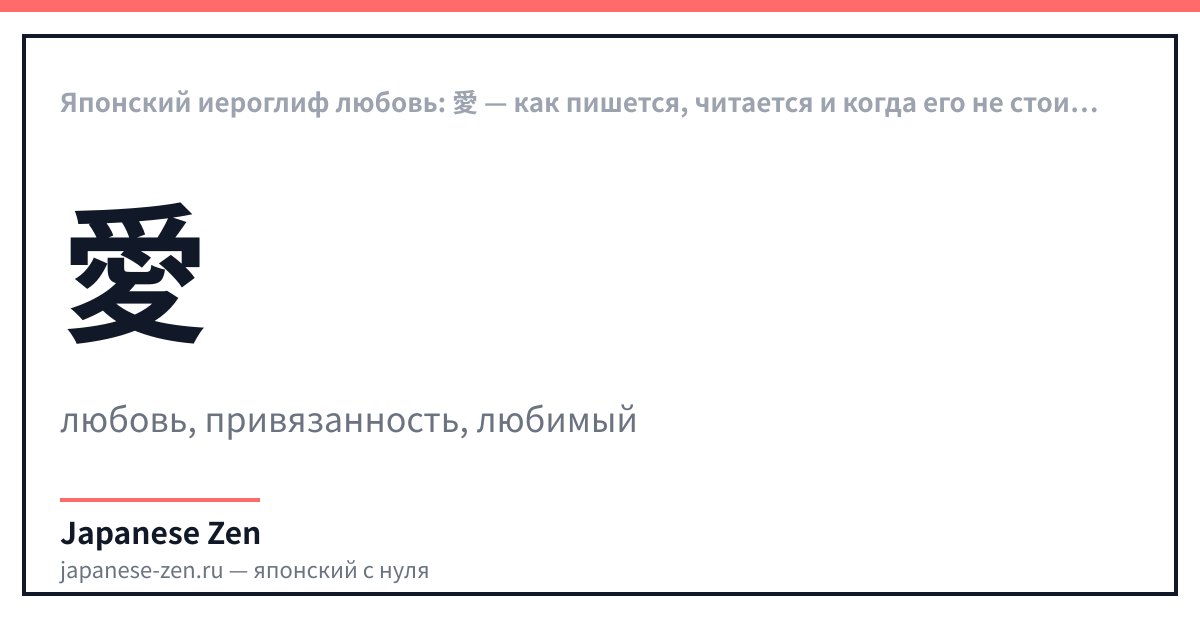
愛 — thirteen strokes, within which a heart 心 is hidden. The character is so heavy in meaning that it is rarely spoken: in Japanese, a confession often sounds quieter than it looks on paper. Hence the paradox — everyone knows the kanji for love, but most Japanese people never say the word 愛してる out loud in years.
How to Write the Japanese Kanji for Love
愛 — значение: love, affection, beloved — онъёми: アイ — кунъёми: いと.しい、かな.しい、め.でる、お.しむ、まな — 13 штрих(ов). Level N3. Click 'Show stroke order' — the strokes will appear in the order they are written by hand.
What the Character Consists Of
At the top are 'claws' 爫, below is a 'roof' 冖, then the heart 心, and at the bottom 夂 ('to go slowly'). The traditional interpretation: a person turns around and lingers because their heart remains behind. That's enough to remember: look for 心 in the middle — it holds the whole character together.
How Japanese 愛 Differs from Chinese 爱
The character came from China, but in the 1950s mainland China simplified the writing: the heart 心 was removed from the middle, resulting in 爱. Japan kept the full form 愛 — the same one used in Taiwan and Hong Kong. So the query 'Chinese kanji for love' leads to two different images: 爱 (simplified) and 愛 (traditional and Japanese).
How to Say 'Love' and 'I Love You' in Japanese
| Japanese | Reading | Translation |
|---|---|---|
| 愛 | ai · ai | Love (noun, 'love in general') |
| 愛してる | aishiteru · aishiteru | I love you (very strong; hardly ever used in everyday life) |
| 大好き | daisuki · daisuki | I really like you, adore you (this is how people usually confess) |
| 好き | suki · suki | I like you (the first confession often sounds like this) |
| 恋 | koi · koi | Infatuation, romantic feeling (a different character: passion for a specific person) |
| 愛情 | aijō · aijō | Love, tenderness, affection (for children, family, work) |
| 恋人 | koibito · koibito | Loved one, partner |
愛 or 恋 — What's the Difference
恋 (koi) is about 'wanting to be together': infatuation, longing, heart skipping a beat. 愛 (ai) is about 'wanting you to be well': calm, responsible love. Japanese people joke that 恋 takes, and 愛 gives. There is also a word that unites both — 恋愛 (ren'ai), 'romantic relationship'.
Love Kanji for Tattoos and Inscriptions: What to Know in Advance
- A lone 愛 a Japanese person will read as abstract 'love' — roughly like a Russian tattoo with the word 'Любовь'. It's not a phrase or a name.
- 'Eternal love' is 永遠の愛 (eien no ai). Without the particle の, the combination looks like a set of words.
- Check which character you're being drawn: 愛 (Japanese and traditional) or 爱 (simplified Chinese) — these are different writings.
- The stroke order is visible in the finished work: an incorrectly drawn line immediately reads as 'written by someone who doesn't understand'. Watch the animation above before bringing the design to the artist.
Write 愛 Yourself
Trace the kanji along the guides — the system will evaluate each stroke.
FAQ
- How do you write the kanji for 'love' in Japanese?
- 愛 — 13 strokes, read as 'ai' (onyomi アイ). It is written from top to bottom: first the 'claws' 爫, then the 'roof' 冖, the heart 心, and the bottom element 夂. JLPT N3 level.
- How do you say 'love' in Japanese?
- 愛 (ai) — love as a concept. 愛情 (aijō) — warm affection for loved ones. 恋 (koi) — infatuation. 恋愛 (ren'ai) — romantic relationship.
- How do you say 'I love you' in Japanese?
- 愛してる (aishiteru) — literally 'I love you', but it sounds very weighty and is almost never used in everyday life. The usual confession is 好き (suki) 'I like you' or 大好き (daisuki) 'I really like you'.
- How is the Chinese kanji for love different from the Japanese one?
- In mainland China, the character was simplified to 爱, removing the heart 心 from the middle. Japan preserved the full form 愛. The meaning is the same, the writing is different; Taiwan and Hong Kong also write 愛.
- How do you write 'eternal love' in kanji?
- 永遠の愛 (eien no ai): 永遠 — 'eternity', の — possessive particle, 愛 — 'love'. The particle の cannot be omitted, otherwise you get not a phrase but two words in a row.
Updated: 2026-07-25