Japanese sun kanji: 日 — writing and readings
The Japanese sun kanji is 日, 4 strokes, N5 level. It is read as “hi” or “ka” (kun'yomi ひ、び、か) and “nichi/jitsu” (on'yomi ニチ、ジツ). The same sign means “day”: 日曜日 (nichiyōbi) — Sunday. “Sun” as a separate word is 太陽 (taiyō), and Japan is 日本 (Nihon), “source of the sun”.
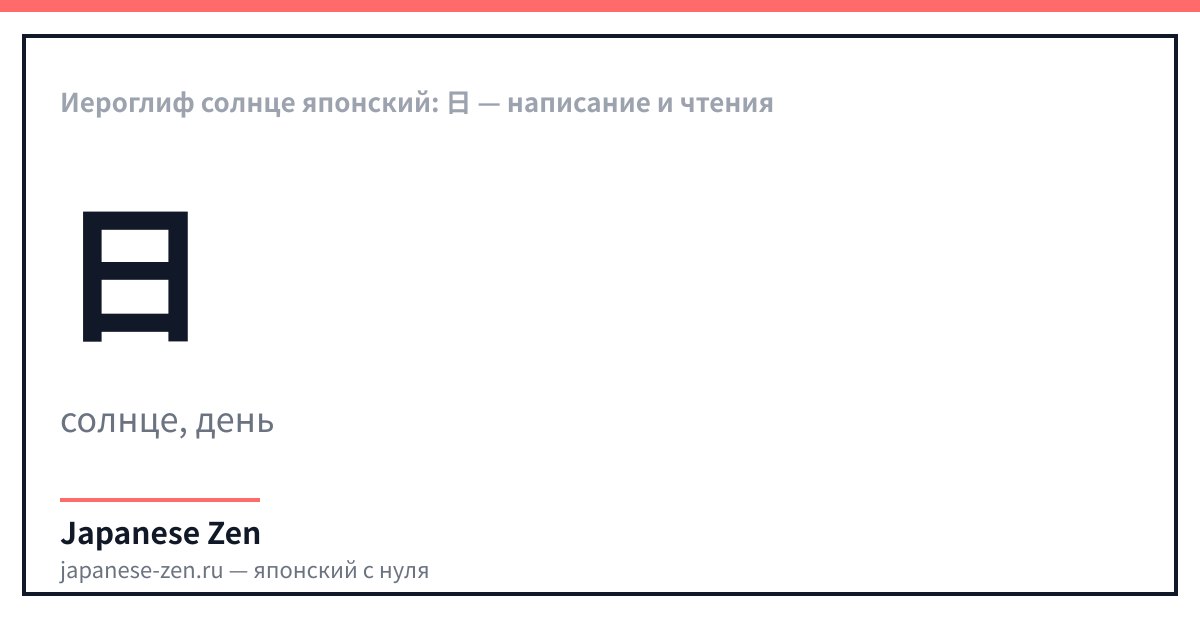
日 is the most practical kanji in the language: a circle with a dot in the middle, from which grew both the sun, the day, and the name of the country. Japan literally calls itself “the place where the sun rises” — 日本. From the Chinese perspective, who gave this name, it's correct: Japan is to the east of them.
How to write the sun kanji in Japanese
日 — значение: sun, day — онъёми: ニチ、ジツ — кунъёми: ひ、-び、-か — 4 штрих(ов). N5 level, 4 strokes. Click “Show order” — the frame closes with the last stroke.
Why one sign means both sun and day
Originally, 日 is a drawing of the sun: a circle with a dot inside, which over time straightened into a rectangle. A day is one rotation of the sun, so the meaning expanded naturally. In modern language, “sun” as a celestial body is more often called 太陽 (taiyō), while 日 remains in the meaning of “day” and in compound words.
Words with the sun kanji
| Japanese | Reading | Translation |
|---|---|---|
| 太陽 | taiyō · taiyō | Sun (celestial body) |
| 日 | hi · hi | Sun, day, light |
| 日本 | Nihon · Nihon | Japan — “source of the sun” |
| 今日 | kyō · kyō | Today (exception: reading is irregular) |
| 日曜日 | nichiyōbi · nichiyōbi | Sunday (“day of the sun”) |
| 日の出 | hinode · hinode | Sunrise |
| 夕日 | yūhi · yūhi | Setting sun |
How many readings does 日 have
This is one of the most “multi-read” signs: ニチ (nichi) in 日曜日, ジツ (jitsu) in 平日 (heijitsu, weekdays), ひ (hi) in 日の出, び (bi) in 曜日, か (ka) in dates — 二日 (futsuka, second day of the month). Memorizing them as a list is pointless: readings come with words.
Write 日 yourself
Trace 日 along the guides: the frame, then the line inside — four strokes in all.
FAQ
- Is 日 the sun or the day?
- 日 — 4 strokes, N5 level, means both “sun” and “day”. The sun as a celestial body is usually called 太陽 (taiyō).
- How do you say “sun” in Japanese?
- 太陽 (taiyō) — the sun in the sky. 日 (hi) — the sun in everyday sense and sunlight: 日が出る “the sun rises”.
- Why is Japan 日本?
- 日 “sun” + 本 “origin, beginning” = “source of the sun”, the land of the rising sun. The name came from the Chinese perspective from the mainland: Japan lies to the east.
- Why does 日 have so many readings?
- The character is very old and appears in hundreds of words, each with its own history: ニチ, ジツ, ひ, び, か. The reading is determined by the word, not by the character itself.
Updated: 2026-07-25