How to say 'How are you?' in Japanese: how to ask and what to answer
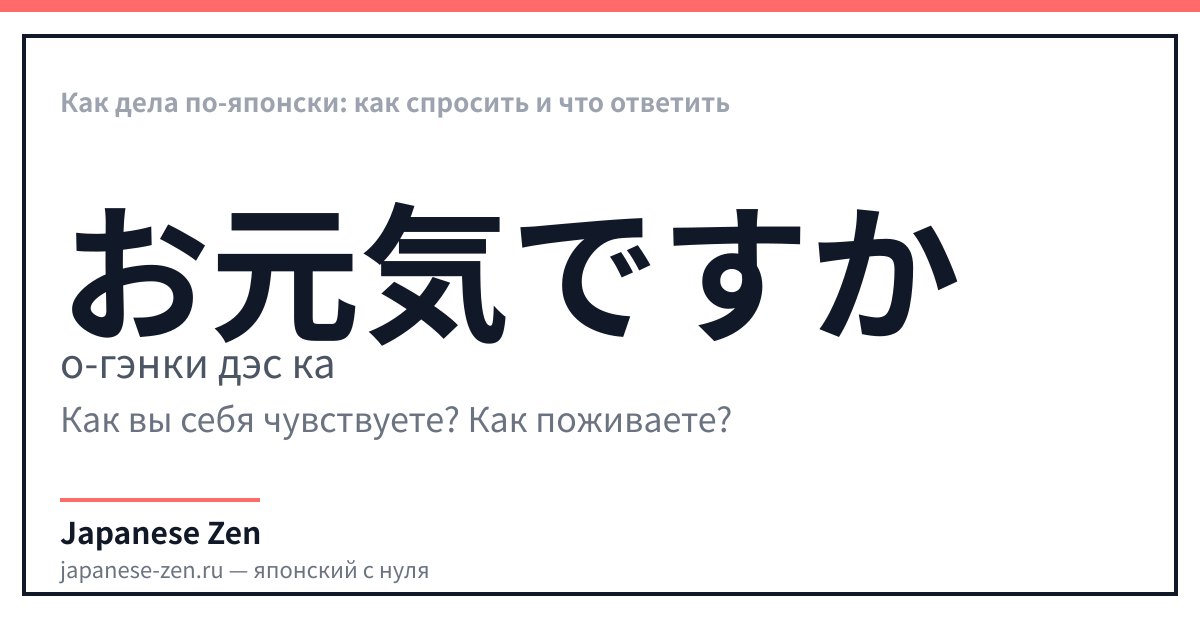
'How are you?' in Japanese is お元気ですか (o-genki desu ka), polite. Among friends, shorter: 元気? (genki?). Answer — 元気です (genki desu) 'I'm fine', まあまあです (māmā desu) 'so-so'. Important detail: Japanese people don't ask this question every day, but to someone they haven't seen in a while.
The Russian 'how are you' is a doorknob: you grab it to enter a conversation. The Japanese 元気ですか is more like a knock on the door after a long absence. Asking a colleague this every morning is like asking every day if they've been sick since yesterday.
How to ask 'how are you' in Japanese
| Japanese | Reading | Translation |
|---|---|---|
| お元気ですか | o-genki desu ka · o-genki desu ka | How are you feeling? How have you been? (polite, to someone you haven't seen in a while) |
| 元気ですか | genki desu ka · genki desu ka | How are you? Are you okay? (neutral, without the polite お) |
| 元気 | genki? · genki? | How's it going? (very friendly, with a questioning intonation) |
| 久しぶりですね | hisashiburi desu ne · hisashiburi desu ne | Long time no see! (more often used instead of 'how are you' when meeting) |
| 調子はどうですか | chōshi wa dō desu ka · chōshi wa dō desu ka | How's it going? How are things progressing? (about matters, work, health after illness) |
Why the お at the beginning changes everything
元気 means 'vigor, energy'. The prefix お is a polite bow towards the listener: you're not asking about abstract vigor, but about theirs. Therefore お元気ですか is appropriate with a teacher, neighbor, older colleague, while bare 元気? is for a classmate.
What to answer to 'how are you' in Japanese
| Japanese | Reading | Translation |
|---|---|---|
| 元気です | genki desu · genki desu | I'm fine, I'm okay |
| おかげさまで | okagesama de · okagesama de | Thank you, thanks to you (polite formula; often fully: おかげさまで元気です) |
| まあまあです | māmā desu · māmā desu | So-so, average |
| 大丈夫です | daijōbu desu · daijōbu desu | It's fine, everything is okay |
| 疲れました | tsukaremashita · tsukaremashita | I'm tired (honest answer to a tired colleague at the end of the day) |
How to return the question to the other person
After answering, add あなたは? (anata wa?) — 'and you?'. In casual speech, the pronoun is often omitted and you just say ~は? with the name: 田中さんは? (Tanaka-san wa?) — 'and you, Tanaka-san?'.
How the Japanese 'how are you' differs from the Russian one
- It's not a daily ritual. Every morning you say おはようございます to a colleague, not 'how are you'.
- The question implies you haven't seen each other for a while — otherwise it sounds like you suspect the person is ill.
- The default answer is positive: 元気です. A detailed story about problems in response to a polite formula is not expected.
- In business correspondence, instead of 'how are you' they write お世話になっております (o-sewa ni natte orimasu) — 'thank you for your cooperation'.
Say 'how are you' out loud and check your pronunciation
Speak the phrase into the microphone — the AI will rate how close it is to Japanese pronunciation.
FAQ
- How do you say 'how are you' in Japanese?
- お元気ですか (o-genki desu ka) — polite, 元気ですか (genki desu ka) — neutral, 元気? (genki?) — friendly. Literally it means 'are you vigorous?', so the question is appropriate when meeting after a break, not every day.
- What do you answer to 'o-genki desu ka'?
- 元気です (genki desu) — 'I'm fine'. More polite — おかげさまで元気です (okagesama de genki desu). If so-so — まあまあです (māmā desu). After answering, it's customary to return the question: あなたは? (anata wa?).
- Can you ask 'how are you' every day?
- No, it sounds strange. The daily greeting in Japan is おはようございます in the morning, こんにちは in the afternoon. 元気ですか is reserved for meeting after a long break, along with 久しぶりですね ('long time no see').
- What does 元気 (genki) literally mean?
- 'Original energy': 元 — source, beginning, 気 — spirit, energy. Hence the meaning of the question: not 'what's new with you', but 'do you have strength'. The word 元気 also works as an adjective: 元気な子 — 'a lively, energetic child'.
- How to ask 'how are you' to a friend informally?
- 元気? (genki?) with a questioning intonation or 調子はどう? (chōshi wa dō?) — 'how's it going?'. Young people often just say 最近どう? (saikin dō?) — 'what's new lately?'.
Updated: 2026-07-25