Which language is harder, Chinese or Japanese: an honest comparison
There is no single answer to which language is harder, Chinese or Japanese — their difficulties are different. Chinese is complicated by tones and the sheer number of characters, Japanese by two syllabaries, multiple readings of one character, and polite grammar with endings. Korean is simpler in writing, and its grammar is close to Japanese.
The debate over "which is harder" comes down to what you are willing to pay: hearing and pronunciation, or writing and grammar. Let's break down both languages honestly along the axes — writing, sound, grammar — and also see where Korean fits in this company and which language is better to start with if you want to learn both.
Short answer: the difficulties are different
Both languages are considered difficult for English speakers, but each has its own difficulty. In Chinese, the hardest part is sound: the same word with a different tone means something different. In Japanese, sounds are simple, but writing and grammar take more time.
| What we compare | Chinese | Japanese | Korean |
|---|---|---|---|
| Writing | only characters | characters and two syllabaries: hiragana and katakana | hangul — an alphabet, syllables are built from letters |
| Reading of a character | usually one | two types: on'yomi and kun'yomi, a character often has several readings | characters are almost unnecessary in everyday reading |
| Sound | four tones | no tones, but pitch accent | no tones |
| Words | do not change, no conjugations | verbs and adjectives change | verbs and adjectives change |
| Politeness | expressed with words | built into the verb form | built into endings |
Are Chinese and Japanese similar or not
As languages they are not related: they have different grammar and word roots. What they share is the characters that Japan borrowed from China, and part of the vocabulary that came with them. So they are not close relatives like Spanish and Italian, but familiar signs sometimes read and mean different things. For more on these differences, see the article on the difference between Chinese and Japanese characters.
Chinese and Japanese along three axes: writing, sound, grammar
It is more honest to compare "difficulty" not as a whole, but by individual areas: in each of them Chinese and Japanese have different obstacles.
Writing: characters in both, but differently
You will have to learn characters in both languages. In China, simplified characters have been officially in use since 1956, while Japan has its own set: according to Kotobank, the list of 常用漢字, that is, standard characters for documents and newspapers, includes 2136 characters. The difference is that Japanese adds two syllabaries and many readings: a character has an on'yomi reading that came from China and a kun'yomi reading that is native Japanese. In Chinese, a character usually has one reading, but you have to remember its tone.
Sound: tones versus pitch accent
Modern Chinese distinguishes four tones: level, rising, low, and falling, and Kotobank emphasizes that a word with a different tone means something different. For those who have never lived with tones, this is the toughest barrier. Japanese has no tones, few sounds, and pronunciation is mastered faster, although pitch accent also needs to be heard.
Grammar: without conjugations or with politeness
Chinese grammar looks simpler: words do not change, time is conveyed by particles and context, and word order is close to English. Japanese is stricter: the verb is placed at the end of the phrase, it has many forms, and politeness changes both the verb and the words around it. For a beginner, Chinese grammar is usually easier, while Japanese requires a lot of practice from the very start.
Which language is harder, Japanese or Korean
Korean is usually mentioned alongside because it shares a lot with Japanese in sentence structure. The difference is in writing, where Korean is noticeably simpler.
Hangul: a writing system that is learned quickly
According to Kotobank, hangul was created under King Sejong in 1443 and published in 1446. Today it has 24 letters — 14 consonants and 10 vowels, which combine into syllables. The alphabet can be learned very quickly: you do not need to memorize thousands of characters. Japanese writing, by contrast, includes characters, which stretches writing study over years.
Korean grammar is close to Japanese
In both languages, the verb stands at the end of the sentence, particles define the relationships between words, and politeness is expressed by endings. Someone who has mastered Japanese sentence logic enters Korean more easily, and vice versa. Scholars have not proven these languages are related, but in structure they are similar. So in grammar, Japanese and Korean are roughly equal, while in writing, Korean is simpler.
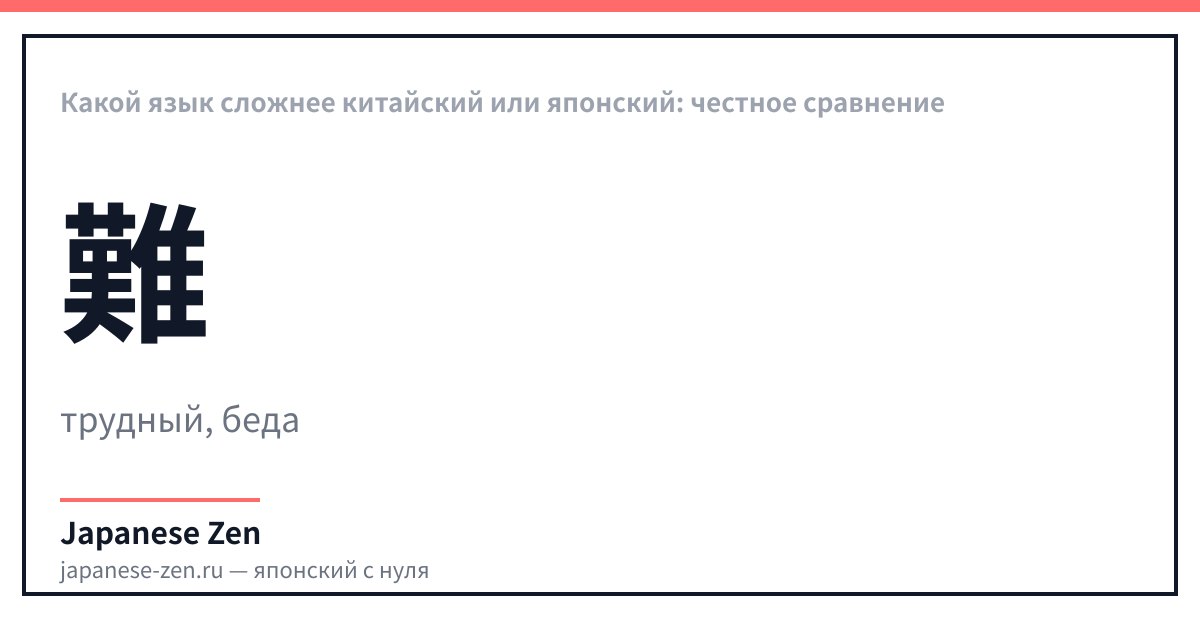
The word "difficult" in Japanese: 難
難 — значение: difficult, misfortune — онъёми: ナン — кунъёми: かた.い、-がた.い、むずか.しい、むづか.しい、むつか.しい、-にく.い — 18 штрих(ов). 難 — "difficult, hard", and in other words also "misfortune, disaster". This is the character in the word 難しい "difficult", which you will need when talking about difficulties.
Readings of 難: むずか・しい and ナン
In the word 難しい (muzukashii), the character is read with kun'yomi — むずか, and the ending しい is written in syllabary. The on'yomi reading ナン sounds in compound words: 困難 (konnan) "difficulty", 災難 (sainan) "disaster", 難民 (nanmin) "refugees". The opposite word 易しい (yasashii) "easy" is written with a different character, and in speech it is easy to confuse with 優しい "kind" — they have the same pronunciation.
| Japanese | Reading | Translation |
|---|---|---|
| 難しい | muzukashii · muzukashii | Difficult, hard |
| 易しい | yasashii · yasashii | Easy, simple |
| 簡単 | kantan · kantan | Simple, uncomplicated |
| 中国語 | chūgokugo · chūgokugo | Chinese language |
| 日本語 | nihongo · nihongo | Japanese language |
| 韓国語 | kankokugo · kankokugo | Korean language |
Write 難 along the guides: the character is complex in the number of strokes, and a good trainer for accuracy.
FAQ
- Which language is harder, Chinese or Japanese?
- There is no single answer. Chinese is harder because of four tones and many characters, Japanese because of two syllabaries, multiple readings of a character, and polite forms. For a beginner, Chinese grammar is usually easier, while pronunciation is harder.
- Are Chinese and Japanese similar or not?
- They are not related to each other: grammar and word roots are different. What they share is the characters that Japan borrowed from China, and part of the vocabulary. Because of this, a familiar character sometimes means different things in the two languages.
- Which language is easier for an English speaker, Chinese or Japanese?
- If tones are hard for you, start with Japanese: the sounds there are simpler. If grammar with polite forms scares you, Chinese will seem gentler. Both languages require years of regular practice, so choose by interest, not by hearsay.
- Which language is harder, Japanese or Korean?
- In grammar they are roughly equal: verb at the end, particles, politeness in endings. In writing, Korean is simpler: its hangul is 24 letters, not thousands of characters. Therefore Japanese usually takes longer to master.
- Where to start if you want to learn both Chinese and Japanese?
- Take one language and bring it at least to N5 level or its Chinese equivalent, then add the second. The characters of the two languages are similar and will interfere with each other if you learn both from scratch at the same time.
Sources
Updated: 2026-09-29