Maneki-neko — what the cat with the raised paw means
Maneki-neko (招き猫), often spelled maneki neko without the macron, is a figurine of a cat with a raised paw: according to Japanese belief, it beckons customers and good fortune into a shop. The raised paw is not a "bye-bye" gesture but the Japanese "come here": palm down, as if scooping air toward oneself. The figurine has been known since the 19th century and still stands at the entrance to shops and restaurants.
Left paw or right — it's not a trifle: Japanese sources disagree on what each one promises, and we'll look at both versions. We'll explain why the cat is actually beckoning "come here" in Japanese rather than waving "bye-bye", and which temple is considered its legendary birthplace. And also why the tradition is Japanese, not Chinese, even though outside Japan people surprisingly often believe the opposite.
Which paw is for money and which is for guests
The most common interpretation: the raised right paw beckons money, the left — people and good luck in business. But the opposite reading also occurs, and in some shops they put it more simply: the left paw is for business, the right is for home. There is no single canon; the meaning varies from place to place and has changed over time.
| Color | What it promises according to belief |
|---|---|
| White | Good luck and well-being in general — the oldest, original color of the figurine |
| Black | Protection from curses and misfortune — the second historical color, alongside white |
| Gold | Prosperity and profit in business |
| Red | Health — according to belief, the smallpox demon dislikes this color |
| Pink | Luck in love and relationships — the newest and clearly commercial meaning |
Originally the maneki-neko was only white or black. The other colors — pink, and along with them the fashion of attributing a little miracle to every shade — spread in our time, together with the fashion for feng shui. So the discrepancies between websites and shops are not a mistake but traces of different eras within one tradition.
Why the cat "waves" differently than it seems
The paw is raised palm down and bends slightly — this is the Japanese gesture for "come here", as if scooping air toward oneself, not a wave of the palm away from oneself. To a European or American, such a motion reads the opposite way, as a farewell "bye": the beckoning gesture in Japan and in the West is mirrored. That is why figurines for the Western market are often made with the paw turned back-side to the viewer — the Western way.
In the raised paw or at the feet there is often a gold koban coin (小判) — a copy of an old Edo-period coin, only with a liberty taken. A real koban denoted one ryō, while the toy coin almost always displays a far more generous sum, like a thousand ryō: this is not historical accuracy but simply an image of great wealth.
Gotokuji, Imado and other claimants to the cat's birthplace
The maneki-neko has no single birthplace — there are several urban legends, and they differ in details. The most famous links the figurine to Gotokuji Temple (豪徳寺) in Tokyo's Setagaya district. According to the legend, the Hikone lord Ii Naotaka was returning from falconry and noticed at the gate of a poor temple a cat that seemed to beckon him with its paw. Naotaka went inside — and just then a downpour began, from which this very delay saved the guest. In gratitude he generously endowed the temple, and it grew into Gotokuji.
There is another version of the same story: Naotaka noticed the beckoning cat, stepped away from the tree under which he was sheltering from the rain — and lightning struck that tree. According to another legend, it happened not in Setagaya but at the Asakusa Imado Shrine. An impoverished old woman let her beloved cat go, and it appeared to her in a dream and advised her to mold a clay figurine of it for sale — and so the craft was born.
Most such legends have no material support. Better documented is the ceramic "marushime-neko" from the Imado workshops: it was sold at Asakusa Shrine at the end of the Edo period, it is mentioned in a source from 1852 and has been found in excavations.
A temple with thousands of cats
At Gotokuji there still stands the Shōneko-dō hall, where visitors leave maneki-neko figurines in gratitude for a wish fulfilled — there are a huge number of them, and they only grow over the years. It is said that this temple gave its appearance to Hikonyan — the mascot of Hikone Castle, the ancestral town of the Ii clan.
What the cat beckons: breaking down the word 招き猫
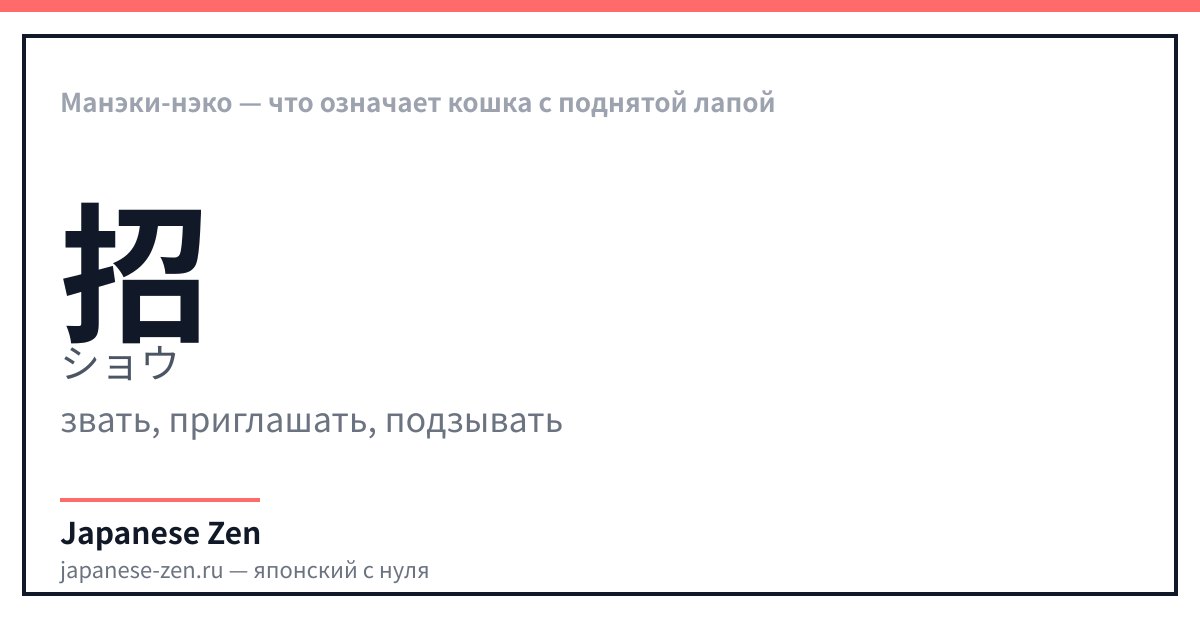
招 — значение: to call, to invite, to beckon — онъёми: ショウ — кунъёми: まね.く — 8 штрих(ов). 招 — "to call, to invite": the same character appears in 招待 (shōtai) "invitation" and 手招き (temaneki) "a hand gesture, beckoning". It is the first character in 招き猫, and it is precisely the one that describes the cat's gesture.
招き猫 literally means "beckoning cat": 招き (maneki) — "beckoning", a verbal noun from 招く "to call, to beckon", plus 猫 (neko) — "cat". The word 猫 itself in Japanese covers both a male and a female cat: a separate word for a male of this animal is almost never used in everyday speech.
| Japanese | Reading | Translation |
|---|---|---|
| 招き猫 | manekineko · maneki-neko | Maneki-neko |
| 招く | maneku · maneku | To call, to beckon, to invite |
| 小判 | koban · koban | A gold coin in the figurine's paw |
| 千両 | senryō · senryō | A thousand ryō — the sum often written on the toy coin |
| 商売繁盛 | shōbai hanjō · shōbai hanjō | Prosperity in business — the main wish of the figurine |
| 開運 | kaiun · kaiun | A turn of fortune for the better |
Write 招 along the guides — the "beckoning" character from the name maneki-neko.
Neko or neko-san
In conversation, Japanese people often add the polite さん to animals and things, as to a person: you get "maneki-neko-san". There is no strict rule — it is simply a shade of warm, almost family-like attitude toward the figurine, not part of the official name.
Chinese cat, waving paw and coin: what's wrong here
What is not supported by sources
- "The maneki-neko is a Chinese cat." The figurine was invented in Japan and only later took root in China and in New York's Chinatowns, where it is called the golden lucky cat.
- "The waving paw is an old tradition." In fact, mechanical and battery-powered figurines with a moving paw are a 20th-century invention: the classic maneki-neko's paw is motionless, and the movement appeared along with affordable motors and, later, solar batteries.
- "The maneki-neko always has a coin in its paw." At Gotokuji, the temple from the main legend, figurines are sold without a coin and always with the right paw raised.
FAQ
- What does maneki neko mean?
- A figurine of a cat with a raised paw is placed at the entrance to a shop or restaurant as a wish for good luck and good sales. One paw beckons money, the other — guests and good luck in business, though sources disagree on which is which.
- What does it mean if the maneki-neko has its left paw raised?
- Most often the left paw is associated with guests and good luck in business, not directly with money — but in different shops and sources this interpretation can swap places with the right paw. There is no single standard on this.
- What does the color of the maneki-neko mean?
- Historically the cat was white or black: white promised good luck in general, black — protection from misfortune. Gold, red and pink are later and clearly commercial additions linked to the fashion for feng shui.
- Where did the maneki-neko come from?
- There are several legends with no single confirmation: the most famous is about Gotokuji Temple in Tokyo and the lord Ii Naotaka, and there is also a version about Imado Shrine. The earliest confirmed find is a ceramic cat from the Imado workshops of the mid-19th century.
- Where do you place a maneki-neko?
- Traditionally — at the entrance to a shop, restaurant or workshop, facing the street, so that the figurine "greets" passersby and invites them in. It is first and foremost a symbol of a welcoming business, not a home amulet on a shelf.
- How is "maneki-neko" written in Japanese?
- 招き猫, read as まねきねこ (maneki-neko). The first part, 招き, is "beckoning" from the verb 招く "to call, to beckon"; the second, 猫, is "cat". In Hepburn romanization it is written maneki-neko.
Sources
Updated: 2026-09-14