Anime quotes in Japanese with translation
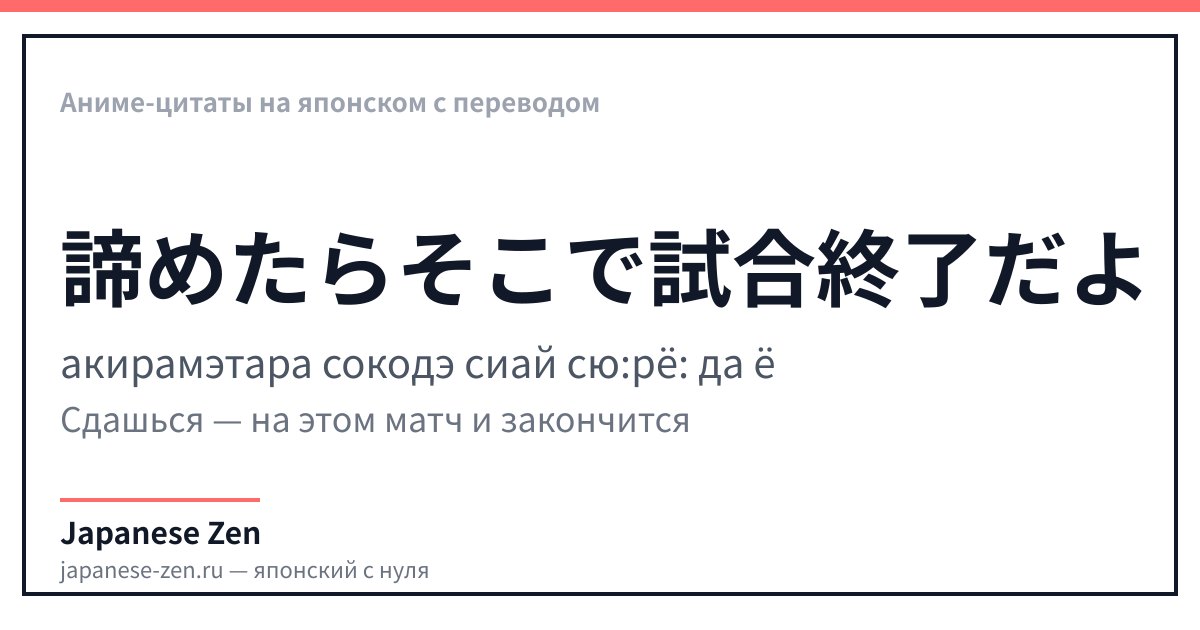
It is more useful to analyze anime quotes in Japanese than to memorize them: in 諦めたらそこで試合終了だよ (“if you give up, the match ends there”) you can see the conditional form 〜たら, and in 月が綺麗ですね there is a whole story about how Natsume Soseki translated “I love you.” Below are quotes with a literal breakdown and an indication of where you should not say them.
A quote is remembered together with the grammar it relies on. Let's analyze famous lines line by line — and also separate what can be repeated in real life from what only sounds on screen.
Quotes with breakdown
| Japanese | Reading | Translation |
|---|---|---|
| 諦めたらそこで試合終了だよ | akirametara sokode shiai shūryō da yo · akirametara sokode shiai shūryō da yo | If you give up, the match ends there (Slam Dunk, Coach Anzai) |
| 月が綺麗ですね | tsuki ga kirei desu ne · tsuki ga kirei desu ne | The moon is beautiful tonight, isn't it? (an indirect confession of love) |
| 人は皆、自分の物語を生きている | hito wa mina, jibun no monogatari o ikite iru · hito wa mina, jibun no monogatari o ikite iru | Everyone lives their own story |
| 頑張って | ganbatte · ganbatte | Hang in there, do your best (the most common encouragement in Japanese) |
| 大丈夫 | daijōbu · daijōbu | It's okay; I'm fine |
| 行くぞ | iku zo · iku zo | Let's go! Let's do this! (masculine ending ぞ, sounds combative) |
“The moon is beautiful tonight” — why it's a confession
According to legend, the writer Natsume Soseki, while teaching English, corrected a student who literally translated “I love you”: a Japanese person wouldn't say that, better to say 月が綺麗ですね. The story's authenticity is debatable, but the expression has caught on and is understood by everyone: feelings are conveyed through the atmosphere, not stated directly.
What the quotes teach in terms of grammar
| From the quote | Construction | What it does |
|---|---|---|
| 諦めたら | 〜たら | condition: “if you give up” |
| 生きている | 〜ている | state, not action: “is living” |
| 行くぞ | ending ぞ | masculine assertiveness, self-encouragement |
| 綺麗ですね | ね | invitation to agree: “right?” |
What of this can you say in real life
頑張って and 大丈夫 are everyday, normal live speech. 行くぞ is appropriate among friends. But pompous monologues and battle cries in conversation will sound like a quote from a cartoon: a Japanese person will recognize the source and smile.
FAQ
- What is the most famous anime quote?
- 「諦めたらそこで試合終了だよ」 — “if you give up, the match ends there” from Slam Dunk. It is known even outside the fandom.
- Why does “the moon is beautiful” mean “I love you”?
- According to legend, Natsume Soseki translated “I love you” that way: a Japanese person doesn't confess directly, feelings are conveyed through the atmosphere.
- Can anime quotes be used in conversation?
- Everyday ones, yes: 頑張って, 大丈夫, 行くぞ. Pompous lines will sound like a recognizable quote from a cartoon.
- Do quotes help learn Japanese?
- Yes, if you analyze the grammar inside: 〜たら, 〜ている, and the role of endings are clearly visible.
Updated: 2026-07-25