Anime phrases in Japanese: 12 lines with translation and reading
Anime phrases in Japanese that you hear most often: やめて (yamete) 'stop', 頑張って (ganbatte) 'hang in there', 仕方がない (shikata ga nai) 'it can't be helped', 行くぞ (iku zo) 'let's go!', 大丈夫 (daijōbu) 'it's okay'. Below are 12 lines with reading in Russian letters and an explanation of where they are appropriate in life.
Anime is a great source of living speech and a bad source of politeness: half of the vivid lines sound like something you can't say in a real conversation with a stranger. Below, we mark what you can take into life and what to leave to the characters.
Phrases that appear in every other anime
| Japanese | Reading | Translation |
|---|---|---|
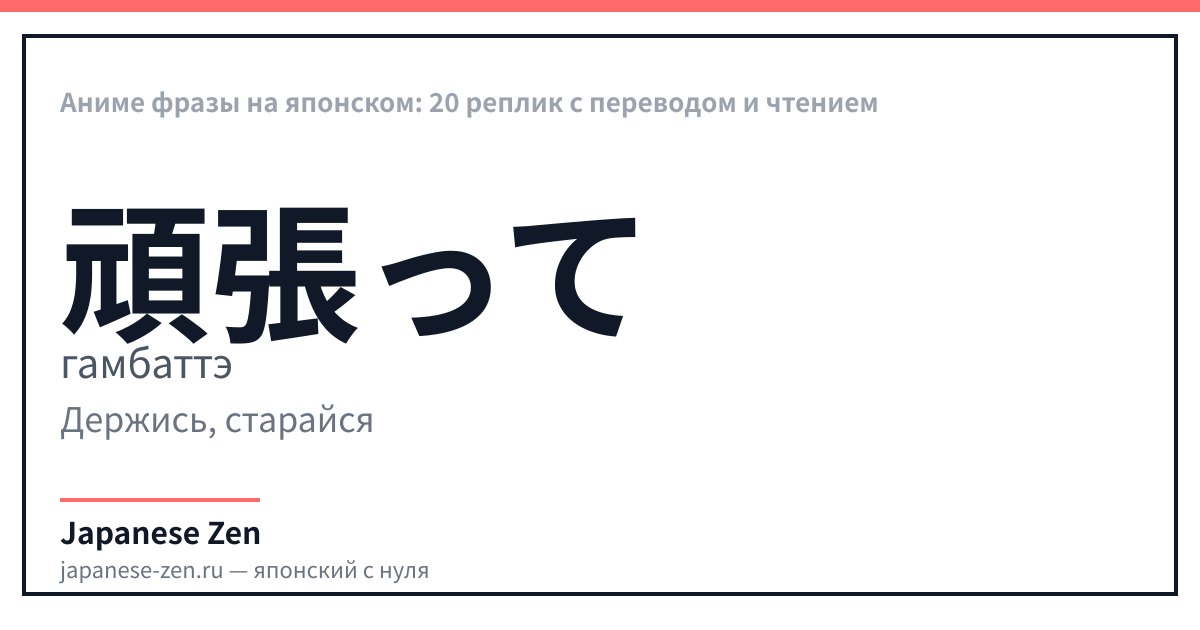
| 頑張って | ganbatte · ganbatte | Hang in there, do your best (lively and polite, suitable everywhere) |
| 大丈夫 | daijōbu · daijōbu | It's okay; are you okay? |
| やめて | yamete · yamete | Stop, quit it (harsh; polite form is やめてください) |
| 仕方がない | shikata ga nai · shikata ga nai | It can't be helped (almost philosophical, heard constantly) |
| 行くぞ | iku zo · iku zo | Let's go! (masculine decisive speech) |
| うるさい | urusai · urusai | Noisy; shut up (sounds rude in real life) |
| 待って | matte · matte | Wait |
What of this can you say in real life
Safe: 頑張って, 大丈夫, 待ってください, ありがとう. Be careful with やめて and うるさい — they are harsh. And forms like 行くぞ and 俺 (ore, 'I') are masculine colloquial speech: in a foreigner's mouth in an office, they sound like lines from an action movie.
Legendary lines and what they mean
| Japanese | Reading | Translation |
|---|---|---|
| お前はもう死んでいる | omae wa mō shinde iru · omae wa mō shinde iru | You are already dead (Fist of the North Star) |
| 何 | nani · nani | What?! (response line to the previous one) |
| 諦めたらそこで試合終了だよ | akirametara soko de shiai shūryō da yo · akirametara soko de shiai shūryō da yo | If you give up, the game is over (Slam Dunk) |
| believe it / だってばよ | datteba yo · datteba yo | Naruto's catchphrase without exact meaning (character's speech habit) |
| 月が綺麗ですね | tsuki ga kirei desu ne · tsuki ga kirei desu ne | The moon is beautiful tonight (veiled confession of love) |
Why 'the moon is beautiful' is a confession
According to legend, the writer Natsume Sōseki suggested to his students to translate 'I love you' not literally, but as 月が綺麗ですね: a Japanese person won't say love directly, they'll talk about the moon and be understood. The legend is not documented, but the phrase has long lived as a cultural code.
Say the line out loud
Start with 大丈夫: dai-jō:-bu, with a long 'o' in the middle.
FAQ
- Which anime phrases are heard most often?
- 頑張って (ganbatte) 'hang in there', 大丈夫 (daijōbu) 'it's okay', やめて (yamete) 'stop', 仕方がない (shikata ga nai) 'it can't be helped', 待って (matte) 'wait'.
- Can I say these phrases in real life?
- Some of them: 頑張って, 大丈夫, 待ってください. The harsh やめて and うるさい are better not used with strangers, and masculine speech like 行くぞ sounds affected.
- Can I learn Japanese from anime?
- As a source of listening and vocabulary — yes, as a source of polite speech — no. Anime predominantly features informal and 'characterful' forms that don't exist in ordinary conversation.
- What does 'tsuki ga kirei desu ne' mean?
- 'The moon is beautiful' — a veiled confession of love. A reference to the legend about Natsume Sōseki, who proposed this as a translation of 'I love you'.
Updated: 2026-07-25