Emoji: What These Symbols Are and Why They Have a Japanese Name
Emoji (絵文字) literally means "picture-sign": 絵 "picture" plus 文字 "written sign." The resemblance to English "emotion" is a coincidence, not a shared root. The first mobile set of 90 symbols was released in 1997 by J-Phone, but the better-known version is the 1999 set of 176 pictures by Kurita Shigetaka for NTT DoCoMo. In 2010, Unicode adopted emoji as an international standard for all devices.
Emoji has more than one inventor, and the story of a lone genius is prettier than the truth. Let's look at why the title of "first" emoji set is disputed and how emoji became common to iPhones and Androids. And also how Japanese 顔文字, "faces made of characters," differ from Western emoticons — down to which way you have to tilt your head to read them.
What the Word "Emoji" Means
絵文字 (emoji) is made up of two simple characters: 絵 "picture, drawing" and 文字 "written sign, letter." Together they give "picture-sign" — a fairly accurate description of what emoji are: not letters and not kanji, but small pictures that replace a word or a feeling.
The Coincidence with English "Emotion"
Many people are sure that "emoji" is a blend of English "emotion" and "icon," but that is a false etymology: the word is entirely Japanese, assembled from 絵 and 文字 before it ever entered English. The resemblance to "emotion" is just a sound coincidence, not a shared root.
Who Invented Emoji: Two Versions and One Disputed Title
In the late 1990s, Japanese mobile carriers independently came up with ways to insert small pictures into short messages — texts on the first internet phones were very limited in length.
- 1997 — J-Phone (later SoftBank) released the DP-211SW phone with a set of 90 symbols for the SkyWalker service: this is the earliest known emoji set on a mobile phone.
- 1999 — designer Kurita Shigetaka and colleagues at NTT DoCoMo created a set of 176 symbols for the i-mode internet service. Each picture fit into a 12 by 12 dot grid, and i-mode mail messages were then limited to 250 characters — emoji saved space.
- For many years the 1999 set was called the first emoji set, and popular retellings still say so. The J-Phone set got far less attention: that phone sold poorly, and the symbols were hardly used — but it was still first.
From Phone Icon to Global Standard
For a long time, sets from different carriers did not match: an emoji sent from a DoCoMo phone might not display for a SoftBank subscriber. The problem was solved by the international Unicode Consortium — the organization responsible for making the same character look the same on any device. In 2010, the main body of emoji was added to the Unicode 6.0 standard, and since then an emoji sent from one phone displays the same on any other. In 2016, the Museum of Modern Art (MoMA) in New York included Kurita Shigetaka's set of 176 emoji in its permanent collection and showed it in a separate exhibition in the museum lobby.
顔文字: "Faces Made of Characters" That You Don't Need to Tilt
顔文字 (kaomoji) is made up of 顔 "face" and the already familiar 文字 "sign" — literally "face signs." These are not pictures but faces assembled from ordinary letters and punctuation marks right on the keyboard, without graphics.
Why Japanese Faces Read Without Tilting Your Head
A Western emoticon like :-) is built around the mouth and reads sideways — you have to tilt your head ninety degrees to see the smile. A Japanese kaomoji like (^_^) is built around the eyes and reads straight, without turning: the emotion is conveyed by the shape of the eyes, and the mouth is a simpler detail or not needed at all. This difference reflects a broader observation about communication culture: in Japanese tradition, a person's state is often read from the eyes rather than from a smile.
字: The Writing Sign Inside the Word "Emoji"
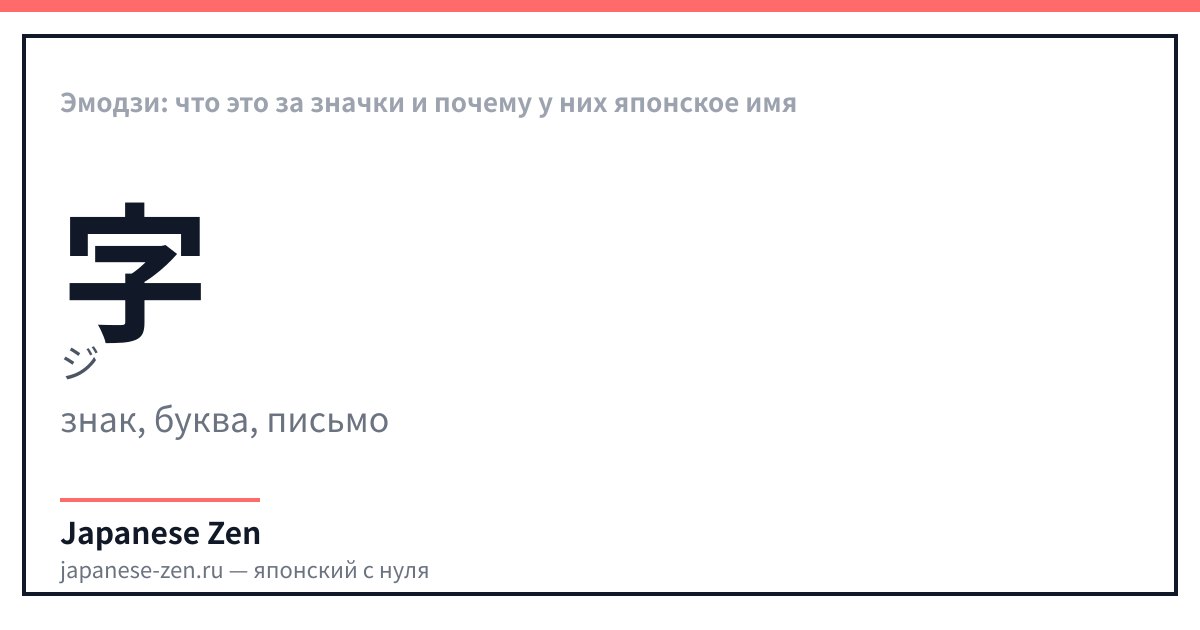
字 — значение: sign, letter, writing — онъёми: ジ — кунъёми: あざ、あざな、-な — 6 штрих(ов). 字 — the second half of 絵文字: "written sign, letter." The same kanji appears in 漢字 "kanji" and 文字 "writing, sign" — words every Japanese learner sees from the first lesson.
Readings of 字: ジ and あざ
The on'yomi ジ is heard in most compound words: 漢字 (kanji) "Chinese character," 文字 (moji) "sign, letter," 字幕 (jimaku) "subtitles." The character also has a rare kun'yomi あざ — it almost never appears in ordinary speech and is used only in old names for small rural plots of land.
絵: The Picture That Starts 絵文字
The first character of the word, 絵, means "picture, drawing" and appears in the same sense in 絵本 (ehon) "picture book" and 浮世絵 (ukiyo-e) "pictures of the floating world" — Japanese woodblock prints. The combination of "picture" and "written sign" gives what emoji essentially are: a picture in place of a letter.
| Japanese | Reading | Translation |
|---|---|---|
| 絵文字 | emoji · emoji | Emoji |
| 顔文字 | kaomoji · kaomoji | Kaomoji, "face made of characters" |
| 文字 | moji · moji | Sign, letter, writing |
| 漢字 | kanji · kanji | Kanji of Chinese origin |
| 字幕 | jimaku · jimaku | Subtitles |
Write 字 along the guides — the "writing" sign without which you can't assemble either 絵文字 or 漢字.
FAQ
- What does the word "emoji" mean?
- 絵文字 literally means "picture-sign": 絵 "picture" plus 文字 "written sign." The word is entirely Japanese and appeared long before emoji became an international phenomenon — the resemblance to English "emotion" is purely a sound coincidence.
- Who invented emoji?
- There is no single answer. Most often credited is Kurita Shigetaka, who with colleagues at NTT DoCoMo created a set of 176 symbols in 1999. But back in 1997, J-Phone released a similar set of 90 pictures — and Kurita himself publicly acknowledged its priority in 2019.
- Is it true that "emoji" and "emotion" are related words?
- No, that's folk etymology. "Emoji" is a purely Japanese word from 絵 "picture" and 文字 "sign," and the similarity to English "emotion" is a coincidence that arose after the word entered English.
- How do kaomoji differ from emoji?
- Emoji are ready-made small pictures, while kaomoji are faces assembled from ordinary letters and punctuation marks on the keyboard, without graphics. Also, Japanese kaomoji like (^_^) read straight, without tilting your head, unlike Western emoticons like :-).
- When did emoji become available on all phones?
- Before 2010, sets from different Japanese carriers did not match, and emoji might not display on another phone. In 2010, the Unicode Consortium included the main body of emoji in the Unicode 6.0 standard, and since then they work the same on any device.
- Is it true that emoji were exhibited in a museum?
- Yes. In 2016, the Museum of Modern Art (MoMA) in New York included Kurita Shigetaka's original set of 176 emoji in its permanent collection and showed it in a separate exhibition in the museum lobby.
Sources
Updated: 2026-09-15