Japanese Taiko Drums: Types and Why They're Played with the Whole Body
Japanese taiko drums are not a single instrument but a whole family: from the small, ringing shime-daiko to the massive o-daiko. The body is usually carved from a single tree trunk and covered with skin, and they are played standing, swinging the whole body, not just the wrists. The ensemble style of playing several taiko of different sizes, kumidaiko, only took shape in the mid-20th century.
It seems that "taiko" is just a word for a drum, but behind it lies a whole system: several different bodies, their own ways of gripping the sticks, and above all a young tradition of stage ensembles that is less than a century old. Let's look at what kinds of taiko there are, what their name means, and where the fashion for playing them standing, with the whole body, came from.
Nagado-daiko, Shime-daiko, O-daiko: Types of Taiko
All taiko share the way the body is made — usually carved from a single piece of wood, less often assembled from planks — and the way they are played with bachi (撥) sticks. But size, shape, and purpose vary greatly.
| Type | Writing | Feature |
|---|---|---|
| Nagado-daiko | 長胴太鼓 | barrel-shaped body from a single trunk, the most recognizable type |
| Shime-daiko | 締太鼓 | small, tightly bound with ropes, high ringing sound |
| O-daiko | 大太鼓 | the largest of the common ones, low booming sound |
| Okedo-daiko | 桶胴太鼓 | body made of staved planks, lighter than nagado-daiko |
Kumidaiko: An Ensemble of Dozens of Drums
Playing several taiko at once to a common score — the kumidaiko (組太鼓) style — only took shape in 1951. That year the musician Oguchi Daihachi revived the Osuwa-daiko drum tradition, forgotten since the Meiji era, and invented an ensemble form for it with several drums of different sizes. Before that, taiko was more often heard solo or paired with a flute, not in a large stage lineup.
太鼓 — "Big Drum" and a Character That Also Means "Heartbeat"
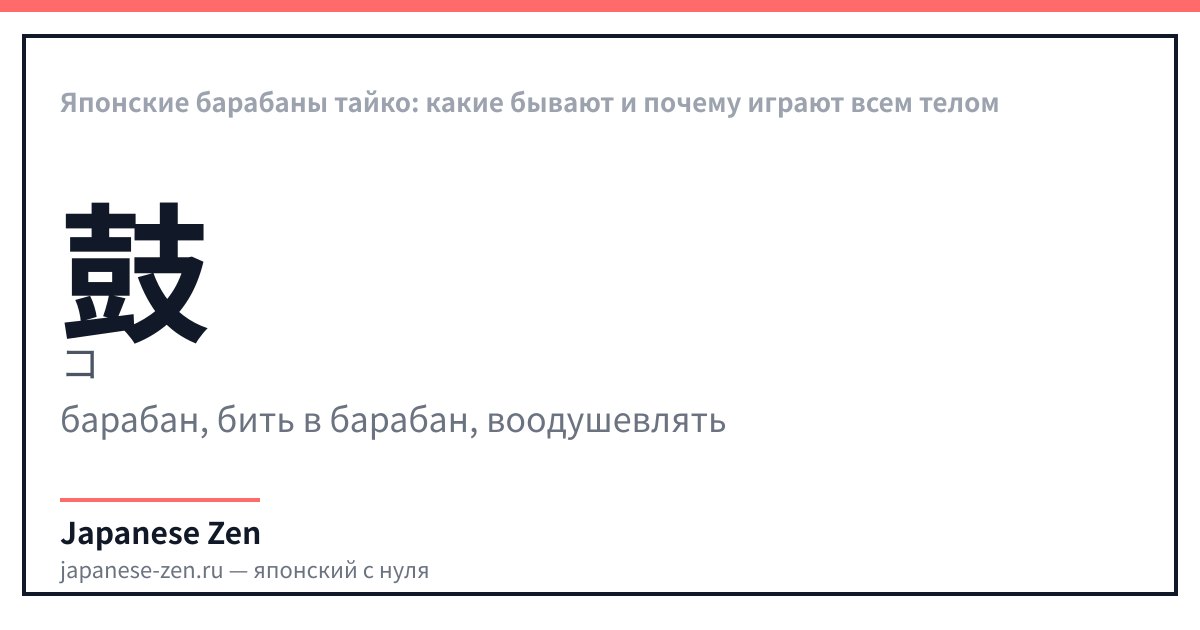
鼓 — значение: drum, to beat a drum, to inspire — онъёми: コ — кунъёми: つづみ — 13 штрих(ов). 鼓 — "drum": as part of 太鼓 it is read "ko" and means a drum in general. On its own, as a separate word, it is read "tsuzumi" and names a different, hand-held drum from Noh theater — these two cases should not be confused.
太鼓 — 太 "big, thick" plus 鼓 "drum": literally "big drum," though this is the name for drums of any size, not just large ones. 和太鼓 (wadaiko), "Japanese drum," is a clarification used when you need to distinguish the traditional instrument from a drum kit or timpani.
| Japanese | Reading | Translation |
|---|---|---|
| 太鼓 | taiko · taiko | Taiko drum |
| 和太鼓 | wadaiko · wadaiko | Japanese drum |
| 大太鼓 | ōdaiko · ōdaiko | The largest of the common taiko |
| 撥 | bachi · bachi | Drumsticks |
| 鼓 | tsuzumi · tsuzumi | Hand drum — a different instrument |
| 鼓動 | kodō · kodō | Heartbeat, pulse |
A Drum That Beats Like a Heart
The same character 鼓 is part of the word 鼓動 (kodō), "heartbeat, pulse." The name of the ensemble Kodo, founded in 1981 on Sado Island, sounds the same but is written with different characters — 鼓童, "drum" and "child." This creates a pun with two meanings at once: "heartbeat" and "beating the drum like a child," without a second thought.
Write 鼓 along the guides — the "drum" character from the word 太鼓.
Where Taiko Is Heard: From Shrines to Arcade Games
Taiko is heard at matsuri and during bon-odori, at Shinto shrines and Buddhist temples — the drumbeat traditionally announced the start of a ceremony. Since 1981, the Kodo ensemble has been based on Sado Island: it made stage performances with taiko known around the world and still tours regularly.
In video games, the sound of taiko was turned into a genre of its own. The arcade series "Taiko no Tatsujin" (太鼓の達人, Namco, since 2001) has players hit a drawn drum in time with music — from classical pieces to anime openings. It remains one of the most recognizable Japanese games in arcades.
Why They Play "with the Whole Body"
In kumidaiko, the drummer does not sit but stands or plants their feet wide, and the strike comes from the torso and shoulder, not just the wrist: this makes the sound louder and more visible to a spectator in the back row of the hall. This same spectacular, athletic playing style distinguishes stage taiko from the quiet temple drum that simply keeps the rhythm of a service.
Taiko Is Not as Ancient or as Strict as It Seems
Three Common Claims About Taiko
- "Taiko is an ancient art of ensembles." The taiko drum itself has been heard in Japan for over a thousand years, but ensemble playing on several taiko at once, kumidaiko, is a mid-20th-century invention, not an ancient tradition.
- "Taiko is a men-only art." Among modern ensembles there are both women's and mixed groups: for example, in Kodo itself, women perform on stage alongside men. Gender restrictions are not a rule of the art form but a feature of individual schools.
- "All Japanese drums are called taiko." The hand drum tsuzumi (鼓), held on the shoulder in Noh and Kabuki theater, is a completely different instrument: smaller, hourglass-shaped, and sounding different.
FAQ
- What are Japanese drums called?
- The general word is taiko (太鼓), but it is a family of different drums: from the small shime-daiko to the massive o-daiko. Besides taiko, there is also the hand drum tsuzumi (鼓) — built differently and belonging to another tradition, Noh theater.
- What is taiko?
- Taiko is a Japanese drum with a body most often carved from a single tree trunk and covered with skin. It is played with bachi sticks, and since the mid-20th century several taiko of different sizes are played together, standing, with the whole body — this ensemble style is called kumidaiko.
- How does o-daiko differ from nagado-daiko?
- Both have a barrel-shaped body from a single piece of wood, but o-daiko (大太鼓) is larger and produces a lower, more booming sound, while nagado-daiko (長胴太鼓) is the most recognizable medium size, the foundation of the sound of most ensembles and solo parts.
- Where can you hear taiko?
- Taiko can be heard at matsuri and temple festivals throughout Japan, at concerts by ensembles like Kodo from Sado Island. And also in recordings, soundtracks, and the arcade game "Taiko no Tatsujin," where the drum rhythm is turned into a game format.
- How is "taiko" written in kanji?
- 太鼓, read たいこ: 太 "big, thick" plus 鼓 "drum." The more specific name 和太鼓 (wadaiko), "Japanese drum," is used to distinguish the traditional instrument from a drum kit and from timpani in an orchestra.
- What does the name of the Kodo ensemble mean?
- 鼓童 is read the same as 鼓動, "heartbeat," but written with different characters — "drum" and "child": this creates a pun with two meanings at once, the beating of a heart and an absorbed, reckless playing of the drum. The ensemble was founded in 1981 on Sado Island.
Sources
Updated: 2026-09-14