Shakuhachi — the bamboo flute of Zen monks: where the name comes from and how it sounds
The shakuhachi (尺八) is a vertical bamboo flute with five holes, played for centuries by wandering Zen monks called komusō. The name is not a metaphor but an exact measurement: the standard length of the instrument, one shaku and eight sun, gave it its name — 尺八 literally means “shaku and eight.” For the komusō, playing the shakuhachi was not music but a form of meditation — suizen, “Zen through breathing.”
Five holes, no mechanics, and a sound in which you can hear the player’s breath — the shakuhachi is unmistakable, both to the ear and to the eye. Let’s look at where its name comes from, who the monks in woven basket hats were, and why the characteristic noise in the sound is not a defect of the instrument but part of the tradition.
Five holes and a sound without a mouthpiece
The shakuhachi is a vertical bamboo flute without a reed or mouthpiece: the sound is produced by directing the breath against the sharp edge of the top opening. There are five finger holes: four in front and one on the back for the thumb — far fewer than on a transverse flute, so many notes are made not with the fingers but by tilting the instrument and varying the force of the breath.
The standard length of a modern shakuhachi is one shaku and eight sun, about 54.5 cm; hence the name. It is made from the root end of the bamboo, the section with thickened nodes at the very base — this gives the instrument its characteristic weight and depth of sound.
Komusō and the legend of spies
The shakuhachi is inextricably linked with the komusō (虚無僧) — wandering monks of the Fuke school who traveled from village to village in tall woven basket hats called tengai, which completely hid their faces. For them, playing the flute was not a concert but a form of meditation, suizen (吹禅) — “Zen through breathing,” a continuation of seated zazen practice in motion. In 1871, the Meiji government dissolved the Fuke school, and the komusō monks as a separate class disappeared.
The face hidden under the hat gave rise to the legend that shinobi spies often disguised themselves as komusō: a wandering monk was one of the disguises used for espionage, according to the 1681 treatise Shōninki. How often this actually happened is hard to judge — there are no reliable figures, and the legend rests mainly on the very possibility of hiding one’s face under a tengai.
尺八 — a name that is a measurement: shaku and eight sun
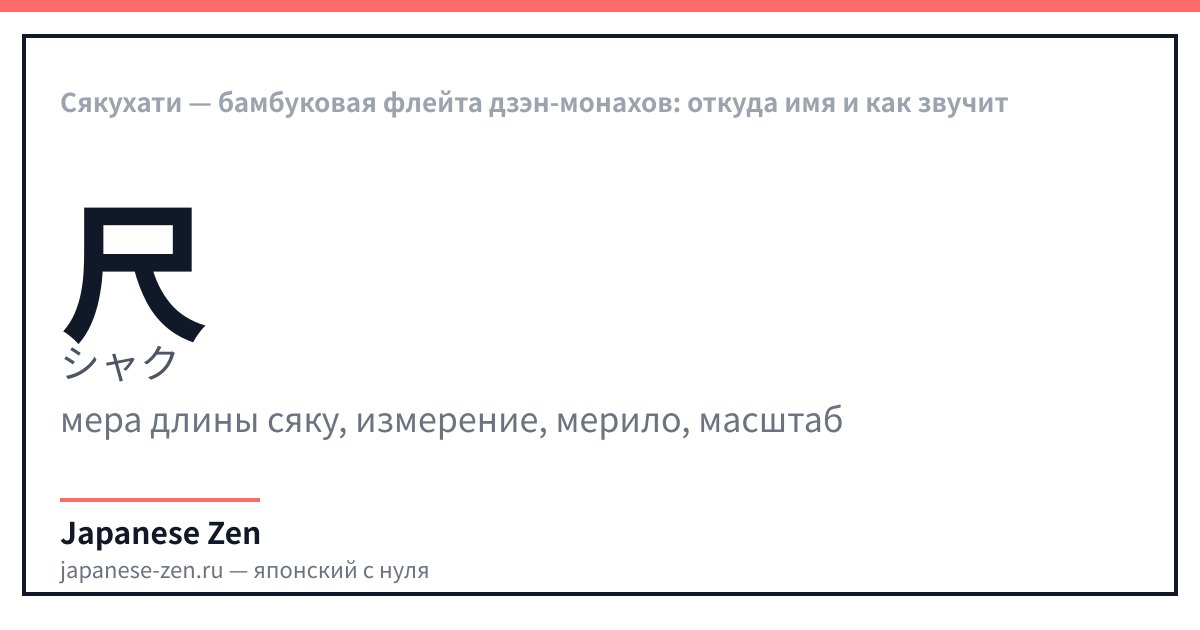
尺八 is read literally: 尺 — “shaku,” an old Japanese unit of length of about 30.3 cm, and 八 — “eight.” The full name of the instrument is “one shaku and eight sun,” where sun is another unit of length, about 3 cm. The name of the instrument is its exact size, not an image or a metaphor.
尺 — значение: unit of length shaku, measurement, criterion, scale — онъёми: シャク、セキ — кунъёми: さし — 4 штрих(ов). 尺 — “shaku,” an old unit of length of about 30.3 cm: the same character appears in 尺度 (shakudo) “measure, criterion” and in 縮尺 (shukushaku) “scale of a map or drawing” — both words grew out of the simple idea of “measuring.”
Japanese units of length in words
Besides shaku, this name also includes sun (寸) — a smaller unit of about 3 cm, one tenth of a shaku. Both units fell out of everyday use after Japan switched to the metric system, but they remain in the language — in names like 尺八 or in the word 一寸 (issun), “a tiny bit, just a little,” literally “one sun.”
| Japanese | Reading | Translation |
|---|---|---|
| 尺八 | shakuhachi · shakuhachi | Shakuhachi |
| 尺 | shaku · shaku | Unit of length, about 30.3 cm |
| 寸 | sun · sun | Unit of length, about 3 cm |
| 虚無僧 | komusō · komusō | Wandering monk of the Fuke school |
| 吹禅 | suizen · suizen | “Zen through breathing” — meditation by playing the flute |
| 本曲 | honkyoku · honkyoku | Traditional solo repertoire for the shakuhachi |
Write 尺 along the guides — the character for a unit of length that gave the shakuhachi its name.
From temple to concert hall
The traditional solo repertoire for the shakuhachi is called honkyoku (本曲) — pieces that komusō monks played as spiritual practice, not as concert numbers; many of them were passed down orally from teacher to student for centuries.
After the dissolution of the Fuke school in 1871, not only former komusō began to learn the shakuhachi, and the instrument entered secular ensembles — duets and trios with koto and shamisen. In the 20th century, works for orchestra were written for the shakuhachi, and contemporary composers continue to write new music for it.
Why a “breathy” sound is not a mistake
Unlike the European flute, where breath noise is minimized, in the shakuhachi the breathiness and slight air noise are part of the sound aesthetic, not a technical flaw. That is why a shakuhachi recording is easy to recognize among other wind instruments: in the tone you hear the living breath of the player, not just a pure note.
FAQ
- What is the shakuhachi?
- The shakuhachi is a vertical bamboo flute with five finger holes: four in front and one in back for the thumb. It was traditionally played by wandering Zen monks of the Fuke school called komusō, for whom the playing itself was a form of meditation, not a concert performance.
- Why is the flute called “shakuhachi”?
- The name is its standard length: one shaku and eight sun, about 54.5 cm. 尺 (shaku) and 八 (eight) in the name are not an image but the exact size of the instrument — as if a flute were simply called “half a meter and a bit.”
- Who are the komusō?
- The komusō (虚無僧) were wandering monks of the Fuke school of Zen Buddhism who wore tall woven basket hats that completely hid their faces. Playing the shakuhachi was for them a form of spiritual practice, suizen. The school was dissolved by the Meiji government in 1871.
- How is “shakuhachi” written in kanji?
- 尺八, read しゃくはち: 尺 “shaku” (a unit of length, about 30.3 cm) plus 八 “eight” — together they indicate the standard length of the instrument, one shaku and eight sun, that is, about 54.5 centimeters. This is the flute’s actual size, not a figurative name.
- How many holes does the shakuhachi have?
- Five: four on the front and one on the back for the thumb. That is few compared to the European flute, so many notes are made not with the fingers but by changing the angle of the breath and the tilt of the instrument.
Sources
Updated: 2026-09-14