Japanese Musical Instruments: Shamisen, Koto, Shakuhachi and Taiko
Japanese musical instruments are above all the shamisen (三味線), koto (箏), shakuhachi (尺八) and taiko drums (太鼓): together they are called by one word 和楽器 (wagakki). Most of them have no frets or keys, and the timbre is deliberately made slightly rough, with an overtone — this is not a flaw but part of the sound aesthetic. Such music can be heard in the theater, at shrines, on New Year's, and in modern bands.
The list of traditional instruments of Japan is far longer than the four named, but it makes sense to start with them: three strings and one percussion give an idea of how Japanese music sounds as a whole. Let's look at how they are built, how they fundamentally differ from European counterparts, and where they are still played — from a Shinto shrine to a video game console.
Strings, Winds and Percussion: The Main Instruments of Japanese Music
Over the centuries, traditional instruments of Japan have divided into three groups: plucked strings, winds and percussion. There are almost no bowed instruments of the European type among them — the sound is produced by plucking, striking or breathing, not by moving a bow across a string.
| Instrument | Writing | Type | Where it sounds |
|---|---|---|---|
| Shamisen | 三味線 | string, plucked | theater, stage, Tsugaru style |
| Koto | 箏 | string, plucked | concerts, weddings, New Year |
| Biwa | 琵琶 | string, plucked | narrative epic, temple music |
| Shakuhachi | 尺八 | wind | Zen practice, ensembles |
| Shinobue | 篠笛 | wind | matsuri, Noh and Kabuki theater |
| Ryūteki | 龍笛 | wind | gagaku, court orchestra |
| Shō | 笙 | wind, mouth organ | gagaku |
| Taiko | 太鼓 | percussion | matsuri, temples, ensembles |
| Tsuzumi | 鼓 | percussion, hand | Noh and Kabuki theater |
Gagaku — the oldest court music
Gagaku (雅楽) is court music and dance that has been performed in Japan for over a thousand years: its orchestra includes the ryūteki, shō and various taiko. UNESCO describes gagaku as the oldest of Japanese stage traditions and in 2009 included it in the list of the Intangible Cultural Heritage of Humanity.
和楽器 — three characters for all traditional instruments at once
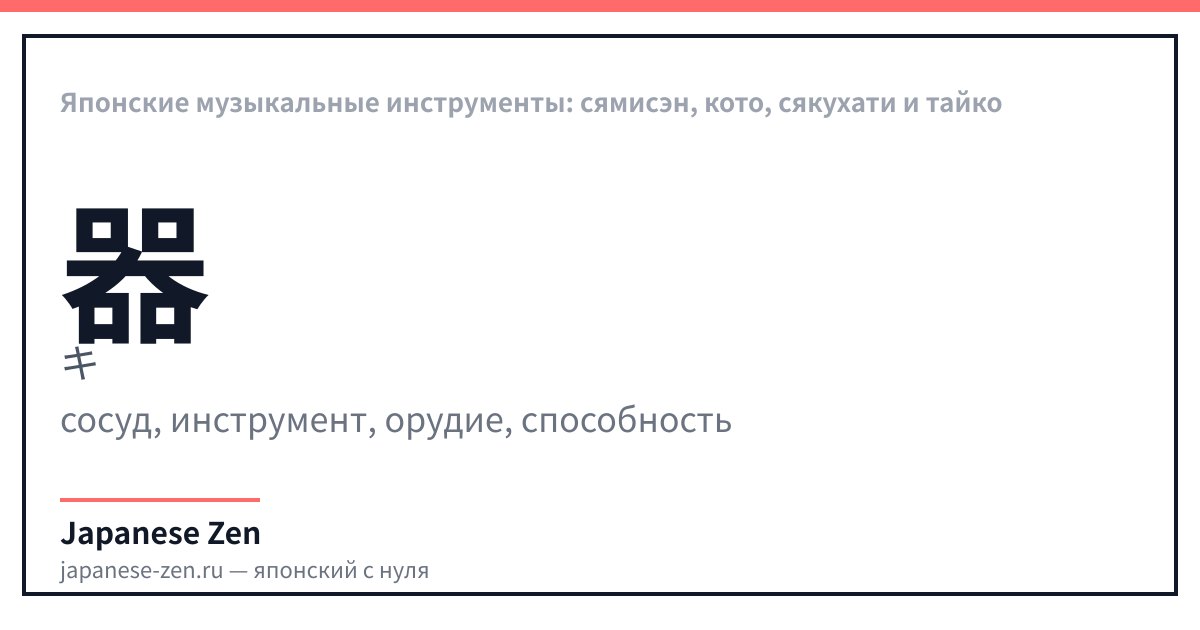
器 — значение: vessel, instrument, tool, ability — онъёми: キ — кунъёми: うつわ — 15 штрих(ов). 器 — 'vessel, instrument': the same character in 楽器 (gakki) 'musical instrument' and in 食器 (shokki) 'tableware' — in both cases it is a container or tool for a task.
和楽器 (wagakki) is the word for traditional Japanese instruments as a whole: 和 'Japanese', 楽 'music', 器 'instrument, vessel'. The second character, 楽, sounds 'gaku' in words about music and quite differently, 'raku', in words about ease and pleasure — these are two on'yomi readings of the same kanji.
| Japanese | Reading | Translation |
|---|---|---|
| 和楽器 | wagakki · wagakki | Japanese traditional instruments |
| 楽器 | gakki · gakki | Musical instrument |
| 邦楽 | hōgaku · hōgaku | Japanese traditional music |
| 雅楽 | gagaku · gagaku | Gagaku court music |
| 三味線 | shamisen · shamisen | Three-stringed plucked instrument |
| 太鼓 | taiko · taiko | Drum |
Write 器 along the guides — the character 'instrument, vessel' from the word 楽器, 'musical instrument'.
Why 'Japanese music' is 邦楽
Japanese music as a whole has two rival words: 邦楽 (hōgaku) and 洋楽 (yōgaku). Hōgaku literally means 'music of the native country' — this is what both old genres like gagaku and any Japanese music in the broad sense are called. Yōgaku is 'music from across the ocean', everything that came from the West, from classical to Western pop. 邦楽 does not directly mean 'traditional': it is rather 'our own' music as opposed to 'foreign'.
Where Japanese instruments sound today
The shamisen leads the part in Kabuki and Bunraku theater, flutes and drums accompany the action in Noh theater, and at matsuri and temple festivals you will almost certainly hear taiko. Once a year, at New Year, Japanese television and shopping malls resound with the koto and shakuhachi duet 'Haru no Umi' (春の海, 1929, Miyagi Michio) — the unofficial musical symbol of the holiday.
Traditional instruments have also been built into new formats. The band Wagakki Band has been playing rock on shakuhachi, koto, Tsugaru shamisen and taiko together with guitar since 2014. The sound of taiko is also recognizable from the arcade series 'Taiko no Tatsujin' (Namco, since 2001).
The Japanese scale
Traditional music is more often built on pentatonic scales: the yo scale does without semitones, the in scale has two semitones and a minor coloring. Hence the sound that is unusual to the European ear.
Three comparisons that don't work
Similar does not mean the same
- 'Koto is the Chinese zither.' The koto came from China in the 8th century and is related to the guzheng, but it long ago became an independent Japanese instrument.
- 'Shamisen is the Japanese balalaika.' The balalaika has a triangular body and frets, while the shamisen has a smooth neck, without a single fret.
- 'Taiko is just a drum.' Behind the word stands a whole genre of ensemble playing, kumidaiko — standing, with the whole body.
FAQ
- What are the most famous Japanese musical instruments?
- Most often four are named: the three-stringed shamisen, the thirteen-stringed koto zither, the bamboo shakuhachi flute and taiko drums. All four still sound today in the theater, at temples and in modern ensembles, not only in recordings of ancient music.
- What is the Japanese three-stringed guitar called?
- The shamisen (三味線) is not a guitar by construction: it has no resonating body with a hole and no frets on the neck. But in its role in music the comparison is understandable — it is a three-stringed plucked instrument with a long neck, played with a plectrum called bachi.
- What is the Japanese flute called?
- It depends which one: the shakuhachi (尺八) is the vertical bamboo flute of Zen monks, the shinobue (篠笛) is the transverse flute of matsuri and theater, the ryūteki (龍笛) is the flute of the gagaku court orchestra. All three are made of bamboo, but they are held and blown differently.
- What drums sound in Japanese music?
- The general name is taiko (太鼓), but it is more of a family: the nagado-daiko resembles a barrel, the shime-daiko is small and tightly stretched, the o-daiko is the largest of the common ones. The hand drum tsuzumi (鼓), which is held on the shoulder in Noh theater, does not belong to taiko.
- How do you say 'musical instrument' in Japanese?
- 楽器 (gakki) — 'music' plus 'instrument, tool'. If you need to name specifically a traditional Japanese instrument, and not a piano or guitar, you say 和楽器 (wagakki), 'Japanese instrument' — the same word also refers to the whole group of traditional instruments together.
- Why does traditional Japanese music sound unusual to the European ear?
- Because of the pentatonic yo and in scales instead of the usual seven steps — and because of the timbre: the shamisen and other instruments deliberately produce a humming overtone. For a Japanese listener this is not a flaw but part of the sound aesthetic.
Sources
Updated: 2026-09-14