Japanese calligraphy shodō: styles, tools, and the first writing of the year
Japanese calligraphy shodō (書道) is the art of writing with brush and ink, where pressure, speed, and the density of ink on a hair tip convey the writer's character as much as the text itself. There are three main styles — the block style kaisho, the semi-cursive gyōsho, and the cursive sōsho — and by tradition the first line of the year is written on January 2, during the New Year's kakizome.
Shodō is often mistaken for "just beautiful handwriting," though the technique is closer to painting: brush pressure and the amount of ink on a hair tip change the look of a character just as a stroke does in monochrome sumi-e painting. Let's look at the writing styles, the "four treasures of the study" on a calligrapher's desk, and the school subject through which every Japanese child encounters this art.
Three writing styles and a separate kana calligraphy
Shodō is based on three classical styles of writing kanji and a separate tradition of writing the Japanese syllabary. Each style is read by its own logic: the block style with clear, legible strokes, the cursive style with almost abstract brush movement.
| Style | Written | What it looks like | Where it appears |
|---|---|---|---|
| Kaisho | 楷書 | Clear separate strokes, as in a textbook | Signs, documents, writing instruction |
| Gyōsho | 行書 | Strokes slightly connected, movement faster | Personal letters, everyday notes |
| Sōsho | 草書 | The character is compressed into a few smooth lines | Artistic scrolls, masters' signatures |
| Kana calligraphy | 仮名 | Thin, flowing lines of the syllabary | Waka poetry, scrolls in a Japanese, not Chinese, spirit |
Calligraphy in Japanese school
In Japanese school, brush writing is part of the native language lesson, the subject shōsha (書写): it is taught from third to sixth grade of elementary school and in all grades of middle school. In high school, shodō becomes a separate elective subject — on par with music and drawing.
The four treasures of the study and the first writing of the year
The minimal set for shodō is called the "four treasures of the study," bunbō shihō (文房四宝). These are the brush fude (筆), the ink sumi (墨), the inkstone suzuri (硯) — on which the ink is ground with water — and paper, most often a thin sheet of hanshi (半紙) of the standard training size. Separately, a paperweight bunchin and a felt mat shitajiki are placed under the sheet.
Kakizome — the first writing of the year
Kakizome (書き初め) is the first calligraphic inscription of the year: by tradition it is written on January 2, usually a line from a poem or a wish for the year. The custom came from court etiquette and by the Edo period had spread to ordinary townspeople. The written sheets are later burned in a New Year's bonfire: according to belief, the higher the flames rise, the better the handwriting will become in the new year.
書道 — the way of writing, not just writing
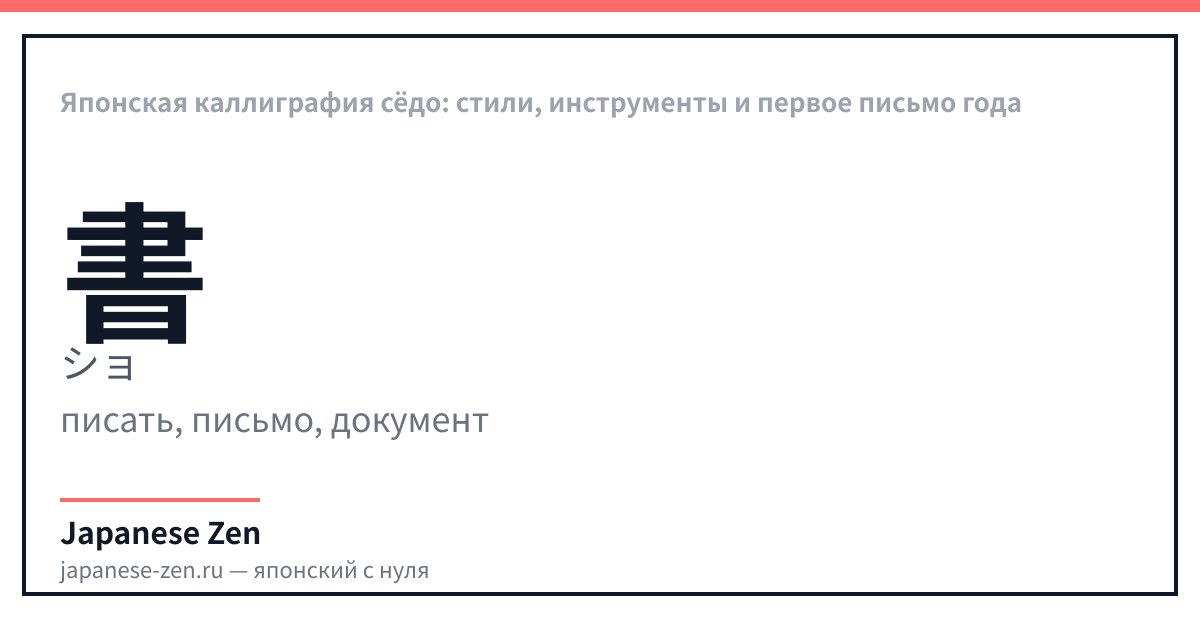
書 — значение: write, writing, document — онъёми: ショ — кунъёми: か.く、-が.き、-がき — 10 штрих(ов). 書 — "to write": the same character is in the ordinary verb 書く (kaku) "to write" and in the word 辞書 (jisho) "dictionary."
書道 — two characters: 書 "to write" and 道 "way." The second character is the same as in judo or karatedō: it turns a craft into a lifelong path with no final point of mastery. Calligraphy belongs to the same series as martial arts and the tea ceremony — not a set of skills, but a discipline that shapes a person.
Ensō — a circle in one stroke
Ensō (円相) is a circle that a Zen monk draws in one movement of the brush, without lifting the hand from the paper. The meaning is not tied to text: the circle symbolizes enlightenment, emptiness, or the wholeness of the world, and the viewer is invited to interpret the image themselves.
| Japanese | Reading | Translation |
|---|---|---|
| 書道 | shodō · shodō | Japanese calligraphy |
| 書く | kaku · kaku | To write |
| 筆 | fude · fude | Writing brush |
| 墨 | sumi · sumi | Ink |
| 硯 | suzuri · suzuri | Inkstone |
| 書き初め | kakizome · kakizome | First writing of the year |
Write 書 along the guides — the character "to write" from the word 書道.
Shodō is not handwriting and not a copy of Chinese tradition
- "Calligraphy is just beautiful handwriting." Beautiful handwriting is a side effect, and the essence is in controlling pressure, speed, and the amount of ink on the brush: the same elements as in painting, only instead of an image there is a character.
- "In Japan people write with a brush every day." In everyday life almost everyone writes with a pen or types, and the brush is taken out for shōsha lessons, calligraphy exams, kakizome, and artistic practice.
- "Japanese and Chinese calligraphy are the same thing." The genre has common roots and styles — kaisho, gyōsho, sōsho — but in Japan a separate kana calligraphy developed for the native syllabary, which simply does not exist in the Chinese tradition.
FAQ
- What is Japanese calligraphy?
- The art of writing with brush and ink, shodō: pressure, speed, and the density of ink on a hair tip convey the writer's character and mood as much as the text itself. At school, all children encounter this art in native language lessons.
- What is Japanese calligraphy called?
- Shodō, 書道 — literally "the way of writing." The second character, 道 "way," is the same as in judo or karatedō: in this tradition writing is seen as a lifelong discipline, not just a set of skills. At school, the same subject for children is called differently — shōsha.
- What styles exist in Japanese calligraphy?
- Three classical ones: the block style kaisho with clear separate strokes, the semi-cursive gyōsho, and the cursive sōsho, where the character is compressed into a few smooth lines. Separately, there is kana calligraphy — for the Japanese syllabary.
- What is needed for Japanese calligraphy?
- The "four treasures of the study": the brush fude, the ink sumi, the inkstone suzuri on which the ink is ground with water, and paper — usually a thin sheet of hanshi. Additionally, a paperweight and a felt mat under the sheet are used.
- What is kakizome?
- The first calligraphic inscription of the year: by tradition it is written on January 2. The custom came from court etiquette and by the Edo period became common for townspeople. The written sheets are later burned in a New Year's bonfire for good luck.
- How is "shodō" written in kanji?
- 書道, read しょどう. 書 means "to write," 道 — "way": together — "the way of writing." The same second character is in the names of judo, kendo, and other Japanese disciplines that build a lifelong practice from a craft, not a set of technical moves for one season.
Sources
Updated: 2026-09-14