Japanese ukiyo-e woodblock prints: what they are, who the masters were, and how they were printed
Ukiyo-e (浮世絵) is a genre of the Edo period: "pictures of the floating world" featuring beauties, kabuki actors, and landscapes, printed from wooden blocks. A print was made by four people — publisher, artist, carver, and printer — not by a single author. The most famous masters are Katsushika Hokusai and Utagawa Hiroshige: their landscapes influenced Van Gogh and Monet in the 19th century.
Ukiyo-e is often reduced to a single textbook Hokusai "Wave," but behind it lies an entire craft with clear roles and established genres — from portraits of beauties to kabuki scenes. Let's break down the word 浮世絵 by its kanji, see how a print was made with layers of color from a separate block for each hue, and why European artists of the late 19th century specifically sought out such sheets.
Ukiyo-e — "pictures of the floating world" of the Edo period
Ukiyo-e are prints and paintings of the Edo period (1603–1868) that were printed in large editions on cheap paper, not painted one by one on commission. The word is translated as "pictures of the floating world": the subjects are not gods and generals, but actors, beauties, landscapes, and everyday city life. The genre grew out of book illustration in the 17th century and by the 19th century had split into several established directions.
| Genre | What was depicted | Example master |
|---|---|---|
| Bijin-ga (美人画) | Beauties and courtesans | Kitagawa Utamaro |
| Yakusha-e (役者絵) | Kabuki actors | Tōshūsai Sharaku |
| Fūkei-ga (風景画) | Landscapes, roads, mountains | Hokusai, Hiroshige |
| Musha-e (武者絵) | Warriors and legendary heroes | Utagawa Kuniyoshi |
| Kachō-ga (花鳥画) | Birds and flowers | Utagawa Hiroshige |
From Moronobu to Hiroshige: seven names of one genre
Hishikawa Moronobu is considered the founder of ukiyo-e, at the end of the 17th century. Suzuki Harunobu around 1765 was the first to produce the multicolored "brocade" print nishiki-e. After that, the genre was led by Kitagawa Utamaro with his portraits of beauties and the enigmatic Tōshūsai Sharaku — in ten months of 1794–1795 he produced about one and a half hundred actor portraits. Landscape was brought to its peak by Hokusai, Hiroshige, and Kuniyoshi.
Breaking down the word: 浮世絵 — "picture of the floating world"
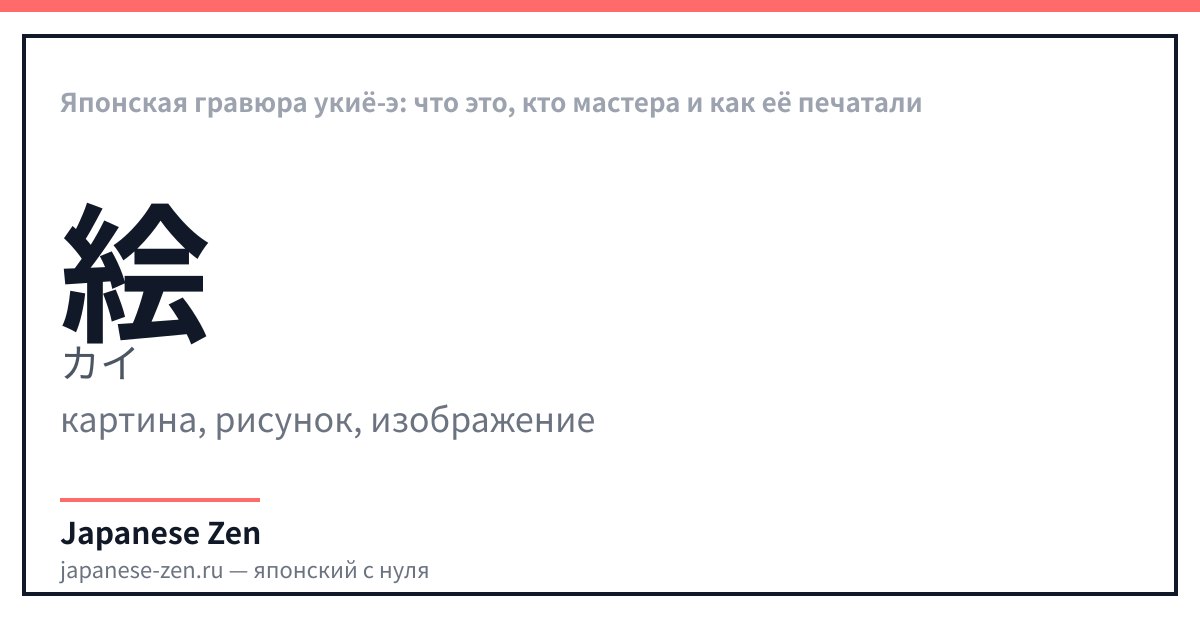
絵 — значение: picture, drawing, image — онъёми: カイ、エ — 12 штрих(ов). 絵 — "picture, drawing": the last character in 浮世絵. The same character is in 絵本 "picture book"; it shows that we are talking about an image, not text.
浮世絵 is 浮 "to float," 世 "world," and 絵 "picture." In the Buddhist tradition, earthly life was called 憂き世, "world of sorrow"; in the Edo period, townspeople reinterpreted it as a reason to enjoy the present day and began to write the same word with the characters 浮世 — "floating, fleeting world of pleasures."
Why the "world" became "floating"
Changing one character to a homophone changed the entire tone of the word: 憂き ("sorrowful") and 浮き ("floating, unstable") sound almost identical in Japanese. The print adopted a lighter meaning for itself — the world as a theater of pleasures, not a vale of suffering — and remained 浮世絵, "a picture of this unstable, fleeting world."
| Japanese | Reading | Translation |
|---|---|---|
| 浮世絵 | ukiyo-e · ukiyo-e | Japanese woodblock print |
| 浮世 | ukiyo · ukiyo | Floating, fleeting world |
| 版画 | hanga · hanga | Print, woodblock print in general |
| 錦絵 | nishiki-e · nishiki-e | Multicolored "brocade" print |
| 美人画 | bijinga · bijinga | Portrait of a beauty |
| 役者絵 | yakusha-e · yakusha-e | Kabuki actor portrait |
Write 絵 along the guides — the character for "picture" that ends the word 浮世絵.
How a print was made: publisher, artist, carver, printer
An ukiyo-e print was never made by one person. The publisher, hanmoto (版元), commissioned the theme from the artist, eshi (絵師), approved the sketch, and paid the carver and printer, then sold the finished sheets. The artist drew only a thin contour sketch in ink — he usually did not touch the block itself. The carver, horishi (彫師), pasted the sketch face down onto a cherry wood block and cut the lines with hair's-breadth precision: one slip of the chisel ruined the whole block. The printer, surishi (摺師), applied pigment with a pad and rubbed the paper against the block with a baren — a separate block was carved and printed for each color.
How many impressions were printed
The exact edition size is almost never documented, and surviving impressions today are usually fewer than were originally printed: blocks wore down from repeated printing, and some sheets were lost or damaged. Even for the most famous prints — such as Hokusai's "Great Wave" — researchers have to estimate the original edition from indirect evidence rather than the publisher's records.
Japonisme: how ukiyo-e changed European painting
After Japan opened in the mid-19th century, prints reached Europe — according to a well-known story, first as packing paper for porcelain. Flat color without shading, bold cropping, and unusual angles captivated the future Impressionists. Van Gogh in 1887 copied two Hiroshige prints in oils, and Monet collected more than two hundred Japanese sheets — they still hang in his house in Giverny.
Where to see ukiyo-e today
The largest collection in Japan is held by the Tokyo National Museum; the Ota Memorial Museum in Tokyo's Harajuku district is dedicated entirely to ukiyo-e, where the display is completely changed every month. Outside Japan, major ukiyo-e collections are held by museums in Europe and the United States — precisely with the prints that once spread around the world thanks to the Impressionists' enthusiasm for Japanese art.
FAQ
- What is a Japanese ukiyo-e print?
- Ukiyo-e are printed, more rarely hand-painted, pictures of the Edo period: kabuki actors, beauties, landscapes, and warriors, printed from wooden blocks in large editions. The name translates as "pictures of the floating, fleeting world" — the genre showed the everyday pleasures of the city, not myths or nobility.
- What does the word "ukiyo-e" mean?
- 浮世絵 breaks down into "to float," "world," and "picture" — "picture of the floating world." Previously the same sound (憂き世) referred to the transient vale of suffering in Buddhist thought; in the Edo period, townspeople reinterpreted it as a world of fleeting pleasures, and the characters were changed to lighter ones in meaning.
- Who are the most famous masters of Japanese woodblock prints?
- Hishikawa Moronobu is considered the founder of the genre, Suzuki Harunobu was the first to print a multicolored print, and Kitagawa Utamaro became famous for his portraits of beauties. Katsushika Hokusai and Utagawa Hiroshige raised landscape to a new level — it was their works that were later seen in Europe.
- How were Japanese woodblock prints made?
- Four people worked on a single print: the publisher commissioned the theme, the artist drew the contour sketch. The carver cut it into cherry wood blocks — a separate block for each color — and the printer manually rubbed the paper against each block in turn.
- Why did Japanese woodblock prints influence the Impressionists?
- European artists saw in ukiyo-e what academic painting lacked: flat color without shading, bold cropping, unusual angles. Van Gogh in 1887 directly copied two Hiroshige prints, and Monet collected more than two hundred Japanese sheets for his house in Giverny.
- How is "ukiyo-e" written in Japanese?
- 浮世絵, read as うきよえ. Three characters: 浮 "to float," 世 "world," 絵 "picture" — together "picture of the floating world." In English it is usually written ukiyo-e, following the Hepburn romanization; the pronunciation is roughly oo-kee-yo-eh.
Sources
Updated: 2026-09-14