The Great Wave off Kanagawa by Hokusai: What the Print Shows
The Great Wave off Kanagawa (神奈川沖浪裏) is a woodblock print by Hokusai from around 1831, one sheet from the series Thirty-six Views of Mount Fuji: three boats amid a towering open-sea wave, with Mount Fuji a tiny triangle in the distance. It is not a tsunami: a tsunami breaks at the shore, while this shows a rare but real open-ocean wave. The blue comes from imported Prussian blue, then a novelty in Japanese printing.
One sheet from a series about Mount Fuji has outgrown the mountain itself in fame: the image is printed on banknotes, book covers, and T-shirts around the world. Let's look at what lies behind that fame — the printing technique, the exact Japanese title, and who is actually shown in the boats — and why the wave in the picture should not be called a tsunami.
What the print The Great Wave off Kanagawa is
The Great Wave off Kanagawa is one sheet from Katsushika Hokusai's series Thirty-six Views of Mount Fuji (冨嶽三十六景), created around 1831; the whole series was printed roughly between 1830 and 1832. It is a color woodblock print: the design was carved into cherry wood blocks and printed with a separate block for each color, including the unusually bright blue — Prussian blue, a chemical pigment that had recently been imported into Japan through the Dutch.
Why the wave is not a tsunami
The wave in the print is often called a tsunami, but that is not correct: a tsunami is a series of long waves caused by displacement of the seafloor, which break at the shore. Hokusai instead depicted a tall, steep open-ocean wave — according to modern oceanographers' calculations, similar to a rare 'rogue wave' about ten meters high. Mount Fuji stands in the distance in its usual place — this is the open sea somewhere off the coast of Kanagawa, not a coastal disaster.
What the long title 神奈川沖浪裏 means
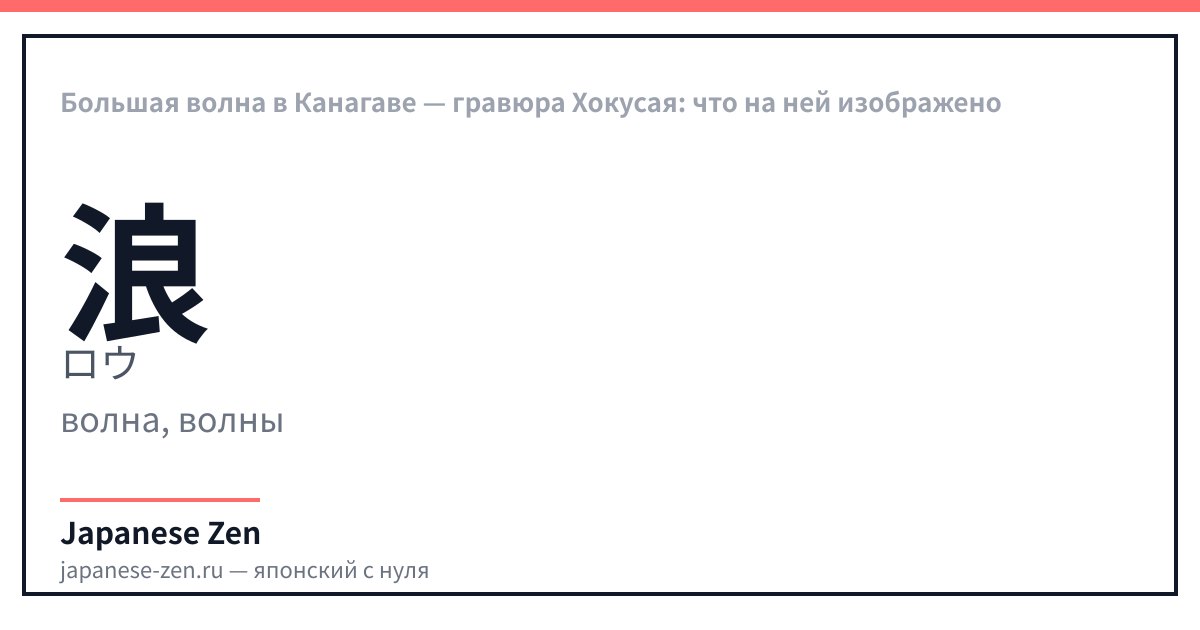
浪 — значение: wave, waves — онъёми: ロウ — 10 штрих(ов). 浪 — 'wave': the third character in the title 神奈川沖浪裏. The same character, in a different word, writes 浪人 (ronin) — a masterless samurai, literally a 'wave person,' tossed about the world like a piece of driftwood.
神奈川沖浪裏 is read as かながわおきなみうら and literally assembles from four parts: 神奈川 (Kanagawa — a place by Tokyo Bay), 沖 'open sea,' 浪 'wave,' and 裏 'underside, that which is beneath.' Together it means 'beneath the wave in the open sea off Kanagawa' — that is how museums translate the title, while the familiar short 'Great Wave' is a later, colloquial name.
浪 and 波: two 'waves' in Japanese
The title uses 浪, not the more everyday 波: both characters mean 'wave.' But 波 is a neutral, everyday word, while 浪 often carries a nuance of elemental force and wandering — the same character appears in 浪人, 'ronin.'
| Japanese | Reading | Translation |
|---|---|---|
| 神奈川沖浪裏 | Kanagawa-oki nami ura · Kanagawa-oki nami ura | Full title of the print |
| 冨嶽三十六景 | Fugaku Sanjūrokkei · Fugaku Sanjūrokkei | Thirty-six Views of Mount Fuji — the series |
| 沖 | oki · oki | Open sea, offshore |
| 波 | nami · nami | Wave — the ordinary everyday word |
| 裏 | ura · ura | Underside, back side, 'beneath' |
Write 浪 along the guides — the 'wave' character from the print's title.
What is shown: boats, rowers, and a tiny Mount Fuji
The print shows three fast oshiokuri-bune boats that delivered fresh fish from the coasts of Izu and Boso to the markets of Edo; the rowers cling to their oars, trying to hold course between two crests. Mount Fuji appears in the distance as a small triangle — a device that immediately reveals Hokusai's hand: the series' main subject is deliberately shrunk and pushed back to give way to the elemental force in the foreground.
How to read the composition
Many art historians suggest reading the sheet the way Japanese text of that time was read — from right to left: the eye travels from the right-hand boat along the wave's crest to its highest point and only then finds Fuji. Scrolls and book pages in Japan were read in the same direction.
Where impressions are kept
Original impressions of the Great Wave were dispersed to museums around the world as early as the 19th century. Major collections are held at the Metropolitan Museum of Art in New York and the British Museum in London, as well as other museums in Europe, the United States, and Japan itself. By one estimate, as many as eight thousand impressions may have been pulled from the blocks, and by various counts about a hundred survive to this day.
The 'Wave' on a banknote, in music, and in a passport
Since July 3, 2024, the image of the print has been printed on the reverse of the new 1000-yen banknote — the front features a portrait of the bacteriologist Kitasato Shibasaburo. Since 2020, 24 sheets from the series Thirty-six Views of Mount Fuji, including the Great Wave, have been used on the visa pages of the new Japanese passport — as a decorative element that also guards against forgery.
- The first edition of the score of Claude Debussy's La Mer (1905) appeared with a cover based on the Great Wave: the publisher, at the composer's personal insistence, used a fragment of the print, changing the color and removing Mount Fuji from the image.
The most recognizable Japanese print
There are no exact counts of 'Japan's most famous picture.' But by frequency of use in advertising, design, and souvenirs, the Great Wave confidently outpaces any other Japanese print — a rare case where a sheet from a series has surpassed in recognition the series' main subject, Mount Fuji.
FAQ
- What is shown in the picture The Great Wave off Kanagawa?
- Three fishing boats amid a towering open-sea wave and Mount Fuji in the distance, deliberately shrunk and pushed into the background. It is one sheet from Hokusai's series Thirty-six Views of Mount Fuji, and the rowers in the boats are fishermen who delivered their catch to Edo.
- Who painted the Great Wave?
- The Japanese artist Katsushika Hokusai — he created the print around 1831, when he was already over seventy, as one sheet from the series Thirty-six Views of Mount Fuji. Formally the main subject of the whole series is Mount Fuji, not the wave, though it is this sheet that became famous.
- When was The Great Wave off Kanagawa created?
- Around 1831 — that is the date of the sheet itself; the whole series Thirty-six Views of Mount Fuji, to which it belongs, was printed roughly between 1830 and 1832. The exact day of creation is unknown: ukiyo-e publishers almost never documented such details.
- Is it a tsunami?
- No: a tsunami is a long wave caused by displacement of the seafloor, which breaks at the shore. The print instead shows a tall open-ocean wave, similar — according to oceanographers' calculations — to a rare 'rogue wave'; such waves arise suddenly and without connection to earthquakes.
- Where is the Great Wave kept?
- Original impressions are scattered across museums worldwide — in particular, at the Metropolitan Museum of Art in New York and the British Museum in London. By one estimate, as many as eight thousand impressions were printed, and about a hundred survive to this day.
- How does the title sound in Japanese?
- 神奈川沖浪裏, かながわおきなみうら — literally 'beneath the wave in the open sea off Kanagawa': 神奈川 'Kanagawa,' 沖 'open sea,' 浪 'wave,' 裏 'underside, beneath.' The familiar short name 'Great Wave' is later and colloquial; museums more often use the full translation.
Sources
Updated: 2026-09-14