Utagawa Hiroshige — the landscape master copied by Van Gogh
Utagawa Hiroshige (歌川広重, 1797–1858) was a Japanese artist and master of ukiyo-e landscape prints, creator of the series "Fifty-three Stations of the Tōkaidō" and "One Hundred Famous Views of Edo." His real family name was Andō; his artistic name came from the Utagawa school, which he entered in 1811. In 1887, Vincent van Gogh copied two of his prints in oil, keeping the composition almost unchanged.
Hiroshige is rarely the first name that comes to mind for Japanese prints — that fame usually goes to Hokusai. But it was his quiet, detailed landscapes that Van Gogh copied in oil, and the title of his main series still serves as a model for the genre. Let's look at the master's biography, the breakdown of his name by kanji, and what exactly Europe borrowed from him.
Hiroshige: from firefighter to landscape master
Utagawa Hiroshige was born in 1797 in Edo into the family of a firefighter at the shogun's court under the name Andō Tokutarō; orphaned early, at twelve he inherited his father's post. In 1811 he entered the studio of the artist Utagawa Toyohiro, and in 1812 he received the right to sign with the name "Utagawa Hiroshige." In his early years he drew portraits of beauties and actors, and around 1830 he switched to landscape — the genre in which he remained in history. Hiroshige died in 1858 of cholera during a major epidemic in Edo.
| Series | Years | What is depicted |
|---|---|---|
| "Fifty-three Stations of the Tōkaidō" (東海道五十三次) | 1833–1834 | 55 prints — all the stations of the main road between Edo and Kyoto, including the starting and ending points |
| "One Hundred Famous Views of Edo" (名所江戸百景) | 1856–1858 | about 120 prints about the artist's native city — his last series, unfinished during his lifetime |
Hiroshige and Hokusai: rivals?
Hiroshige was more than thirty years younger than Hokusai, and both took up landscape seriously at about the same time — competition between their schools existed, but sources do not describe direct clashes between the artists themselves. Their styles differ: in Hokusai's work, landscape is often subordinated to dramatic form and the elements; in Hiroshige's, to silence, mist, and rain as an ordinary state of weather rather than a rare natural phenomenon.
歌川広重: a school name instead of the Andō family name
歌川広重 is read as うたがわひろしげ: 歌川 (Utagawa) is the name of the artistic school he was accepted into in 1811, and 広重 (Hiroshige) is the personal artistic name received from his teacher Toyohiro. The artist's real family name was Andō, and in some old editions he is called "Andō Hiroshige," mixing the real family name with the artistic name.
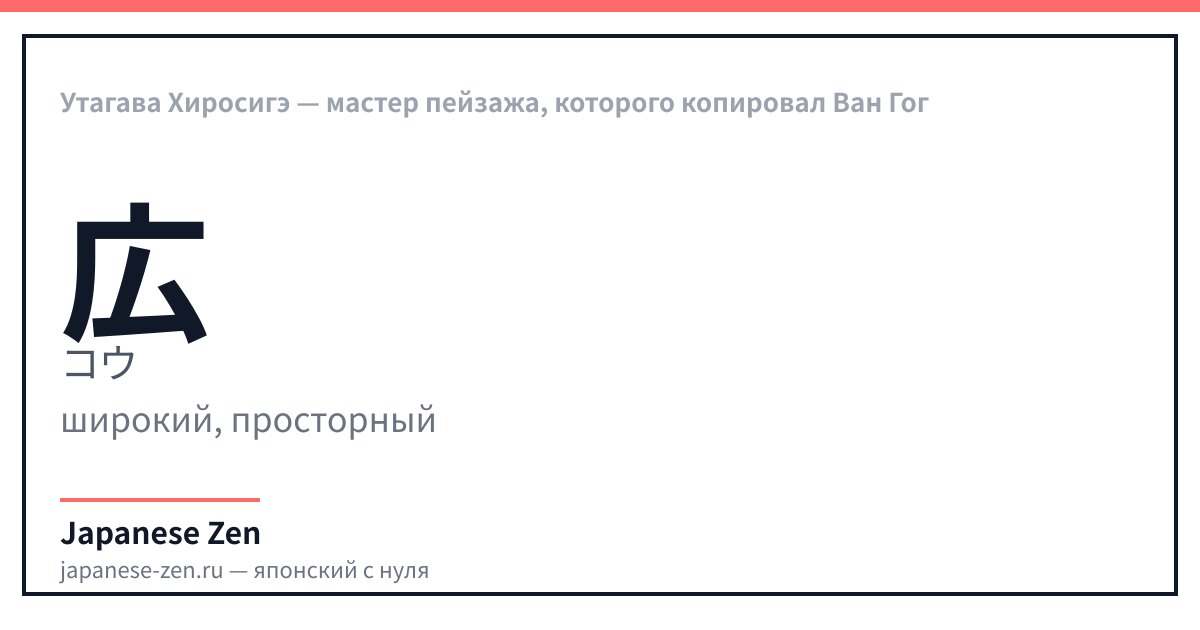
広 — значение: wide, spacious — онъёми: コウ — кунъёми: ひろ.い、ひろ.まる、ひろ.める、ひろ.がる — 5 штрих(ов). 広 — "wide": the first character of the name Hiroshige (広重). The same root is in 広い "wide, spacious" and in the city name Hiroshima (広島), "wide island."
| Japanese | Reading | Translation |
|---|---|---|
| 歌川広重 | Utagawa Hiroshige · Utagawa Hiroshige | Full name of the artist |
| 東海道五十三次 | Tōkaidō Gojūsan-tsugi · Tōkaidō Gojūsan-tsugi | "Fifty-three Stations of the Tōkaidō" |
| 名所江戸百景 | Meisho Edo Hyakkei · Meisho Edo Hyakkei | "One Hundred Famous Views of Edo" |
| 広い | hiroi · hiroi | Wide |
| 版画 | hanga · hanga | Print, woodblock print |
What "Tōkaidō" means
東海道 (Tōkaidō) translates as "road along the eastern sea": 東 "east," 海 "sea," 道 "road." This was the name of the main highway between Edo and Kyoto with fifty-three stations for changing horses and overnight stays — it is dedicated to this road that Hiroshige's most famous series is devoted.
Write 広 along the guides — the first character of the name Hiroshige.
How Van Gogh copied Hiroshige in oil
In 1887, Vincent van Gogh painted oil copies of two Hiroshige prints from the series "One Hundred Famous Views of Edo" — "Plum Garden at Kameido" and "Bridge Ōhashi at Atake in Sudden Shower." He kept the composition almost unchanged but made the color noticeably brighter and added borders with Japanese characters copied from other prints. Both of Van Gogh's paintings are now in the Van Gogh Museum in Amsterdam.
"Hiroshige blue": Japanese landscape in European paint
In the West, the deep blue of his landscapes was nicknamed "Hiroshige blue." The pigment itself — Prussian blue — was European: it was imported to Japan through Holland, and in the 1830s it became a fashionable novelty in Japanese printing. Hiroshige's prints are now held in major museums in Japan, Europe, and the United States.
FAQ
- Who was Utagawa Hiroshige?
- A Japanese artist of 1797–1858, a master of ukiyo-e landscape prints. His real family name was Andō; his artistic name came from the Utagawa school, which he entered in 1811. He is known primarily for the series "Fifty-three Stations of the Tōkaidō" and "One Hundred Famous Views of Edo."
- Which Hiroshige prints did Van Gogh copy?
- In 1887, Van Gogh painted oil copies of "Plum Garden at Kameido" and "Bridge Ōhashi at Atake in Sudden Shower" from the series "One Hundred Famous Views of Edo," keeping the composition and noticeably changing the color. Both copies are now in the Van Gogh Museum in Amsterdam.
- What is the "53 Stations of the Tōkaidō"?
- A series of 55 prints from 1833–1834 dedicated to the stations of the main highway between Edo and Kyoto — one print for each stop, including the starting and ending points of the route. It was Hiroshige's first major landscape work and a success during his lifetime.
- How is "Hiroshige" written in kanji?
- 歌川広重, read as うたがわひろしげ. 歌川 is the name of the Utagawa artistic school, 広重 is the personal artistic name, where the first character 広 means "wide" — the same as in the city name Hiroshima — and the second, 重, has no relation to that meaning.
Sources
Updated: 2026-09-14