Hiroshima — the "wide island" in the delta of the Ōta River
Hiroshima is a city in the southwest of Honshu, in the delta of the Ōta River, and the administrative center of the prefecture of the same name. The name 広島 means "wide island": in 1589 the warlord Mōri Terumoto gave it to a new castle on the river's floodplain. According to the 2020 census, more than 1.2 million people live in Hiroshima — it is the largest city in the Chūgoku region, known for its local okonomiyaki and its proximity to Miyajima island.
Let's look at two versions of the origin of the name Hiroshima: one through the surnames of an ancestor of the Mōri clan and a local commander, the other through the relief of the delta itself. Along the way we'll learn why in 1589 Mōri Terumoto moved his headquarters from the mountains to the sea, how the Ōta River splits into six branches right within the city limits, and what today reminds us of the events of 1945.
Hiroshima: the castle of 1589 and two explanations of one name
広島 is read ひろしま (Hiroshima) and is made up of 広 "wide" and 島 "island". The name appeared in written sources in 1589, when the warlord Mōri Terumoto began building a castle on the floodplain of the Ōta River, on a site then called simply Gokamura — "five villages". There are two versions of the origin of the name: according to one, "Hiro" comes from the name of an ancestor of the Mōri clan, Ōe no Hiromoto, and "shima" from the surname of the local commander Fukushima Motonaga; according to the other, the name simply describes the wide islands of the river delta.
Why Terumoto moved his headquarters from the mountains to the sea
Before that, the Mōri clan ruled from the mountain fortress of Koriyama — convenient for defense, but inconvenient for governing lands. In 1588, during a visit to Kyoto and Osaka, Terumoto saw Toyotomi Hideyoshi's castle and his Jurakudai palace and decided that trade and power required a city by the water, not a fortress in the mountains.
The six branches of the Ōta, local okonomiyaki, and the island next door
Where it flows into Hiroshima Bay, the Ōta River splits into six branches, and the city lies right on the delta they form. According to the 2020 census, more than 1.2 million people live in Hiroshima — it is the largest city in the Chūgoku region.
Hiroshima-style okonomiyaki and Miyajima island
Hiroshima okonomiyaki — with a thin crepe, layers of cabbage and noodles — is a local pride: the recipe is noticeably different from Osaka's, where all the ingredients are mixed right into the batter. Nearby, in the bay, lies Miyajima island with Itsukushima Shrine and its torii gate, which stands right in the water.
August 6, 1945: what the city preserves and restores
On the morning of August 6, 1945, an atomic bomb fell on Hiroshima — the first combat use of nuclear weapons in history. The city was almost completely destroyed. Today, near the hypocenter stands the Genbaku Dome — the ruins of a building deliberately left as they were after the explosion, and around it lies Peace Memorial Park with a museum. In 1996 the dome was added to the UNESCO World Heritage list — the same year Itsukushima Shrine on Miyajima island was added to the same list.
島 — the island that entered dozens of Japanese words
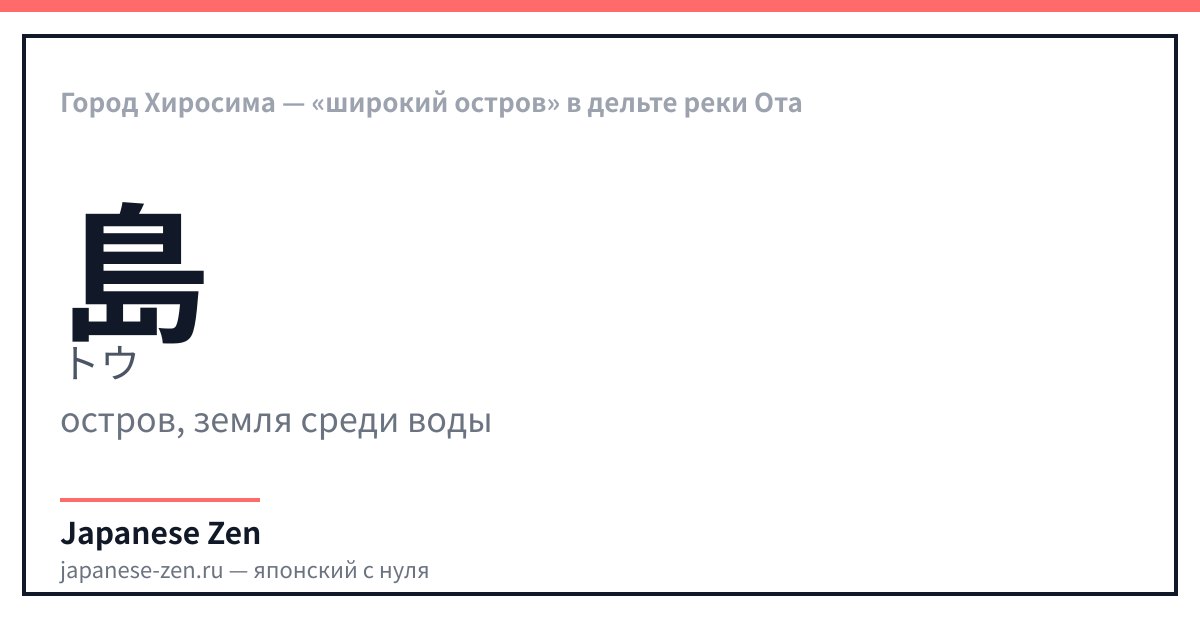
島 — значение: island, land amid water — онъёми: トウ — кунъёми: しま — 10 штрих(ов). 島 — "island": the second character in the name Hiroshima. The same character appears in 島国 (shimaguni) "island country", as Japan itself is called, and in 半島 (hantō) "peninsula", literally "half an island".
How the character 半 turns an island into a peninsula
半島 (hantō) — "peninsula" — is formed by adding 半 "half" to 島: a clear way of word formation worth remembering. Japanese often builds new concepts from simple building blocks rather than borrowing a separate word for each new meaning.
| Japanese | Reading | Translation |
|---|---|---|
| 広島 | Hiroshima · Hiroshima | Hiroshima — the name of the city itself |
| 広島市 | Hiroshima-shi · Hiroshima-shi | Hiroshima City — the full official name |
| 太田川 | Ōta-gawa · Ōta-gawa | The Ōta River, on whose delta the city stands |
| 島国 | shimaguni · shimaguni | Island country — as Japan itself is called |
| 半島 | hantō · hantō | Peninsula, literally "half an island" |
| 原爆ドーム | genbaku dōmu · genbaku dōmu | The Genbaku Dome — a memorial near the hypocenter of the explosion |
Write 島 along the guides — the "island" character from the name Hiroshima.
FAQ
- What kind of city is Hiroshima and where is it located?
- Hiroshima is a city in the southwest of Honshu, on the coast of the Seto Inland Sea, and the administrative center of the prefecture of the same name. The city stands in the delta of the Ōta River; its population according to the 2020 census is over 1.2 million people, making it the largest city in the Chūgoku region.
- What does the Japanese name Hiroshima mean?
- 広島 literally means "wide island": 広 — "wide", 島 — "island". The name dates to 1589, when the warlord Mōri Terumoto began building a castle here on the floodplain of the Ōta River. According to another version, the name is composed of parts of the names of an ancestor of the Mōri clan and a local commander.
- Why did Mōri Terumoto build his castle here?
- Before that, the Mōri clan ruled from the mountain fortress of Koriyama — convenient for defense, but inconvenient for trade and governance. After seeing Toyotomi Hideyoshi's castle in 1588, Terumoto decided that the land needed a city by the water, not a fortress in the mountains, and in 1589 he began building Hiroshima on the river delta.
- What in Hiroshima reminds us of the events of 1945?
- Above all the Genbaku Dome — the charred frame of a building at the very hypocenter of the explosion, left unchanged as a monument. Nearby lies Peace Memorial Park with a museum, and the dome itself has been on the UNESCO World Heritage list since 1996.
- What else is Hiroshima known for besides the history of 1945?
- For its okonomiyaki — a dish with layers of batter, cabbage and noodles, noticeably different from the Osaka version. And also for its proximity to Miyajima island, where Itsukushima Shrine stands with its torii gate right in the water.
- Which kanji are used to write the name Hiroshima?
- 広島, read ひろしま. The first character 広 means "wide", the second 島 — "island". The first written mention of the name dates to 1589, when a castle began to be built on the site of the future city; before that, the lands at the mouth of the Ōta River were called simply Gokamura — "five villages".
Sources
Updated: 2026-09-15