History of Japan: Periods from Jomon to Reiwa
The history of Japan is divided into periods by three different principles: prehistoric eras are dated by archaeological finds, medieval ones by the city where the shogun's headquarters stood, and modern times by the era names of the emperors' reigns. From the Jomon hunters to the current Reiwa, the country has traveled a path of several millennia, and the exact date of the beginning of Japanese history remains a matter of debate.
Textbooks usually dump two dozen incomprehensible names on the reader in a row, and it's not easy to figure out what followed what. Below is a table that puts all the eras in their places: how they are counted and why in the Middle Ages a period was named after the city of the shogun's headquarters, not after the name of the victor. And then — where to go if you're interested not in Japan in general, but in a specific century.
Periods of Japanese History: From Jomon to Reiwa
The history of Japan is officially divided into about fifteen periods — from Jomon, the longest era, to the current Reiwa. The first three are named after pottery and burials — there are no written sources for them, and they can only be distinguished by excavations. The next seven bear the name of the place where decisions were made: Asuka, Nara, Heian-kyo (present-day Kyoto), Kamakura, Muromachi, Azuchi-Momoyama, and Edo (present-day Tokyo). The last five are named after the era name of the emperor's reign: since 1868, gengo has been used to designate not only years in documents but entire eras.
| Period | Kanji | Years | Known for |
|---|---|---|---|
| Jomon | 縄文時代 | c. 14,000 – 300 BCE | Hunting and gathering, pottery with cord-marked ornament |
| Yayoi | 弥生時代 | 300 BCE – 250 CE | Wet-rice agriculture, metal, first proto-states |
| Kofun | 古墳時代 | 250–538 | Kofun burial mounds, unification of the country under Yamato rule |
| Asuka | 飛鳥時代 | 538–710 | Arrival of Buddhism, first ritsuryo law code |
| Nara | 奈良時代 | 710–794 | First permanent capital, Kojiki and Nihon Shoki chronicles |
| Heian | 平安時代 | 794–1185 (or 1192) | Court culture, kana, The Tale of Genji |
| Kamakura | 鎌倉時代 | 1185 (or 1192) – 1333 | First shogunate, samurai in power, Mongol invasions |
| Muromachi | 室町時代 | 1336–1573 | Ashikaga shogunate, Zen culture, Onin War |
| Azuchi-Momoyama | 安土桃山時代 | 1573–1603 | Unification of the country by Nobunaga and Hideyoshi |
| Edo | 江戸時代 | 1603–1868 | Peace under Tokugawa rule, almost closed country |
| Meiji | 明治時代 | 1868–1912 | Abolition of the shogunate, Westernization, industrialization |
| Taisho | 大正時代 | 1912–1926 | Democratization, growth of cities |
| Showa | 昭和時代 | 1926–1989 | War, defeat, postwar reconstruction |
| Heisei | 平成時代 | 1989–2019 | Stagnation after the economic bubble, major earthquakes |
| Reiwa | 令和時代 | since 2019 | Current era |
By what principle they are divided into periods
There is no single system — historians simply use the unit of measurement available for a particular era. Jomon and Yayoi are distinguished by archaeology: by pottery, by the appearance of rice fields, because writing did not yet exist. The eras from Kamakura to Edo are named after the place where decisions were actually made — the shogun's residence, not the imperial capital, which for most of the time remained purely ceremonial. Periods from Meiji onward coincide with era names: one reign — one gengo, which also becomes the name of the era. That is why the count of periods differs among sources: some combine the short Azuchi-Momoyama with the broader Sengoku, others consider Asuka part of Nara — hence the range from 12 to 15 items.
From what point the beginning of Japanese history is counted
The beginning of Japanese history is a question with a disputed date. Official legend names 660 BCE, when the first emperor Jimmu supposedly founded the state; this day was established as a national holiday back in 1872, although historians do not consider Jimmu a real figure — there is no direct evidence of him. Archaeology pushes the beginning much further back, to the Jomon period, and the earliest written mentions of Japan are not Japanese at all, but Chinese chronicles of the first centuries CE. Therefore, there is no single starting point: everything depends on what is considered history — the state, writing, or simply land inhabited by people.
Where to Start: Five Eras That Are Easiest to Remember First
- Jomon — the longest era: more than ten millennia of hunting, gathering, and cord-marked pottery, which gave the whole period its name.
- Heian — almost four centuries when the main events took place not on the battlefield but at court: with court novels like The Tale of Genji and the birth of the kana syllabary.
- Kamakura, Muromachi, and Sengoku — three centuries in a row during which power passed from the court nobility to military houses, and then was again united in the hands of one clan.
- Edo — two and a half centuries of peace under the Tokugawa shoguns and almost complete isolation of the country from the outside world.
- Meiji — a sharp turn to Western technology and order after 1868: in less than half a century, Japan became an industrial power.
Rice in the History of Japan
Wet-rice agriculture came to Japan from the continent during the Yayoi period, around the 3rd century BCE, and changed the country more than almost any other innovation. To maintain shared irrigation canals, farmers had to unite in permanent settlements, and the harvest could be accumulated and taken away — thus property inequality first appeared in Japanese society. Centuries later, rice became a direct measure of wealth: a koku (石) is the amount that was enough to feed one adult for a year. It came to measure not land but income: a vassal received so many koku of rice per year, a whole domain received so many. On a national scale, this system, kokudaka, was introduced by Toyotomi Hideyoshi through land surveys at the end of the 16th century, and it served as a measure of wealth throughout the subsequent Edo period.
Name and Kanji: 日本史
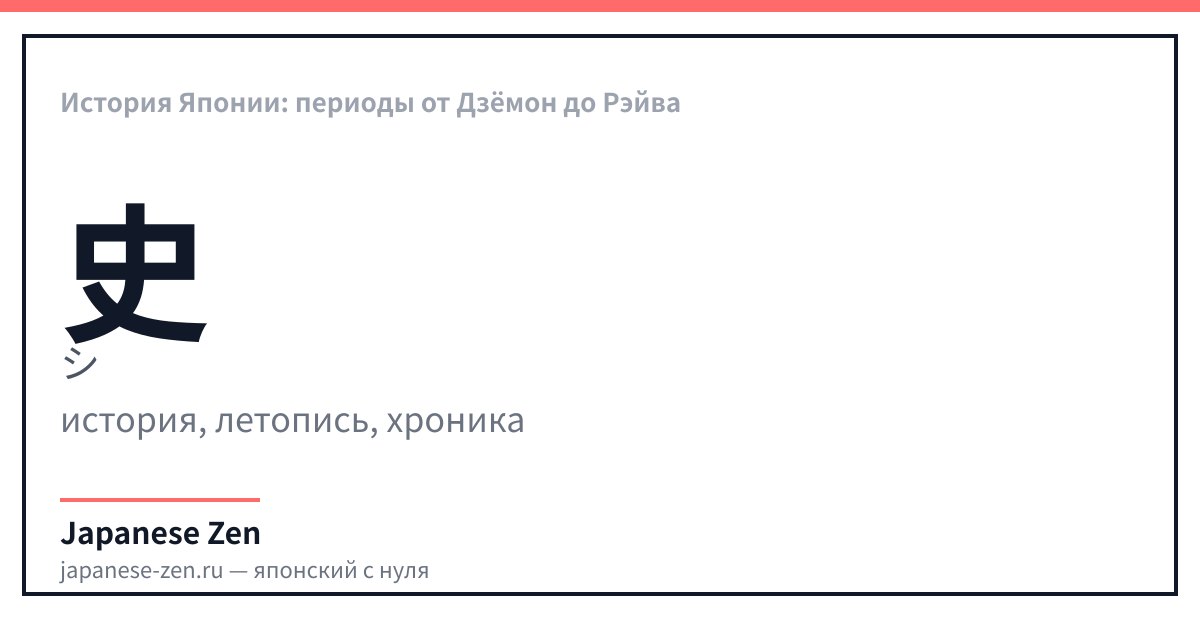
日本史 is read にほんし and is made up of two parts: 日本 "Japan" and 史 "history, chronicle." The same word is used for a school subject — "Japanese history" as an academic discipline is officially called exactly that, in contrast to 世界史 (sekaishi, "world history").
史 — значение: history, chronicle, record — онъёми: シ — 5 штрих(ов). 史 — "history, chronicle, record": 5 strokes, N2-level character. The same root is in 歴史 (rekishi, "history") and 世界史 (sekaishi, "world history").
| Japanese | Reading | Translation |
|---|---|---|
| 日本史 | Nihon-shi · Nihon-shi | History of Japan — also the name of a school subject |
| 時代 | jidai · jidai | Era, period |
| 歴史 | rekishi · rekishi | History in the general sense of the word |
| 元号 | gengō · gengō | Era name used to designate years and eras |
| 古代 | kodai · kodai | Antiquity — the name for the earliest periods |
| 天皇 | tennō · tennō | Emperor — the formal ruler of Japan in all eras |
Write 史 along the guides — the character for "history" from 日本史.
How these periods are called in Japanese
Each period's Japanese name ends in 時代 (jidai, "era"): 縄文時代, 鎌倉時代, 江戸時代. Only the last five eras, from Meiji to Reiwa, can also be called without this word — simply by the era name: the years that are going on now, Japanese people in everyday speech more often call simply 令和 (Reiwa), not "the Reiwa era."
Where Japanese History Appears in Anime and Games
Different eras of Japanese history have become the backdrop for dozens of titles — here are a few examples that are actually tied to a specific period, rather than just depicting "Japanese Middle Ages in general."
- Angolmois: Record of Mongol Invasion (2018) — manga and anime about the defense of Tsushima Island in 1274, the first Mongol invasion of the Kamakura era.
- The Elusive Samurai (逃げ上手の若君, anime by Clover Works, 2024) — about Hojo Tokiyuki, heir of the last rulers of Kamakura, and about Ashikaga Takauji, who founded the next shogunate.
- Ikkyu-san (1975–1982) — a classic Toei Animation anime about the childhood of the real Zen monk Ikkyu Sojun, who lived in the Muromachi era.
- Rurouni Kenshin — manga and anime about a former assassin who in 1878, already in the Meiji era, vowed never to kill again.
- Demon Slayer: Kimetsu no Yaiba — the action takes place in the Taisho era, 1912–1926: electricity and trains coexist with swords and villages.
- Fate/Grand Order — in this game, among the summonable "servants" are Yamato Takeru, the legendary prince of the Kofun period, and Himiko, the first known ruler of Japan in the 3rd century.
FAQ
- What periods does the history of Japan include?
- From Jomon, the longest prehistoric era, to the current Reiwa — a total of 12 to 15 periods, depending on the level of detail. Prehistoric ones are distinguished by archaeology, medieval ones by the location of the shogun's residence, modern ones by the era names of the emperors' reigns.
- How many periods are there in the history of Japan?
- Usually 12 to 15 are named: different sources divide the transitional eras differently — for example, they combine the short Azuchi-Momoyama period with the broader Sengoku, or consider Asuka part of the Nara period. There is no rigid standard, only an established order of eras.
- Where does the history of Japan begin?
- Official legend names 660 BCE and the first emperor Jimmu, but historians do not recognize this figure as real. Archaeologically, the settlement of the archipelago goes back many thousands of years earlier, to the Jomon period — there is no single date for the beginning.
- What role did rice play in the history of Japan?
- Wet-rice agriculture, which arrived in the Yayoi period, forced people to unite in permanent settlements for shared canals — that is how property inequality arose. Later, rice became a direct measure of wealth: the koku of harvest measured the income of a samurai or an entire domain until the end of the Edo period.
- What is the history of Japan in Countryballs format?
- Countryballs is an internet genre of comics and videos where countries are drawn as balls in the colors of their flags; Japan there periodically "goes through" wars and eras in a simplified, often joking form. It is an entertainment meme format, not a historical source — dates and causes are deliberately coarsened for the sake of a joke.
- Where does Japanese history appear in anime?
- Each major era has its own titles: Angolmois — about the Mongol invasions of Kamakura, Ikkyu-san — about Muromachi, Rurouni Kenshin — about Meiji, Demon Slayer — about Taisho. The earliest periods appear less often — more in games like Fate/Grand Order than in anime.
Sources
Updated: 2026-09-11