Sengoku Period — When It Was and What It Is Known For
The Sengoku period was an era of fragmentation and war in Japan that began in 1467 with the Onin War and lasted about a century and a half. There is no single end date: historians cite 1568, 1590, 1600, or 1615, depending on what is considered the end of the turmoil. The era was defined by ashigaru infantry, arquebuses, and the principle of gekokujo — power passed to whoever was stronger, not nobler.
A century and a half of Japanese history rarely fits into one textbook paragraph — the Sengoku period is no exception: too many warring houses and too many points at which the turmoil could be declared over. There is no single finale from the start: power passed from hand to hand until, after Sekigahara and the fall of Osaka, the Tokugawa clan stood above all. We examine when this era began, what in it changed Japan forever, and why historians disagree about its end.
When the Sengoku Period Was and How Long It Lasted
The Sengoku period (戦国時代) is an era of Japanese history that stretched for roughly 130–150 years. Its beginning is not disputed: the Onin War of 1467–1477 destroyed the unity of the Ashikaga shogunate, and power in the provinces passed to local warlords. The end is more complicated — there is no single date. Historians cite 1568, when Oda Nobunaga entered Kyoto; 1590, the completion of unification under Toyotomi Hideyoshi; 1600, the year of the Battle of Sekigahara; and 1615, the fall of Osaka Castle and the destruction of the Toyotomi house. All four dates are justified in their own way: Japan did not settle down in one night but was reassembled over decades.
| Year | Event |
|---|---|
| 1467–1477 | Onin War — the Ashikaga shogunate loses real power over the provinces |
| 1568 | Oda Nobunaga enters Kyoto — the first version of the era's end |
| 1590 | Toyotomi Hideyoshi completes the unification of the country — the second version |
| 1600 | Battle of Sekigahara — the third version |
| 1615 | Fall of Osaka Castle, destruction of the Toyotomi house — the fourth, latest version |
How the Sengoku Period Differed from Neighboring Eras
What distinguishes the period from the aristocratic Heian era and from the two centuries of Tokugawa peace that followed Sengoku is one principle — gekokujo (下剋上), 'the low overcome the high.' A vassal could overthrow his lord, and a military commander of non-noble birth could lead an entire province if he had enough troops and luck. Power was no longer passed automatically by blood right: it was held by military force and lost at the first defeat. Therefore, over a century and a half, several generations of rulers changed on the map of provinces, and the borders of domains were redrawn almost annually — Japanese history never again knew such fluidity of power.
How People Lived at This Time
- Power — land and troops were controlled by daimyo, the rulers of provinces: the Oda, Takeda, Uesugi, Hojo, Mori, Shimazu, Date, and dozens of smaller houses. By this time the Ashikaga shogunate had almost no influence.
- Classes — the boundary between warrior and commoner became permeable: an ashigaru infantryman could rise to military commander, and an impoverished samurai could lose land and status after a single lost battle. Toyotomi Hideyoshi, who rose from a simple peasant to ruler of the country, is the most famous but not the only example.
- Troops and weapons — from 1543, when the Portuguese landed at Tanegashima with arquebuses, infantry with firearms began to decide the outcome of battles as well as mounted samurai spearmen. Along with traders came the Jesuits: the mission of Francis Xavier in 1549 was initially received favorably by Japanese daimyo.
- Money — daimyo competed not only with weapons: they introduced uniform measures, minted their own coins, and removed internal toll barriers so that trade would pass through their lands. Oda Nobunaga pursued this policy earlier and more consistently than others.
- Daily life — peasants could be called into the infantry at any moment for the duration of a campaign. At the same time the landscape changed: old mountain fortresses gave way to castles on the plains, and castle towns (jokamachi) with artisans and merchants grew up beside them.
Name and Kanji: 戦国
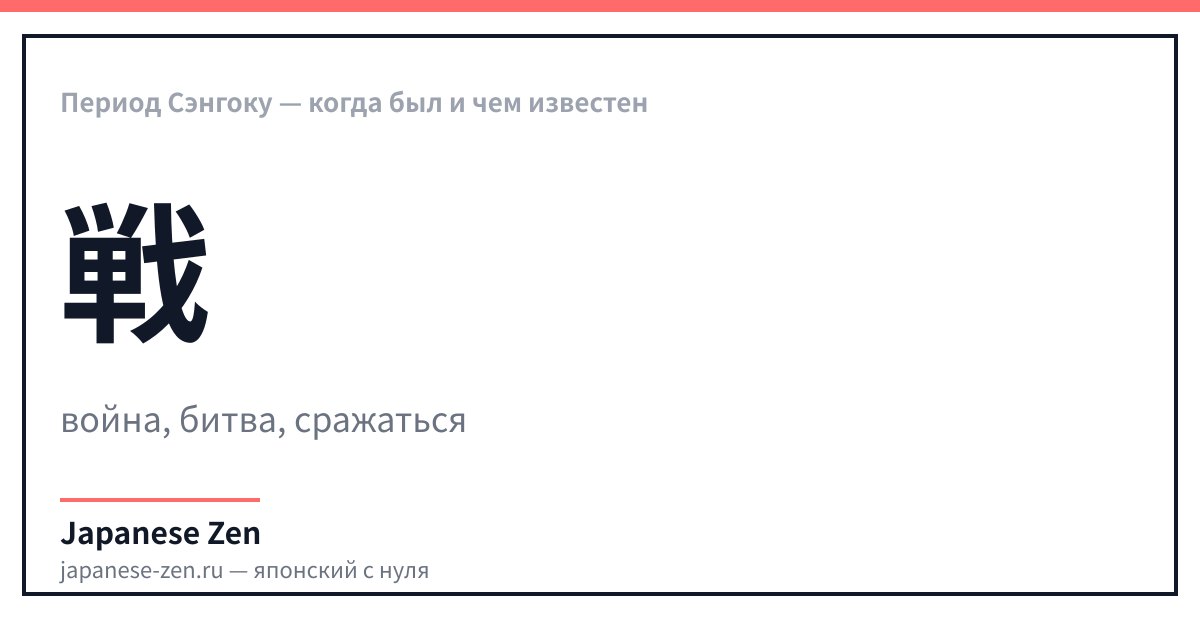
戦国 (sengoku) is read せんごく and means 'warring provinces' or, loosely, 'era of the warring states': 戦 — 'war, battle,' 国 — 'country, province.' The name was not invented anew in the 16th century but borrowed. Contemporaries of the turmoil compared their era to the Chinese Warring States period (戰國, 'warring states,' 5th–3rd centuries BCE) — a time of the collapse of central authority and wars between regional rulers of ancient China. Thus the Chinese name for a foreign civil war became the name of the Japanese one — a direct calque, not a chance similarity of sound.
戦 — значение: war, battle, to fight — онъёми: セン — кунъёми: いくさ、たたか.う、おのの.く、そよ.ぐ、わなな.く — 13 штрих(ов). 戦 — 'war, battle, to fight': 13 strokes, JLPT N3. The same character appears in 戦国 (sengoku) and in 戦い (tatakai, 'battle, fight').
| Japanese | Reading | Translation |
|---|---|---|
| 戦国時代 | Sengoku jidai · Sengoku jidai | The full Japanese name of the era — 'time of the warring provinces' |
| 下剋上 | gekokujō · gekokujō | 'The low overcome the high' — the defining principle of the century |
| 足軽 | ashigaru · ashigaru | Commoner infantryman — the backbone of Sengoku armies |
| 城下町 | jōkamachi · jōkamachi | Castle town of a daimyo |
| 戦い | tatakai · tatakai | Battle, fight |
Write 戦 along the guides — the first character in 戦国, 'war' in the name of the era.
How the Japanese Still Name the Years
In Japan, each year is simultaneously dated by the era name (元号, gengō) — as it is today: since 2019 the Reiwa era has been in progress, before it was Heisei. During the Sengoku period, era names changed frequently: for example, Eiroku (1558–1570) and later Tensho (1573–1592) — the name for the latter, according to legend, was proposed by Oda Nobunaga himself. But for the period as a whole, another name stuck — 'Sengoku,' based on meaning rather than an era name: too many times did era names change over a century and a half to call the era after one of them.
Which Anime and Games Are Set in the Sengoku Period
- Nobunaga no Yabou ('Nobunaga's Ambition') — a Koei strategy series since 1983: a campaign of any daimyo to unify the country, unvarnished, by provinces and armies.
- Sengoku Basara — Capcom fighting games where daimyo are turned into grotesque super-warriors: events and names are recognizable, not personalities.
- Samurai Warriors (in Japan — Sengoku Musou) — Koei Tecmo's 'musou' epic: one warrior against crowds of ashigaru on the battlefields of the era.
- Nioh — Team Ninja's action game about the end of the era: the hero is a fantasy version of a real English navigator in the service of Tokugawa, among enemies are Nobunaga and Hideyoshi with supernatural powers.
- Total War: Shogun 2 — Creative Assembly's strategy game set right after the Onin War: the Ashikaga shogunate is already powerless, provinces are ruled by daimyo.
- Nobunaga no Shinobi — comedic manga and anime about the ninja Chidori from the Iga clan, serving Oda Nobunaga from Owari to Honnoji.
- Drifters — manga and anime by Kota Hirano: the military commander Shimazu Toyohisa is transported to another world straight from the battlefield of Sekigahara in 1600.
How to Recognize the Era on Screen
The Sengoku period on screen is revealed by several persistent markers: sashimono flags with the clan crest on the backs of infantrymen, dense ranks of arquebusiers behind wooden barricades, and castles on the plains instead of the mountain fortresses of earlier centuries. Another marker is a plot about a vassal betraying his lord, a direct reference to that very gekokujo. If there is an arquebus in the frame and the plot hinges on a commander's betrayal — it is almost certainly Sengoku.
FAQ
- When was the Sengoku period?
- The Sengoku period began in 1467 with the Onin War, which destroyed the power of the Ashikaga shogunate, and continued until the end of the 16th — beginning of the 17th century. There is no single end date: historians cite 1568, 1590, 1600, and 1615, depending on what is considered the end of the turmoil.
- How long did the Sengoku period last?
- From the Onin War in 1467 to Sekigahara in 1600 — about 130 years; if the fall of Osaka Castle in 1615 is taken as the end, the era stretches to almost 150 years. Both figures are used in various sources as legitimate.
- Are 'Sengoku jidai' and the Sengoku period the same thing?
- Yes. 'Sengoku jidai' (戦国時代) is the full Japanese name of this era, literally 'time of the warring provinces'; 'Sengoku period' is the established English translation of the same concept. The difference is only in the language of record; it refers to the same century and a half of Japanese history.
- How is 'Sengoku' written in kanji and what does the word itself mean?
- 戦国, せんごく: 戦 — 'war, battle,' 国 — 'country, province.' Literally — 'warring provinces.' The name is not a Japanese invention: it was borrowed from the Chinese designation of the Warring States period — an era of wars between the states of ancient China, with which contemporaries compared their own turmoil.
- Which anime and games depict the Sengoku period?
- The Nobunaga no Yabou, Sengoku Basara, and Samurai Warriors series are entirely built on this era. Total War: Shogun 2 and Nioh unfold at its end, while the manga and anime Nobunaga no Shinobi and Drifters show it through individual historical figures.
- How did the Sengoku period end?
- With the military unification of the country: Toyotomi Hideyoshi brought Japan together by 1590. After his death, Tokugawa Ieyasu defeated his rivals at Sekigahara in 1600 and finished off the Toyotomi house at the siege of Osaka in 1615, opening an era of peace under the Tokugawa shogunate.
Sources
Updated: 2026-09-11