Shogunate — what it actually means
Shogunate is the name used in European languages for military rule in Japan, in which all real power belonged to the shogun while the emperor remained the nominal ruler in Kyoto. Japan itself calls this institution 幕府 (bakufu). Over almost seven centuries there were three shogunates — Kamakura, Ashikaga and Tokugawa — and the system ended in 1867–1868 with the Meiji Restoration.
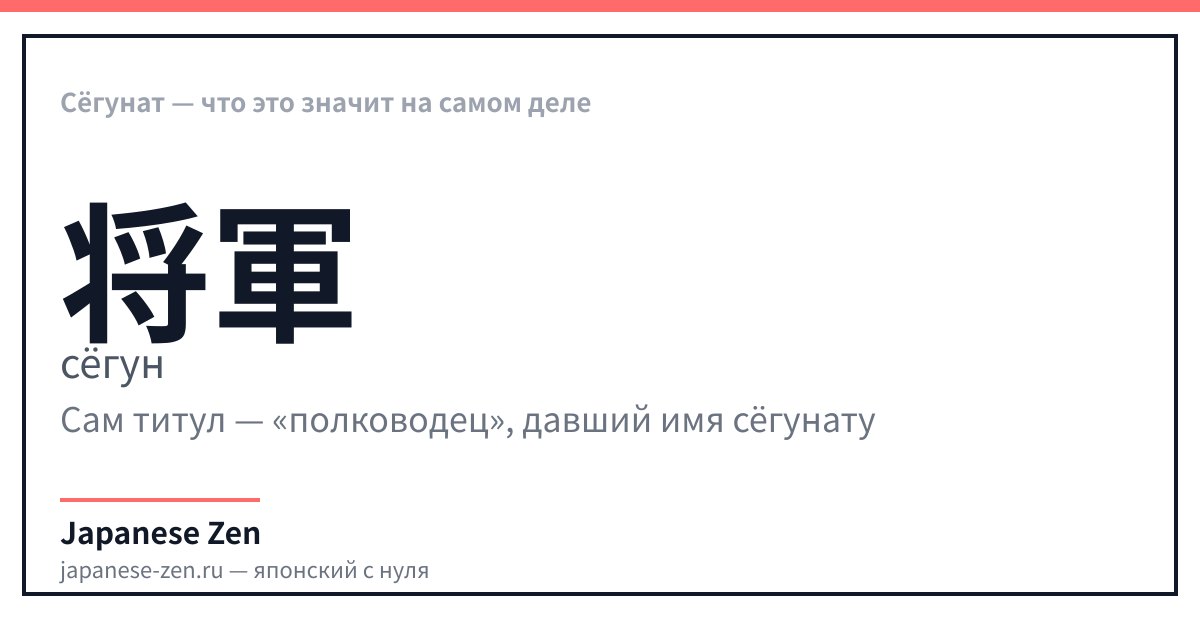
“Shogunate” is a word that does not exist in Japanese itself: it is a European calque from a military title, not a self-designation. Hence two sources of confusion — the shogun is mistaken for the emperor, and three different shogunates, separated by wars and decades of unrest, are merged into one continuous rule. Let us sort out how a shogunate differs from a bakufu and in what year the system actually ended.
What “shogunate” means
Shogunate is not a Japanese word but a European designation for the power of the shogun (将軍, しょうぐん), the military ruler of Japan. The title itself is short for 征夷大将軍 (Sei-i Taishōgun), “great general who subdues the barbarians”: originally this was the name for a military commander sent to pacify the northern lands not held by the court. From the end of the 12th century the title became attached to the hereditary military ruler of the whole country, and the “-ate” at the end is the same suffix as in “emirate” or “sultanate”: a designation of the power of a particular title-holder, not his personal name.
Why “shogunate” and “bakufu” are different words
The translation problem is that “shogunate” describes a person's power, not the name of an institution. The Japanese themselves called the institution 幕府 (bakufu) — literally “curtain-government”, that is, “field headquarters”: the word goes back to the curtain of a commander's campaign tent. “Shogunate” points to the title-holder, “bakufu” to the military government itself alongside the living imperial court.
| Japanese | Reading | Translation |
|---|---|---|
| 将軍 | shōgun · shōgun | The title itself — “general”, which gave the shogunate its name |
| 幕府 | bakufu · bakufu | This is what the Japanese themselves called the shogunate |
| 征夷大将軍 | Sei-i Taishōgun · Sei-i Taishōgun | Full title: “great general who subdues the barbarians” |
| 武士 | bushi · bushi | The warrior class from which shoguns came |
| 江戸 | Edo · Edo | Capital of the last shogunate, present-day Tokyo |
Breaking down the kanji: 将軍
将 — значение: general, commander, admiral — онъёми: ショウ、ソウ — кунъёми: まさ.に、はた、まさ、ひきい.る、もって — 10 штрих(ов). 将 — “general, commander”: 10 strokes, JLPT N3. Together with the second character, 軍 “army”, it gives しょうぐん — “commander of an army”.
What parts make up the character 将
According to a common interpretation by paleographers, in bronze inscriptions 将 consisted of 爿 (an altar-table), 肉 (a piece of meat) and 刀 (a knife) — together they depicted a military ritual: the offering of sacrificial meat before battle, led by a commander. Hence the meaning “general”. By the seal-script era the knife was replaced by the character 寸 “hand” — in this form 将 has come down to modern writing.
Write 将 along the guides — the first character in 将軍, “general” in the shogun's title.
Three shogunates: how it worked in practice
A shogunate is not a single government but a form of rule that arose three times in Japanese history, in three different centuries. It is clearer to show all three at once: who founded it, where the government sat and why each eventually fell.
| Shogunate | Founder | Seat | Years | How it ended |
|---|---|---|---|---|
| Kamakura | Minamoto no Yoritomo | Kamakura | 1185/1192–1333 | Overthrown: Emperor Go-Daigo and the generals Takauji, Yoshisada |
| Ashikaga (Muromachi) | Ashikaga Takauji | Kyoto | 1336/1338–1573 | The last shogun driven out of Kyoto by Oda Nobunaga |
| Tokugawa (Edo) | Tokugawa Ieyasu | Edo, present-day Tokyo | 1603–1867/68 | Yoshinobu returned power to the emperor; the shogunate abolished by decree |
Why Kamakura and Ashikaga have two start dates
The double dates are not a typo. Minamoto no Yoritomo effectively gained military power in 1185, but the title of Sei-i Taishōgun only in 1192; modern historiography more often names 1185 as the beginning. A similar story with Ashikaga Takauji: he was already ruling the country from Kyoto in 1336, but received the formal title in 1338. Tokugawa Ieyasu has no such fork — in 1603 both coincided.
In what year did the shogunate system collapse
The fall stretched over two formal steps and a war. On November 9, 1867, the last shogun, Tokugawa Yoshinobu, submitted a request to return power to the emperor — taisei hōkan. But the shogunate was officially abolished only on January 3, 1868, by the decree of the Meiji Restoration. Resistance to this decree was finished off by the Boshin War of 1868–1869 — some Tokugawa supporters refused to recognize it. So it is more accurate to say not “in 1868” but “in 1867–1868”.
Common misconceptions about the shogunate
- “The shogun is the Japanese emperor” — no. The emperor lived in Kyoto and remained the formal sovereign throughout the centuries of the shogunates, but real power — land, army, courts — was in the shogun's hands. It is more accurate to speak of two parallel centers: the ceremonial court and the military government.
- “The shogunate is one continuous dynasty” — also no. There were three: Kamakura, Ashikaga and Tokugawa, and between them there was not a smooth transfer of power but decades of wars and unrest, including the entire Sengoku era between the second and third shogunates.
- “The title of shogun was passed down by direct inheritance, like a crown” — not quite. Formally only a person descended from the Minamoto clan could become Sei-i Taishōgun. That is why Toyotomi Hideyoshi, who unified the country between the Ashikaga and Tokugawa, did not become shogun — he ruled as kampaku (regent), obtaining the rank through adoption into the Fujiwara clan.
- “The shogunate is simply a military dictatorship” — only partly true. The Tokugawa shogunate, which lasted longer than the others, was not so much a barracks as a bureaucracy. The Buke Shohatto laws from 1615 regulated the life of the daimyo, and sankin kōtai from 1635 kept them on a short leash, preventing them from accumulating strength for rebellion.
FAQ
- What does “shogunate” mean?
- Shogunate is the European name for the power of the shogun (将軍), the military ruler of Japan; the Japanese themselves called this institution 幕府 (bakufu). The title goes back to 征夷大将軍 — “great general who subdues the barbarians”. There were three shogunates in all: Kamakura, Ashikaga and Tokugawa, from the end of the 12th century to 1867–1868.
- How is “shogunate” written in kanji?
- The word “shogunate” has no direct kanji spelling — it is a European suffix added to 将軍 (shōgun, “general”). The shogun's title itself can be written in kanji — 将軍, literally “commander of an army”, or the full name of the office — 征夷大将軍.
- How does a shogunate differ from a bakufu?
- Shogunate is a word about a person: the European designation for the power of a particular shogun. Bakufu (幕府) is a word about a structure: this is what the Japanese themselves called the military government alongside the court, literally “field headquarters”, from a commander's tent on campaign.
- How many shogunates were there in Japan?
- Three: Kamakura (1185/1192–1333, founded by Minamoto no Yoritomo), Ashikaga, also called Muromachi (1336/1338–1573, founded by Ashikaga Takauji), and Tokugawa, also called Edo (1603–1867/68, founded by Tokugawa Ieyasu). Between them there was not smooth continuity but wars and decades of unrest, including the entire Sengoku era.
- In what year did the shogunate system collapse?
- Formally in two stages: on November 9, 1867, the shogun Tokugawa Yoshinobu submitted a request to return power to the emperor (taisei hōkan), and on January 3, 1868, the decree of the Meiji Restoration officially abolished the shogunate. Resistance was finished off by the Boshin War of 1868–1869 — some Tokugawa supporters refused to recognize the decree.
- Is the shogun the same as the Japanese emperor?
- No. The emperor is the formal sovereign, according to legend a descendant of the goddess Amaterasu, who lived in Kyoto without real military power. The shogun is the military ruler with an army, courts and land under his command: formally he was appointed by the emperor, but in fact power was passed within one house or changed hands through war.
Sources
Updated: 2026-09-11