Japanese Kanji for Samurai: 侍 — Writing and Meaning
The Japanese kanji for samurai is 侍, 8 strokes. It is read as 'samurai' (kun'yomi さむらい) and 'ji' (on'yomi ジ). The character consists of the radical 'person' 亻 and 寺 'temple', and the word itself comes from the old verb さぶらう (saburau) 'to be at someone's side': a samurai is first and foremost one who serves.
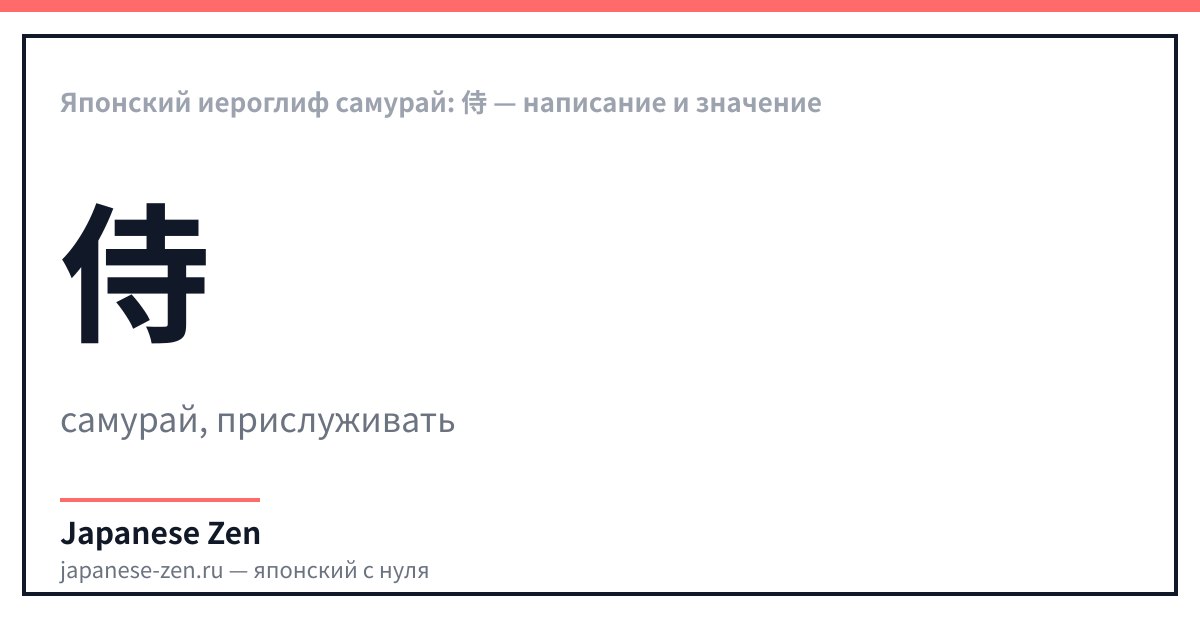
The word 'samurai' describes not a warrior but a servant: さぶらう — 'to be at someone's side'. The sword, the code, and everything else came later. That is why the character begins with a person, not a weapon.
How to Write the Japanese Kanji for Samurai
侍 — значение: samurai, to serve — онъёми: ジ、シ — кунъёми: さむらい、はべ.る — 8 штрих(ов). 8 strokes. Click 'Show order' — the character will unfold stroke by stroke.
A Person Next to a Temple
On the left is the radical 亻 — a compressed 'person'. On the right is 寺 (tera, temple), which here works phonetically and refers to the idea of serving at someone's side. Together it means 'person at the master's side' — that is, a retainer.
Words about Samurai
| Japanese | Reading | Translation |
|---|---|---|
| 侍 | samurai · samurai | Samurai |
| 武士 | bushi · bushi | Warrior, military class (a more general and historically accurate term) |
| 武士道 | bushidō · bushidō | Way of the Warrior |
| 刀 | katana · katana | Sword |
| 浪人 | rōnin · rōnin | Masterless samurai (today also refers to a student who failed entrance exams and is preparing for another year) |
| 切腹 | seppuku · seppuku | Ritual suicide |
| 忠義 | chūgi · chūgi | Loyalty to one's lord |
Samurai or bushi — which is more correct
Historically, 武士 (bushi) refers to the warrior class as a whole, while 侍 (samurai) originally meant court attendants. In modern Japanese, 侍 sounds more romantic and is used in a cultural sense — similar to how 'knight' is used alongside 'warrior'.
Write 侍 Yourself
First the left radical 亻, then the right part. Trace along the guides.
FAQ
- How many strokes are in 侍 and how is it read?
- 侍 — 8 strokes. Kun'yomi さむらい (samurai), on'yomi ジ (ji). The character consists of the 'person' radical and the element 寺.
- What does the word 'samurai' literally mean?
- 'One who serves': the word grew from the old verb さぶらう (saburau) — 'to be at someone's side, to serve'. The meaning 'warrior' appeared later.
- How is 侍 different from 武士?
- 武士 (bushi) is the warrior class as a whole, a more precise historical term. 侍 (samurai) originally referred to court attendants and today sounds more romantic.
- Who is a ronin?
- 浪人 (rōnin) — a samurai who has lost his master. In modern Japanese, the same word is used for a student who failed entrance exams and is preparing for another year.
Updated: 2026-07-25