Kanji Card: What Should Be on It
A kanji card (Japanese) works when it has five things: the character itself, both readings — on'yomi and kun'yomi, the meaning, the stroke count, and at least one word with that character. Without a word, the card is almost useless: kanji are remembered as part of a word, not in a vacuum, and it is the word that tells you which reading is used.
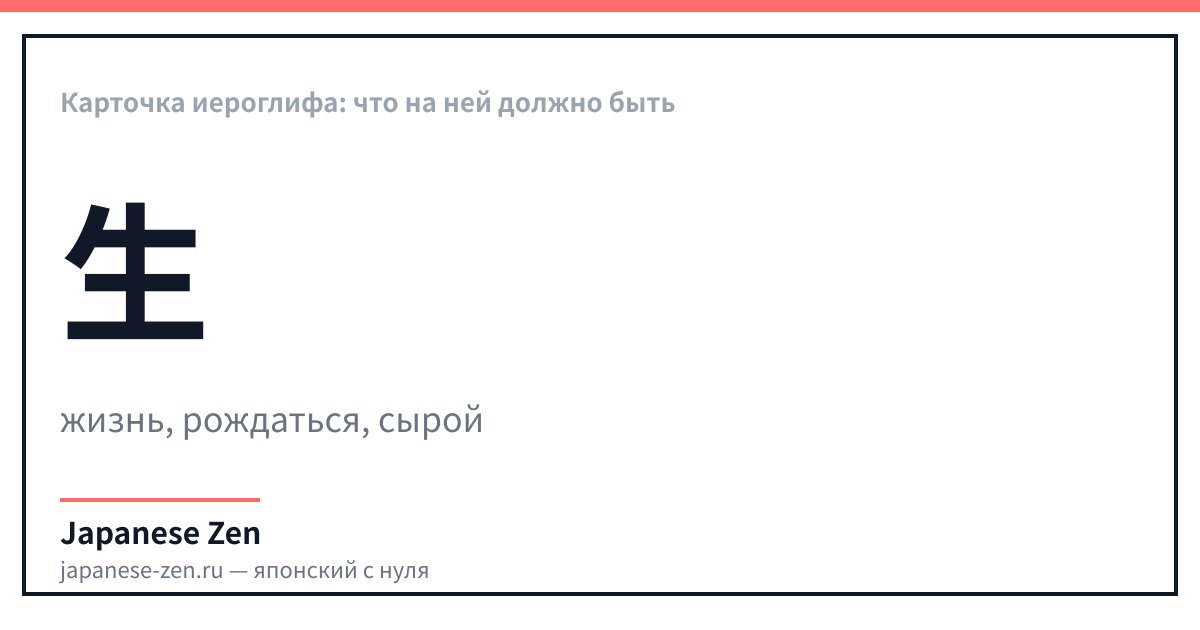
Cards work not because there are many of them, but because they contain what is needed. Let's break down the composition of a working card and the review schedule that keeps characters from slipping away.
What Should Be on the Card
| Element | Purpose |
|---|---|
| The character itself, large | recognizing the shape is the first skill |
| On'yomi and kun'yomi | without both readings, the character won't fit into words |
| Meaning in Russian | semantic anchor |
| Stroke count and radical | helps find the character in a dictionary and write it by hand |
| A word with this character | the main thing: kanji live in words, not separately |
Why the Word Matters More Than the Meaning
The isolated 生 means 'life', but in words it is read differently: 学生 (gakusei — student), 生きる (ikiru — to live), 生ビール (nama-biiru — draft beer). If you learn the character without words, you will recognize it in text but won't be able to read it.
How to Review So You Don't Forget
生 — значение: life, to be born, raw — онъёми: セイ、ショウ — кунъёми: い.きる、い.かす、い.ける、う.まれる、うま.れる、う.まれ、うまれ、う.む、お.う、は.える、は.やす、き、なま、なま-、な.る、な.す、む.す、-う — 5 штрих(ов). 生 is a character with a record number of readings. It is precisely on such characters that you see why example words are needed on the card.
- Take 3–5 new characters a day: with a larger volume, the review queue will eat up all your time.
- Review at increasing intervals: today, tomorrow, in three days, in a week, in a month.
- Test yourself in both directions: from character to reading and from word to character.
- Don't leave 'almost remembered' — that is forgotten; return the card to the beginning of the queue.
- Once a week, write a dozen characters by hand: motor memory holds the shape better than recognition.
Paper or App
A paper card wins in one way: you write it by hand, and the character is remembered through movement. An app wins in another: it calculates the intervals itself and doesn't make you review what you already know. In practice, people combine them: intervals in the app, handwriting in a notebook.
FAQ
- What should be on a kanji card?
- The character, both readings, the meaning, the stroke count and radical, and most importantly — a word with that character.
- How many cards should I make per day?
- Three to five new ones. More is rarely taken: the review queue for the next day grows faster than it seems.
- What is better: paper cards or an app?
- Paper gives you handwriting, the app gives you precise intervals. Usually they are combined.
- Is an example word on the card mandatory?
- Yes. Without a word, the character is recognized but not read: 生's readings change from word to word.
Updated: 2026-07-25