How to check a kanji before getting a tattoo
Before getting a tattoo, a kanji should be checked on four points: whether it is the Japanese form (not simplified Chinese), whether the character has a second meaning, whether the stroke order is correct, and whether the design is mirrored. A fifth point for phrases is to show it to a Japanese reader: machine translation produces grammatically correct nonsense more often than it seems.
The mistake in a tattoo is noticed not by the artist, but by the first Japanese person who sees it. Let's go through the check step by step — it takes an evening and saves years.
Step-by-step check
- Find the character in a Japanese dictionary by radical or reading and compare the form — Chinese variants differ in details: 愛 and 爱, 真 and 眞.
- Read all meanings, not just the first: for 情 it is both 'feeling' and 'circumstances', and for 命 — both 'life' and 'order'.
- Look at the stroke order animation and make sure the design matches it: on the finished work, an incorrect line is noticeable.
- Hold the design up to a mirror: mirror reversal is the most common mistake, and it's easy to miss on paper.
- For a phrase, find it in its entirety in a dictionary or show it to a Japanese reader: word-for-word translation is almost always wrong.
Why a dictionary is better than a translator
A translator gives one variant without explanation, while a dictionary entry gives all meanings, examples, and usage notes. It's the notes that matter: a word can be bookish, archaic, or rude, and that will show in the inscription.
What is most often found
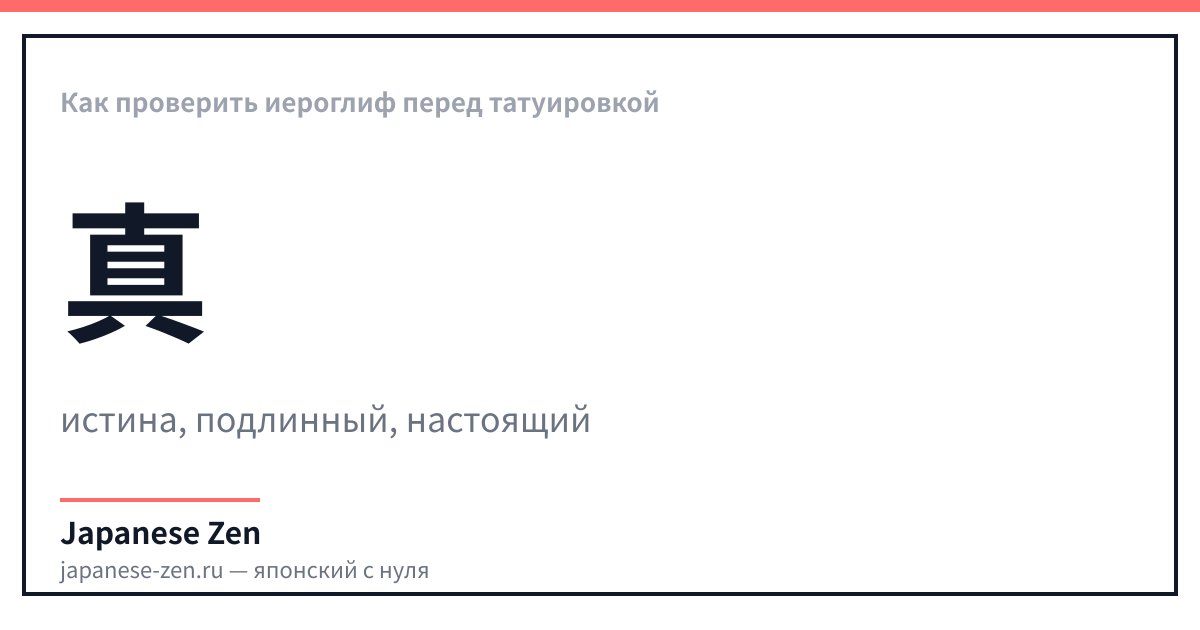
真 — значение: truth, genuine, real — онъёми: シン — кунъёми: ま、ま-、まこと — 10 штрих(ов). 真 is the Japanese form; in Chinese, 眞 is also found. Click 'Show stroke order' to compare with your design.
| Mistake | What it looks like | How to catch it |
|---|---|---|
| Mirror | character is flipped horizontally | hold the design up to a mirror |
| Chinese variant | 爱 instead of 愛 | compare with the dictionary entry |
| Second meaning | 'strength' turns out to be 'violence' | read all meanings |
| Stroke order | a line is drawn in the wrong direction | compare with the animation |
| Phrase from a translator | correct grammar, dead meaning | show to a native speaker |
If there is no one to check with
Choose a single character instead of a phrase: it has fewer surfaces for error. And pick a common one: 愛, 力, 心, 道 can be checked in any dictionary, but a rare character you won't be able to verify against anything.
FAQ
- How to check a kanji before getting a tattoo?
- Compare the form with a Japanese dictionary, read all meanings, check the stroke order, and make sure the design is not mirrored.
- How to distinguish Japanese form from Chinese?
- By the details of the character: 愛 (Japan) and 爱 (simplified Chinese), 真 and 眞. A dictionary entry will show the correct form.
- What to do with a phrase instead of a single character?
- Find the whole phrase in a dictionary or show it to a Japanese reader. Word-for-word translation gives nonsense.
- What is safer if there is no one to check with?
- A single common character: 愛, 力, 心, 道. They can be checked in any dictionary.
Updated: 2026-07-25