Kanji tattoos on the arm: what people get and how to avoid mistakes
Kanji tattoos on the arm are most often done as single characters — 愛 (love), 力 (strength), 夢 (dream), 忍 (endurance), 心 (heart). The main mistake is not in choosing the character, but in the execution: a mirrored orientation, Chinese characters instead of Japanese, and a broken stroke order are noticed by a Japanese person immediately, just as a Russian would notice the letter 'я' written backwards.
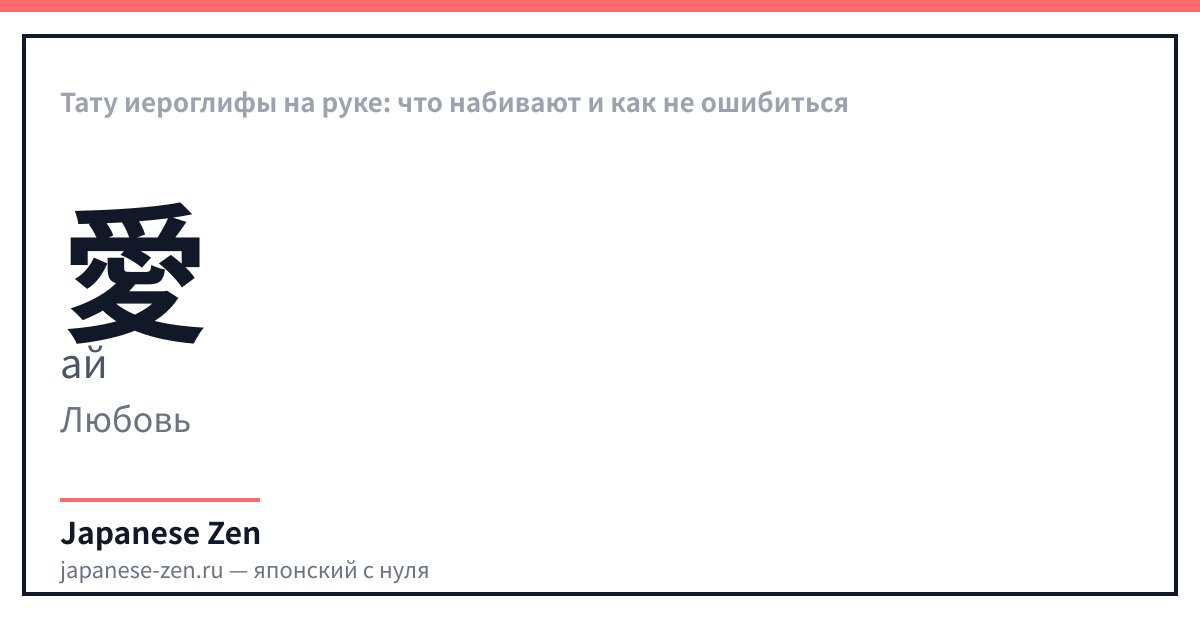
A single kanji on the forearm is the most common Japanese motif in Russian tattoo parlors. Let's look at which characters people choose, what they actually mean, and what signs reveal a work done by someone who doesn't understand.
Which kanji are most often tattooed on the arm
| Japanese | Reading | Translation |
|---|---|---|
| 愛 | ai · ai | Love |
| 力 | chikara · chikara | Strength |
| 夢 | yume · yume | Dream, vision |
| 忍 | shinobu · shinobu | To endure, to conceal (the same character appears in the word 'ninja') |
| 心 | kokoro · kokoro | Heart, soul |
| 道 | michi · michi | Path, road |
Why a single character reads strangely
A Japanese person perceives a single kanji as a dictionary entry, not as a statement: 愛 on the forearm looks roughly like the Russian word 'Любовь' without context. A phrase of two or three characters (永遠の愛 — 'eternal love') reads more naturally, but it's also easier to make a mistake in it.
What is most often done wrong
力 — значение: strength, power, ability — онъёми: リョク、リキ、リイ — кунъёми: ちから — 2 штрих(ов). 力 — two strokes, and their order is strict. Click 'Show stroke order': it immediately reveals whether the character was written by someone who understands or copied.
- Mirrored orientation: the design is flipped for composition, and the character becomes meaningless.
- Chinese characters instead of Japanese: 愛 (Japan) and 爱 (simplified Chinese) are different characters.
- Font from an editor: a machine-made 'bold' kanji looks like a price tag label, not calligraphy.
- Stroke order: on the finished work, you can see where a line was drawn in the wrong direction — the character loses its liveliness.
- Translation via an online dictionary: half of the characters have a second meaning that the artist is unaware of.
How to check the design before the session
Find the character in a dictionary by radical and verify the form, watch the stroke order animation, and make sure the word has no second meaning. If there's a phrase, show it to someone who reads Japanese: machine translation in tattoos fails more often than it seems.
FAQ
- Which kanji are most often tattooed on the arm?
- 愛 (love), 力 (strength), 夢 (dream), 忍 (endurance), 心 (heart), 道 (path). These are single characters with broad meanings.
- What is the most common mistake in kanji tattoos?
- Mirrored orientation of the design and Chinese characters instead of Japanese. Both are immediately visible to a native speaker.
- What is better: a single character or a phrase?
- A phrase of two or three characters reads more naturally, but requires verification by someone who knows the language. A single character is safer, but looks like a dictionary entry.
- How to check a kanji before getting a tattoo?
- Verify the form in a dictionary, look at the stroke order, and check the second meaning of the character. Be sure to show the phrase to someone who reads Japanese.
Updated: 2026-07-25