Japanese demon in tattoo: the meaning of oni and its motifs
The Japanese demon, whose meaning in tattoos is read as strength and protection, is 鬼 (oni): a horned giant of Japanese folklore. In irezumi it is dual: on one hand, elemental destructive power; on the other, a talisman that wards off misfortune, because 'evil scares evil.' Separately, there is the 般若 mask — that is not an oni, but a woman who became a demon.
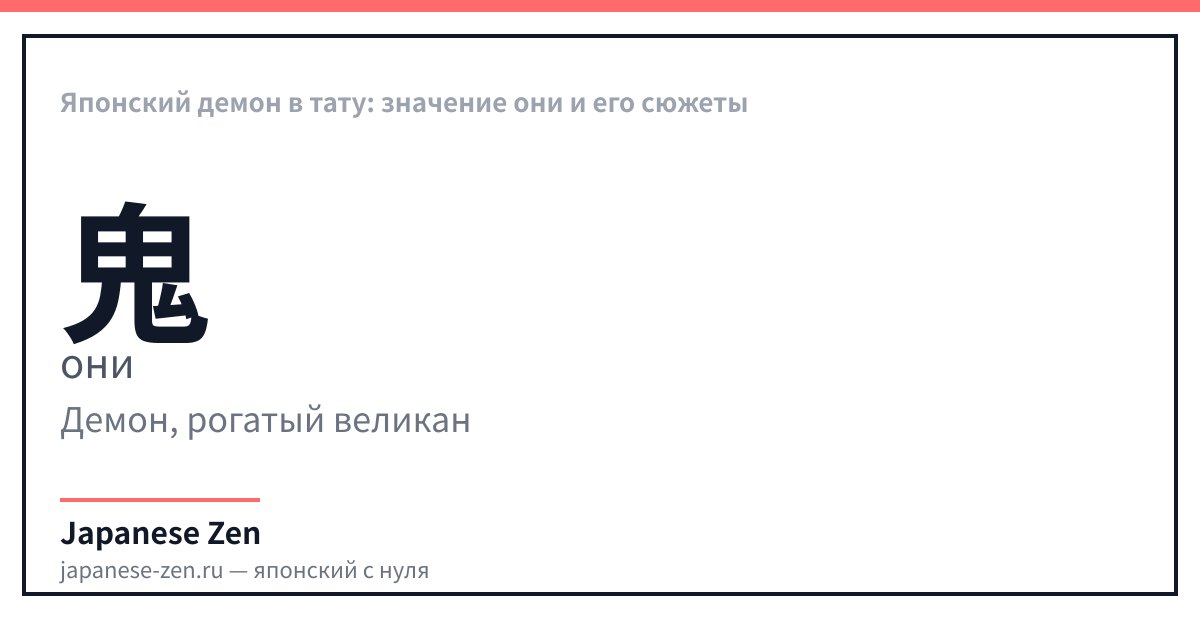
They throw beans at oni during the festival, scare children with them, and also tattoo them on the shoulder as protection. Let's explore where this duality comes from and which demon motifs are considered classic.
Who is oni
| Japanese | Reading | Translation |
|---|---|---|
| 鬼 | oni · oni | Demon, horned giant |
| 鬼退治 | onitaiji · onitaiji | Defeating the demon (motif of the Momotaro tale) |
| 鬼は外 | oni wa soto · oni wa soto | Demons out! (shouted during Setsubun festival) |
| 赤鬼 | akaoni · akaoni | Red oni (embodiment of anger and greed) |
| 青鬼 | aooni · aooni | Blue oni (hatred and malice) |
| 鬼瓦 | onigawara · onigawara | Roof tile with demon face (placed on roofs as a talisman) |
Why the demon works as a talisman
For centuries, 鬼瓦 — roof tiles with a demonic face — have been placed on the ridges of Japanese roofs: they ward off misfortune on the principle of 'evil fears evil.' The same principle explains why oni is appropriate on the body as a protective image, not just as a symbol of aggression.
Classic demon motifs
鬼 — значение: demon, ogre, spirit — онъёми: キ — кунъёми: おに、おに- — 10 штрих(ов). 鬼 — 10 strokes. The same character appears in the title 'Demon Slayer' — 鬼滅の刃.
- Momotaro and the expedition to the demon island — the most recognizable tale of defeating oni in Japan.
- Shuten-dōji, the leader of the demons of Mount Ōe, is a classic motif for large back pieces.
- Demon and monk: the confrontation of strength and spirit, often with a sutra in the composition.
- Red and blue oni set the character by color: anger or hatred.
- What not to do: do not confuse oni with hannya — the latter has a female face and human pain in its expression.
How a Japanese person reads this
For them, oni is primarily a character from fairy tales and the Setsubun festival, not a 'satanic' image. There is no religious challenge in such a design; questions will be raised more by the size and placement of the work than by the motif itself.
FAQ
- What does the Japanese demon mean in a tattoo?
- Elemental strength and simultaneously protection: oni wards off misfortune on the principle of 'evil fears evil.'
- Are oni and hannya the same thing?
- No. Oni is a demon by nature; hannya is the mask of a woman transformed into a demon by jealousy.
- What does the color of oni mean?
- Red — anger and greed; blue — hatred and malice. The color sets the character of the figure.
- Is it true that the demon serves as a talisman?
- Yes, in that logic, 鬼瓦 — roof tiles with a demon face — are placed on roofs to ward off misfortune.
Updated: 2026-07-25