Japanese Tattoos and Their Meanings: A Breakdown of Motifs
Japanese tattoos whose meaning reads like connected text are called irezumi: the dragon — protection and wisdom, the koi carp — perseverance, the hannya — jealousy turned demon, the sakura — the brevity of life, the peony — prosperity and courage. The composition is built from a main motif and a background (waves, wind, clouds), and each element adds to the meaning.
In the irezumi tradition, there are no random details: the background, direction of movement, and the juxtaposition of motifs are read together. Let's break down the main symbols and how they are combined.
What the main motifs mean
| Motif | Meaning | Common companion |
|---|---|---|
| 龍 dragon | protection, wisdom, power over water | wave, tiger |
| 鯉 koi carp | perseverance, overcoming, the path upward | waterfall, wave |
| 般若 hannya | jealousy turned demon; a charm against anger | peony, snake |
| 桜 sakura | beauty and the brevity of life | wind, water |
| 牡丹 peony | prosperity, courage, masculinity | shishi lion, dragon |
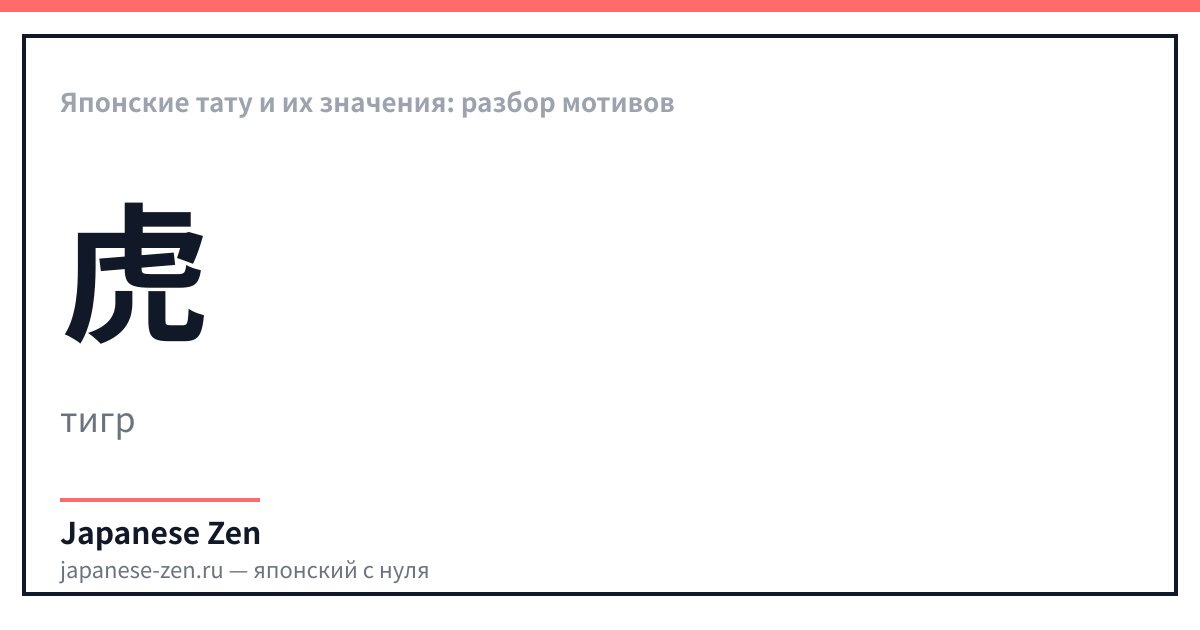
| 虎 tiger | strength of the earth, protection from misfortune | bamboo, wind |
Why the background matters
Waves, wind, and clouds in irezumi are not decoration: they set the environment and tie the elements into one scene. A master of the traditional school first builds the background, then fits the main motif into it — which is why such works are done large and planned as a whole.
What to know about the cultural context
虎 — значение: tiger — онъёми: コ — кунъёми: とら — 8 штрих(ов). 虎 — 8 strokes. The tiger paired with the dragon forms the classic composition 龍虎: earth against heaven.
- In Japan, tattoos are still associated with the yakuza: onsens, pools, and gyms often refuse entry to those with visible ink.
- Attitudes are changing, but slowly: younger people are more relaxed, establishments are not. Cover-up stickers are sold in any shop near hot springs.
- Irezumi is traditionally done by hand — the tebori technique; it is slower than a machine and valued higher.
- The composition is chosen as a whole, not piece by piece: a dragon on a sleeve without a background looks like a cutout from someone else's work.
- What not to do: do not mix Japanese motifs with Chinese elements — a knowledgeable person will notice immediately.
Inscriptions instead of motifs
A kanji or phrase requires more checking than a picture: a character can have a second meaning, and a machine translation of a phrase yields grammatically correct nonsense. Before taking a sketch to a master, it's worth showing the text to someone who reads Japanese.
FAQ
- What do Japanese tattoos mean?
- The dragon — protection and wisdom, the koi carp — perseverance, the hannya — jealousy, the sakura — the brevity of life, the peony — prosperity.
- What is irezumi?
- A traditional Japanese tattoo with a connected narrative: a main motif plus a background of waves, wind, and clouds.
- How are tattoos viewed in Japan?
- With caution because of the association with the yakuza: onsens, pools, and gyms often refuse entry to those with visible ink.
- What is more reliable: a picture or an inscription?
- A picture. An inscription requires verification by someone who reads Japanese: characters can have a second meaning, and machine translation of a phrase yields nonsense.
Updated: 2026-07-25