Demon in Japanese: 鬼 (oni) and 悪魔 (akuma) — what's the difference
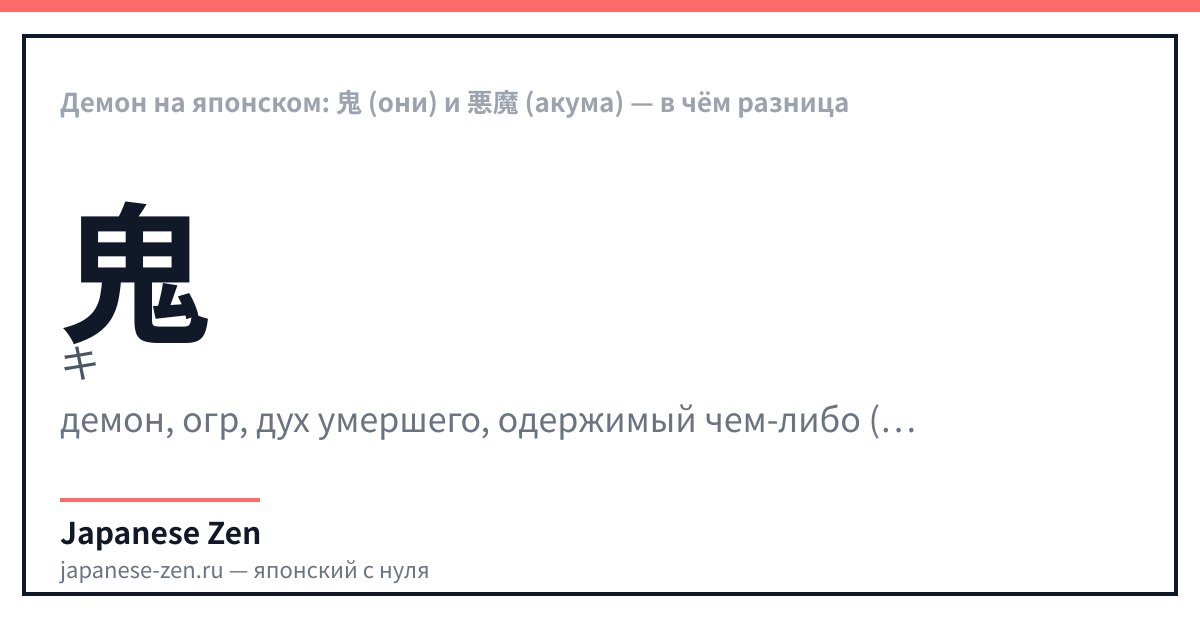
Demon in Japanese is 鬼 (おに, oni), 10 strokes. It's not the same as 悪魔 (akuma) — the Christian devil, a word that entered the language along with translations of religious texts. 鬼 is older and native: a horned character of Japanese folklore, known long before any Christianity. In everyday speech 鬼 lives without any devilry: 鬼ごっこ simply means "tag".
The Japanese "demon" has a surprisingly peaceful everyday life: the same character names a children's game and praise for talent. We won't delve into devilry here — we'll break down the word.
The kanji 鬼: what "demon" looks like and how it reads
鬼 — значение: demon, ogre, spirit of the dead, obsessed with something (in compounds) — онъёми: キ — кунъёми: おに、おに- — 10 штрих(ов).
On-reading "ki" and kun-reading "oni" — where each is used
鬼 existed in Chinese writing many centuries before the Japanese folklore about horned giants. The kun reading "oni" is used when talking about the character itself: 鬼 lives in fairy tales, on masks, in the name of the game of tag. The on reading "ki" appears in Sino-Japanese compounds where the meaning is no longer about a folkloric being but about intensity or obsession: 鬼才 (kisai) — a genius, almost supernatural talent.
oni, akuma, yokai — three different beings
| Japanese | Reading | Translation |
|---|---|---|
| 鬼 | oni · oni | Demon, ogre |
| 悪魔 | akuma · akuma | Devil (a Christian concept borrowed along with translations) |
| 妖怪 | yōkai · yōkai | Supernatural being (a general term; oni is just one type) |
| 鬼ごっこ | onigokko · onigokko | Tag (an ordinary children's game with no mysticism) |
| 鬼才 | kisai · kisai | Genius, phenomenal talent |
| 鬼のように | oni no yō ni · oni no yō ni | Very, extremely (an intensifier, like "insanely" in English) |
Where 鬼 lives without any devilry
鬼 (oni) is a native Japanese concept, while 悪魔 (akuma) is a calque of the Christian devil; the word took hold along with translations of Christian texts: its characters mean "evil" and "demon, nightmare". 妖怪 (yōkai) is a broader term than both: any supernatural being of Japanese folklore, of which oni is just one type. Yet in everyday speech 鬼 is almost always harmless: 鬼ごっこ (onigokko) is ordinary children's tag, and 鬼のように (oni no yō ni) simply means "very, extremely", as in 鬼のように忙しい — "busy as crazy".
Write 鬼 yourself
Trace the strokes of 鬼 in the correct order — from the horns to the tail.
FAQ
- How do you say "demon" in Japanese?
- 鬼 (おに, oni) is a native Japanese word, 10 strokes. The Christian concept of the devil is conveyed by another word — 悪魔 (akuma).
- How is 鬼 different from 悪魔?
- 鬼 is a native Japanese folkloric character, a horned giant from fairy tales and festive rituals. 悪魔 is a calque of the Christian devil; the word entered the language along with translations of the Bible and religious texts.
- Is 妖怪 the same as 鬼?
- No, 妖怪 is a broader concept: any supernatural being of Japanese folklore, from the fox shapeshifter to the water kappa. 鬼 is just one type of yokai, though the most recognizable.
- What does 鬼ごっこ, the children's game of tag, have to do with it?
- The name literally means "demon game": one player becomes the "oni" and chases the others. There's no mysticism in the game — it's the Japanese equivalent of ordinary tag.
- What does the word 鬼才 mean?
- "A genius, almost superhuman talent" — that's how people talk about directors, writers, or athletes whose abilities seem impossible for an ordinary person. There are no demons here, only praise.
- Is 鬼 read as "oni" or "ki"?
- Both readings are correct in different cases. When talking about the character itself — "oni": 鬼ごっこ, 鬼の面. In Sino-Japanese compounds where the meaning shifts toward intensity — "ki": 鬼才, 鬼籍 (kiseki, "list of the dead").
Sources
Updated: 2026-09-09