Darkness in Japanese: 闇 (yami) — writing, readings and words
Darkness in Japanese is 闇 (yami), 17 strokes. The character is built from "gate" 門 and "sound" 音: a darkness where you can't see, but can hear — that is, darkness perceived through hearing rather than empty blackness. This distinguishes 闇 from 暗い "kurai" (simply "dark", a matter of lighting) and from 黒 "kuro" (the color black, a property of an object). 闇 is a noun with an almost mystical nuance; kurai and kuro are neutral everyday words.
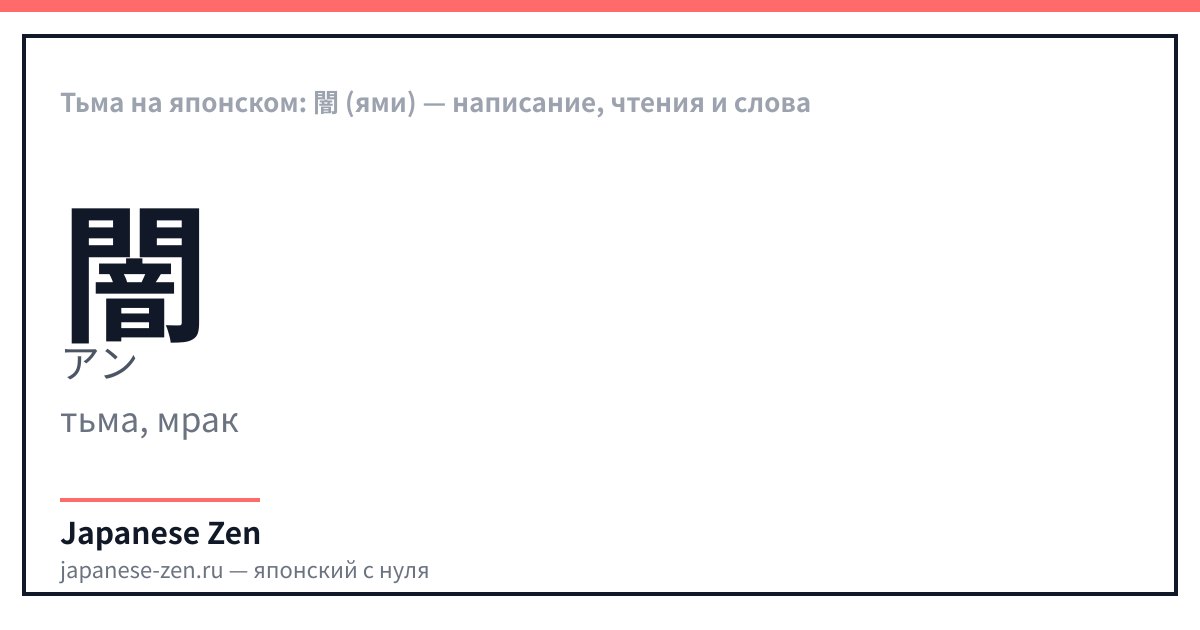
Japanese darkness has a sound. The character 闇 is built from "gate" and "sound": behind the closed door you can't see anything, but you can hear something.
What the character 闇 is made of
闇 — значение: darkness, gloom — онъёми: アン、オン — кунъёми: やみ、くら.い — 17 штрих(ов).
Gate and sound inside one kanji
The outer frame 門 means "gate", and inside stands 音 "sound", and together they form an image: a closed gate behind which nothing can be seen, but something can be heard. Strictly by the structure of the character, 音 is phonetic: it determines the reading "an", not the meaning. But the image turned out to be so fitting that both dictionaries and textbooks repeat it. This is a noun; it has no direct adjective form — you cannot say "dark" with 闇, you need another word.
Yami, kurai and kuro — darkness, dark and the color black
| Japanese | Reading | Translation |
|---|---|---|
| 闇 | yami · yami | Darkness, gloom (noun, tangible darkness) |
| 暗い | kurai · kurai | Dark (adjective about lighting) |
| 黒 | kuro · kuro | Black (color of an object, not about light) |
| 闇市 | yamiichi · yamiichi | Black market (literally "market of darkness") |
| 真っ暗 | makkura · makkura | Pitch darkness (emphatic form of 暗い) |
| 闇夜 | yamiyo · yamiyo | Moonless dark night |
When a Japanese speaker needs specifically 闇
暗い describes a lack of lighting: the room is dark because the light wasn't turned on. 黒 is a matter of color: a black cat, black hair — it has nothing to do with darkness. 闇 is chosen when what is needed is not a characteristic but darkness itself — as a phenomenon or an image. Hence the figurative meanings too: 闇市 "black market", that is, a place without rules, and 心の闇 "darkness in the heart" — a phrase from literature and songs about the hidden side of a person.
Write 闇 yourself
17 strokes: first the "gate" frame, then the "sound" character inside.
FAQ
- How do you say "darkness" in Japanese?
- 闇 (yami), 17 strokes. The character is built from "gate" and "sound" — an image of darkness in which nothing can be seen, but something can be heard.
- How does 闇 differ from 暗い?
- 闇 is a noun, darkness as a phenomenon or image in its own right. 暗い is an adjective; it simply describes a lack of lighting: the room is dark, the street is dark. You cannot say "dark room" with 闇 — the grammar won't allow it.
- Why does the character 闇 combine "gate" and "sound"?
- The outer frame 門 is "gate", inside 音 is "sound": together they produce the image of a closed door behind which nothing can be seen, but something can be heard. Etymologically, 音 here is phonetic; it gives the reading "an". But the coincidence of form and meaning turned out to be so apt that the character has long been explained this way.
- Are darkness and the color black the same thing in Japanese?
- No. 黒 (kuro) is a characteristic of an object's color: a black car, black hair. 闇 has nothing to do with color — it is about the absence of light. The two ideas get mixed up easily enough, but in Japanese they belong to different categories of words.
- What does 闇市 mean?
- Literally "market of darkness" — a historical term for the black market, especially postwar trade that bypassed price controls. The word is still alive today in the meaning "illegal trade", transferring the image of darkness to concealment from the law.
Sources
Updated: 2026-09-09