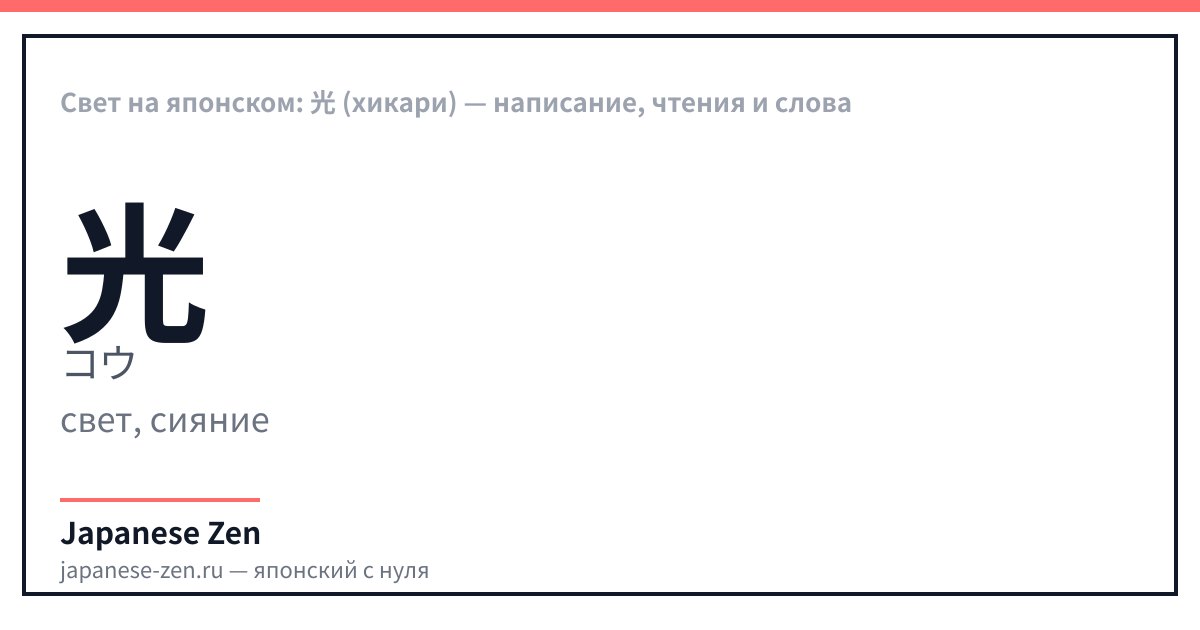
Light in Japanese: 光 (hikari) — writing, readings and words
Light in Japanese is 光 (hikari), 6 strokes. It is light as a natural phenomenon: a sunbeam, the glow of a star, a reflection on water. The light of a lamp is called differently — 明かり (akari) — and the act of turning on a light is described with the word 電気 (denki), 'electricity', which in everyday life is literally 'turned on' and 'turned off'. Three words for what at first glance seems the same phenomenon are in fact not interchangeable.
Asking a Japanese person where the 光 is sounds odd if you mean the switch in the hallway — there it's 電気. The word 'hikari' reserves Japanese for another kind of light: the kind that pours, not the kind that comes on with a click.
Structure of the character 光
光 — значение: light, radiance — онъёми: コウ — кунъёми: ひか.る、ひかり — 6 штрих(ов).
Fire over a walking person
In the upper part of the character 光 one can discern the element 'fire', in the lower part — the figure of a walking person: the ancient drawing conveyed light as something carried or moving together with its source. The kun reading 'hikari' is used for the word as a whole, the on reading 'kō' — in compound terms like 光線 (kōsen, 'ray of light'). On its own, without an ending, the character is hardly ever pronounced: it is either part of the word 光る 'to shine', or the noun 光.
Hikari, akari and electricity — three different lights
| Japanese | Reading | Translation |
|---|---|---|
| 光 | hikari · hikari | Light as a phenomenon (sun, stars, radiance) |
| 明かり | akari · akari | Lamp light, a small flame (man-made, warm light) |
| 電気 | denki · denki | Electricity, electric light (what you turn on and off) |
| 光る | hikaru · hikaru | To shine, to glitter |
| 日光 | nikkō · nikkō | Sunlight (on reading in a compound word) |
| 光陰 | kōin · kōin | Time, fleeting days (literally 'light and shadow', a literary word) |
Light that you turn on, and light that simply is
電気をつける (denki o tsukeru) means 'to turn on the light' — literally 'to attach electricity'. Here we are talking about a light bulb and a switch, not a natural phenomenon. 明かり is cozier and older: it refers to the flame of a candle, a lit window in the evening, any source that provides illumination. And 光 stands apart — it is about light itself as a physical phenomenon, which is not turned on or off, but seen or caught.
Write 光 yourself
6 strokes: the upper element 'fire', then the lower part — the figure of a person.
FAQ
- How do you say 'light' in Japanese?
- If it is light as a phenomenon — sunlight, starlight — then 光 (hikari). If it is the light of a lamp — 明かり (akari). If you mean what you turn on with a switch, people more often say 電気 (denki).
- How does 光 differ from 明かり?
- 光 is light as a physical phenomenon: a ray, a radiance, a reflection, something that exists independently of people. 明かり is a specific source of illumination: the flame of a candle, a lit window, a lamp in a room. One is about the nature of light, the other about its source in everyday life.
- Why do people say 'turn on' electric light rather than 'light' it?
- The set expression 電気をつける literally means 'to attach electricity' — the verb つける describes a mechanical action with a switch. This is a purely everyday phrase about electricity, not about light as such, which is why it does not combine with the word 光.
- Is 光 used as a name?
- Yes, 光 (Hikari) is a common name, usually feminine, but it also occurs as part of masculine names. The same word also names one of the types of Shinkansen — 'Hikari', second in speed after 'Nozomi'.
- How else is the character 光 read besides 'hikari'?
- The on reading is 'kō'; it appears in words like 日光 (nikkō, 'sunlight') and 光線 (kōsen, 'ray'). On its own, without endings, 'kō' is almost never used separately.
Sources
Updated: 2026-09-09