Child in Japanese: 子供 (kodomo) — writing, readings, and words
Child in Japanese is 子供 (kodomo): boy is 男の子 (otoko no ko), girl is 女の子 (onna no ko). The second character in the word, 供, is often taken to mean "companion," though it functions as a plural suffix rather than a separate word with meaning. The same root 子 appears in female names like 花子 — "child of flowers."
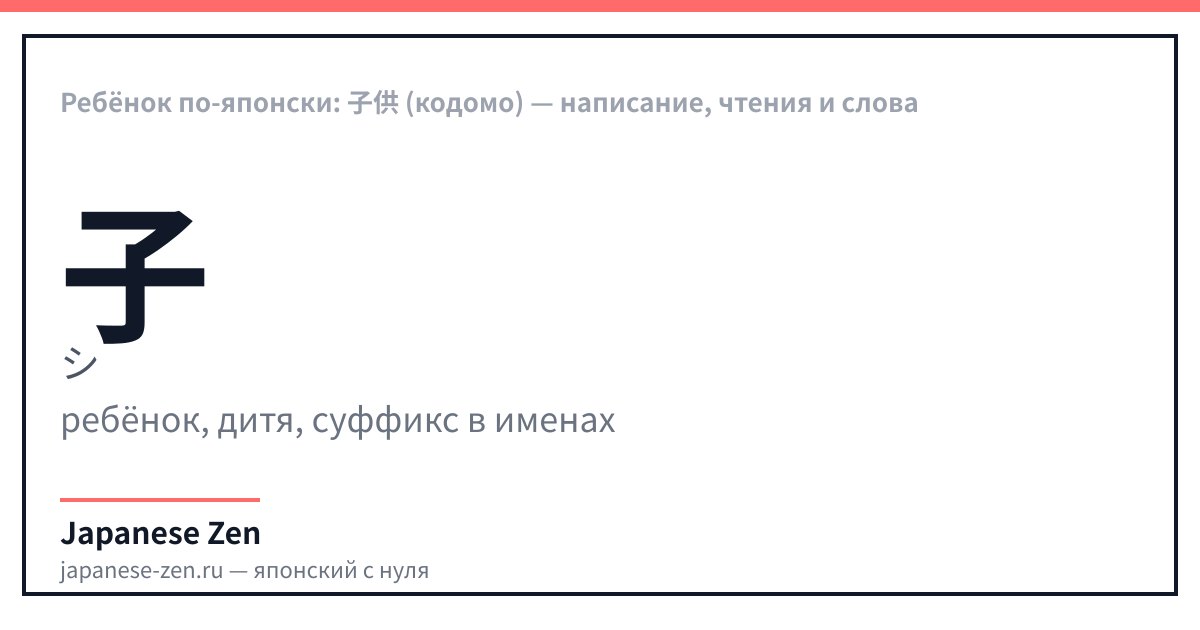
子供 is so often broken down into "child" and "companion" that the tale about the word's origin has spread through textbooks. The real story is calmer and concerns not meaning but sound.
Three strokes — a portrait of a baby
子 — значение: child, kid, suffix in names — онъёми: シ、ス、ツ — кунъёми: こ、-こ、ね — 3 штрих(ов). 3 strokes. Click "Show stroke order" — the strokes will follow as in handwriting.
From a pictogram of a baby to three strokes
子 was drawn as a baby in swaddling clothes: a large head and outstretched arms can still be read in the upper part of the character if you look closely. Three strokes make it one of the simplest kanji in the language, and one of the first learned in Japanese school. The kun reading こ works both as "child" and as a suffix in words and names; the on reading し almost always hides in borrowings from Chinese.
子供 — not "child and companion"
| Japanese | Reading | Translation |
|---|---|---|
| 子供 | kodomo · kodomo | Child (of any gender) |
| 男の子 | otoko no ko · otoko no ko | Boy |
| 女の子 | onna no ko · onna no ko | Girl |
| 子供たち | kodomotachi · kodomotachi | Children (plural) |
| 花子 | Hanako · Hanako | Hanako (female name, "child of flowers") (a popular Japanese name of the last century) |
| 子供っぽい | kodomoppoi · kodomoppoi | Childish, infantile (about an adult's behavior) (about an adult's behavior, not age) |
| お子さん | okosan · okosan | Your child (polite, about someone else's) (polite, about someone else's child) |
What 供 in the word 子供 actually means
The second character in 子供 is 供, the same as in the word お供 "attendant, companion." At first glance it seems that "child" literally means "child-companion" — a beautiful version that has spread through textbooks. Linguists do not support it: 供 in 子供 works as a plural suffix that came to the word by sound, not by meaning — like an ending, not a separate word. Politeness, by the way, works here as with other relatives: about one's own child one says simply 子供, about someone else's — お子さん.
Write 子 yourself
Trace the character along the guides — the system will evaluate each stroke.
FAQ
- How do you say child in Japanese?
- 子供 (kodomo). Boy is 男の子 (otoko no ko), girl is 女の子 (onna no ko). To politely refer to someone else's child, say お子さん.
- What does the character 供 in the word 子供 mean?
- On its own 供 means "to accompany, to attend," but in 子供 it works as a plural suffix, not by meaning. The "child-companion" version is beautiful, but linguists do not confirm it.
- Why does the name 花子 contain the kanji for "child"?
- 花子 (Hanako) literally means "child of flowers." The suffix 子 was widely used in female names roughly from the Meiji era to the Showa era — Yoko, Yumiko, Hanako — and today such an ending is immediately read as feminine.
- How do you affectionately address a child in Japanese?
- Most often the suffix -chan is added to a name or word: Yuki-chan, ぼうやちゃん. A detailed breakdown of this suffix is on the separate page about ちゃん.
- What does the word 子供っぽい mean?
- "Childish, infantile" — this is said not about children but about an adult who behaves childishly. The suffix っぽい adds a shade of "similar to" to a noun.
- Up to what age is a person called 子供 in Japanese?
- There is no strict boundary: the word is opposed to 大人 "adult" more by meaning than by passport. A schoolchild will definitely be called 子供, but about a high-school teenager people already argue, using the word with reservations.
Sources
Updated: 2026-09-09