What does "chan" mean in a Japanese name
"Chan" in a Japanese name means an affectionate address: the suffix ちゃん turns Hanako into "Hana-chan." It is used for girls, babies, pets, and very close people. It is more correctly read as "chan": the Japanese ちゃ is softer than the English "cha." The neutral equivalent is "san," and for boys, "kun."
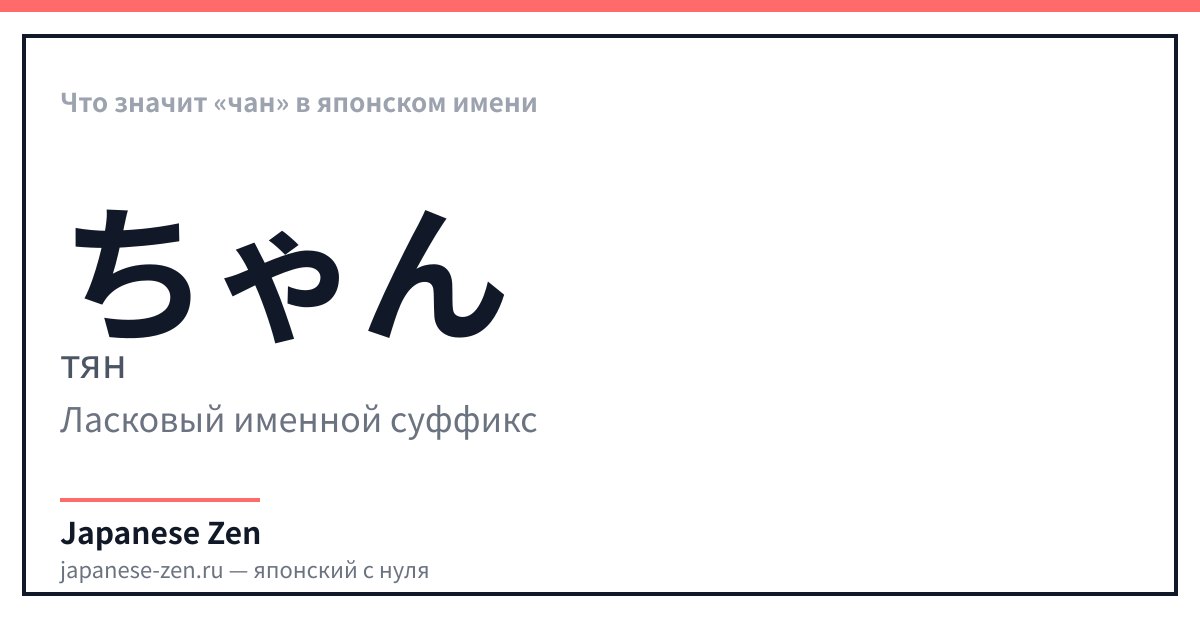
ちゃん was born from a child's attempt to pronounce the adult "san": the child's version came out soft and blurred, and this became established as a sign of tenderness. Therefore, the suffix works like a diminutive — and that is why, for an adult man, it sounds either cute or insulting, with no middle ground.
What does the suffix "tyan" mean
ちゃん is added to a name when you want to express warmth: for girls, younger sisters, female friends, babies, and animals. Often it is used together with a shortened name: Takako → Tako-chan, Keisuke → Kei-chan. An adult woman in the office will be "-san," while her daughter will be "-chan."
Which is correct: "chan" or "tyan"
In Japanese, this is the syllable ちゃ — somewhere between the English "tya" and "cha." In Hepburn romanization, it is written as "cha"; in some systems, it appears as "tya." Both variants refer to the same suffix, but in books and textbooks you will encounter "chan."
How "tyan" differs from "kun," "san," and "sama"
| Suffix | Reading | To whom | Nuance |
|---|---|---|---|
| ちゃん | -tyan | girls, babies, close people, pets | tenderness, diminutive |
| 君 | -kun | boys, younger men | friendly, slightly condescending |
| さん | -san | any adult | neutral politeness |
| 様 | -sama | client, letter recipient | high respect |
| たん | -tan | cute characters, memes | deliberately childish, internet slang |
When "tyan" sounds offensive
- To an adult man from a stranger — condescending, as if he were five years old.
- To a colleague at work, if you are not close — familiarity that everyone will notice.
- To a boss or client — unacceptable, only "-san" and "-sama" here.
- However, elderly people calmly call young female employees "-tyan": from their position, it is kind.
How it sounds
| Japanese | Reading | Translation |
|---|---|---|
| ちゃん | chan · tyan | Affectionate name suffix |
| お姉ちゃん | onēchan · one:tyan | Older sister (affectionate) (the suffix also attaches to kinship terms) |
| 赤ちゃん | akachan · akatyan | Baby (here ちゃん has become part of the word) |
| おばあちゃん | obāchan · oba:tyan | Grandmother (affectionate) |
FAQ
- What does "chan" at the end of a Japanese name mean?
- It is the affectionate suffix ちゃん: Hanako-chan means "Hanochka." It is used for girls, babies, close people, and pets. It shows tenderness and a close distance.
- Which is correct — "chan" or "tyan"?
- The Japanese syllable ちゃ sounds between "tya" and "cha." In Hepburn romanization, it is written as "cha"; in some systems, it becomes "tya." They are the same suffix.
- Can you say "tyan" to a boy?
- To a little boy, yes — it is common in the family. To a teenager or adult man from strangers, no: it will sound like addressing a child. For them, there is "-kun."
- How does "tyan" differ from "san"?
- "San" is neutral politeness, safe with anyone. "Tyan" is warmth and closeness, requiring the right to such a distance. With a stranger, always "-san."
- What about "tan" on the internet?
- たん is a distorted ちゃん, deliberately childish. It is used in memes and for mascot characters; in normal speech it sounds abnormal and usually humorous.
Updated: 2026-09-14