What does "kun" at the end of a name mean in Japanese
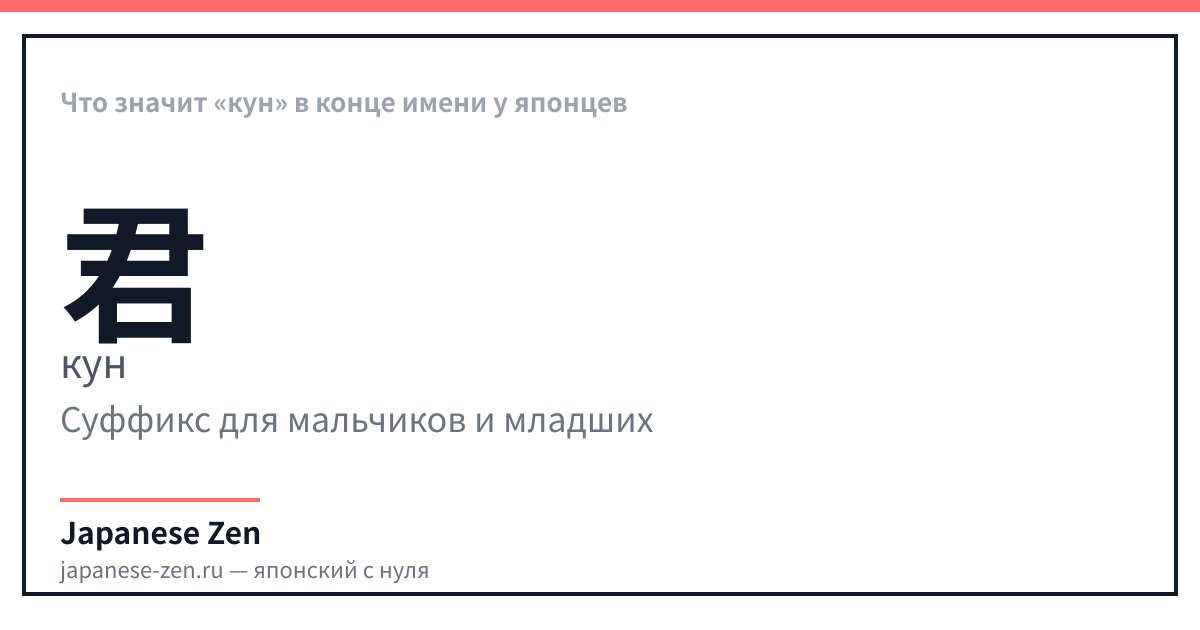
"Kun" (君) at the end of a name means a friendly address to a boy or young man: Tanaka-kun — "Tanaka-pal." It is softer than neutral "san" and indicates that the speaker is older or on equal terms. Girls are called "chan," adults and strangers — "san," teachers are addressed as "sensei."
A Japanese person cannot simply call someone by name: without a suffix, the name sounds bare, like addressing a criminal in court. Therefore, something is always attached to the surname — and by that "something," you can hear the entire distance between people more accurately than by words.
What does the suffix "kun" mean
-kun (君) is added to the name or surname of a boy, classmate, or junior male colleague. It indicates two things at once: the relationship is warm and the speaker is not lower in status. Therefore, a teacher calls a student "Yamada-kun," while a student calls a teacher "Yamada-sensei," but never the other way around.
Who can be called "kun" and who cannot
- Can: schoolboy, student, junior male employee, childhood friend.
- Sometimes can: a girl — if she is a junior colleague in a formal setting, it is emphatically neutral, without flirtation.
- Cannot: boss, client, elderly person, teacher — it will sound condescending.
- Dangerous: an unfamiliar man of your own age — it will come across as familiarity.
All Japanese name suffixes: how "kun" differs from the rest
| Suffix | Reading | To whom | Nuance |
|---|---|---|---|
| 君 | -kun | boys, younger men, friends | warmth and on equal terms or from above |
| さん | -san | almost any adult | neutral politeness by default |
| ちゃん | -chan | girls, small children, close ones | tenderness, diminutive |
| 様 | -sama | clients, gods, letter recipient | high respect |
| 先生 | -sensei | teacher, doctor, writer | respect for the profession |
| 先輩 | -senpai | senior at school or work | recognition of seniority |
| no suffix | yobisute | closest ones | intimacy or rudeness |
How it sounds in anime
When a heroine suddenly switches from "Tanaka-kun" to just "Tanaka," that is a plot moment: removing the suffix means declaring closeness. The reverse move is also telling: if a friend suddenly starts calling you "-san," something has broken between you.
How to pronounce it
| Japanese | Reading | Translation |
|---|---|---|
| 君 | kun · kun | Suffix for boys and younger people (the same character is read "kimi" — poetic "you") |
| さん | san · san | Neutral polite suffix |
| ちゃん | chan · chan | Affectionate suffix |
| 先輩 | senpai · senpai | Senior comrade |
FAQ
- What does "kun" at the end of a name mean?
- It is a friendly suffix for boys and young men: "Tanaka-kun" — roughly "Tanaka-pal." It shows a warm attitude and that the speaker is on equal terms or older.
- Can you call a girl "kun"?
- Sometimes yes — in a formal setting, it is used to address a junior female colleague, emphatically neutral. But in everyday life, "chan" or "san" are used for girls, and "kun" would sound strange.
- How is "kun" different from "san"?
- "San" is polite neutrality, suitable for strangers and elders. "Kun" is closeness plus a signal that you are not younger. You cannot call a boss "kun," but you can call them "san."
- Why is 君 read sometimes "kun" and sometimes "kimi"?
- These are different readings of the same character: as a suffix it is read "kun," as a standalone word — "kimi" and means "you" with a poetic nuance (hence the titles of songs and anime).
- What does addressing without a suffix mean?
- This is called "yobisute" and is only acceptable with very close people — in the family, between long-time friends, between a couple. With a stranger, it sounds rude, like a shout.
Updated: 2026-07-25