What does "urusai" mean in Japanese
"Urusai" (うるさい) means "noisy, annoying," and in conversation, it's a sharp "shut up!" It's an adjective, not a command: 音がうるさい — "the sound is too loud." Shouted alone, it sounds rude, so in anime it's used to brush off an annoying interlocutor.
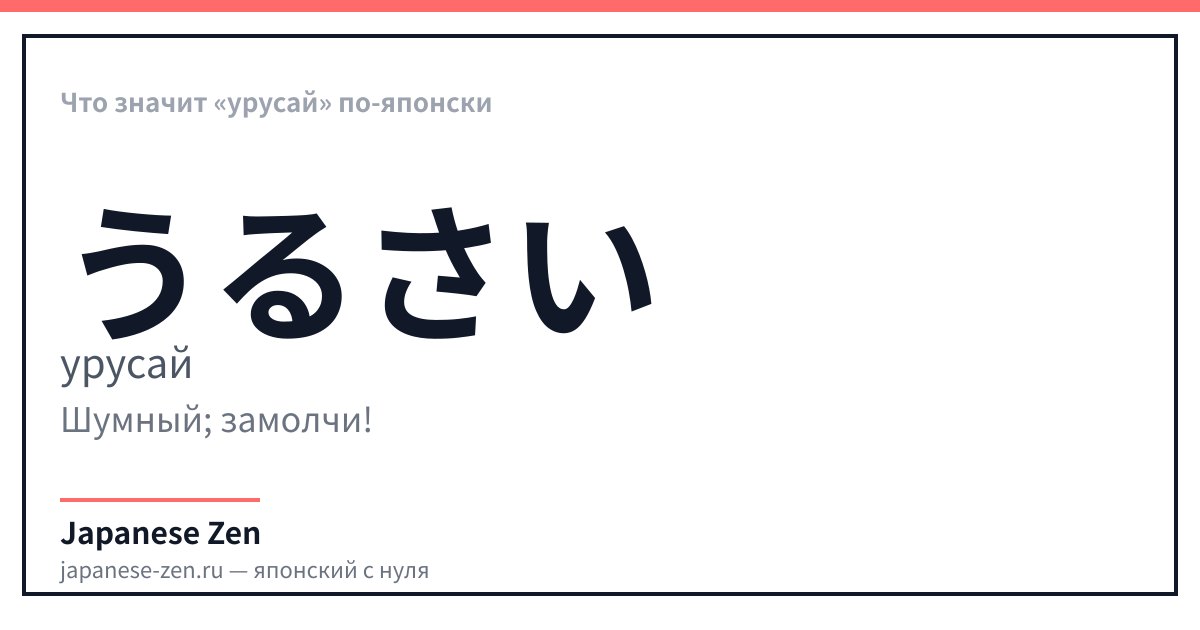
One word that subtitles translate in ten different ways — from "noisy" to "get lost." Let's break down why there's such a range.
What does "urusai" mean and how is it used
| Japanese | Reading | Translation |
|---|---|---|
| うるさい | urusai · urusai | Noisy; shut up! |
| 音がうるさい | oto ga urusai · oto ga urusai | The sound is too loud (neutral usage) |
| うるさいな | urusai na · urusai na | You're really annoying (with a grumbling tone) |
| 静かにして | shizuka ni shite · shizuka ni shite | Please be quiet (polite replacement) |
| 黙れ | damare · damare | Shut up (direct rudeness) |
Not only about sound
うるさい describes any annoyance: 味にうるさい — "picky about taste," meaning a person who fusses over food. In this sense, the word is even complimentary — a connoisseur.
When you shouldn't say it
- To a stranger — no: it's harsh, not a request. Say 静かにしてください.
- In anime, うるさい is shouted constantly because it's quick and emotional — in real life, you only say it to close people.
- A grumbling うるさいな between friends sounds almost affectionate; it's all about intonation.
- Don't confuse it with 面倒くさい (mendōkusai) — "can't be bothered": the words have a similar ending, but the meaning is different.
- What not to do: don't automatically translate it as "shut up" — half the usages are about volume, not about a person.
Say うるさい out loud — the intonation decides whether it comes out as a grumble or as rudeness.
FAQ
- What does "urusai" mean?
- うるさい — "noisy, annoying." Shouted alone, it works as a sharp "shut up."
- How rude does urusai sound?
- Between close people — almost grumbling; to a stranger — noticeably harsh. A polite replacement: 静かにしてください.
- Why do they say 味にうるさい?
- "Picky about taste": the word describes not only sound but also annoying fussiness, and here it sounds like expertise.
- How do you write "urusai" in Japanese?
- In kana as うるさい, with the kanji 煩い. In everyday texts, it's written in kana.
Updated: 2026-07-25