Sister in Japanese: 姉 (ane) and 妹 (imōto) — older and younger
Sister in Japanese is not one word but a choice between two: 姉 (ane) for an older sister and 妹 (imōto) for a younger one. There is simply no general word for "sister" in the language — the grammar forces you to state age right away. The form also changes depending on whether you are talking about your own sister or someone else's: お姉さん is more polite than 姉.
In English, "sister" does not ask whether she is older or younger. In Japanese you cannot avoid the question: age is built right into the word, and without it you simply cannot build the phrase.
Eight strokes and the question of age
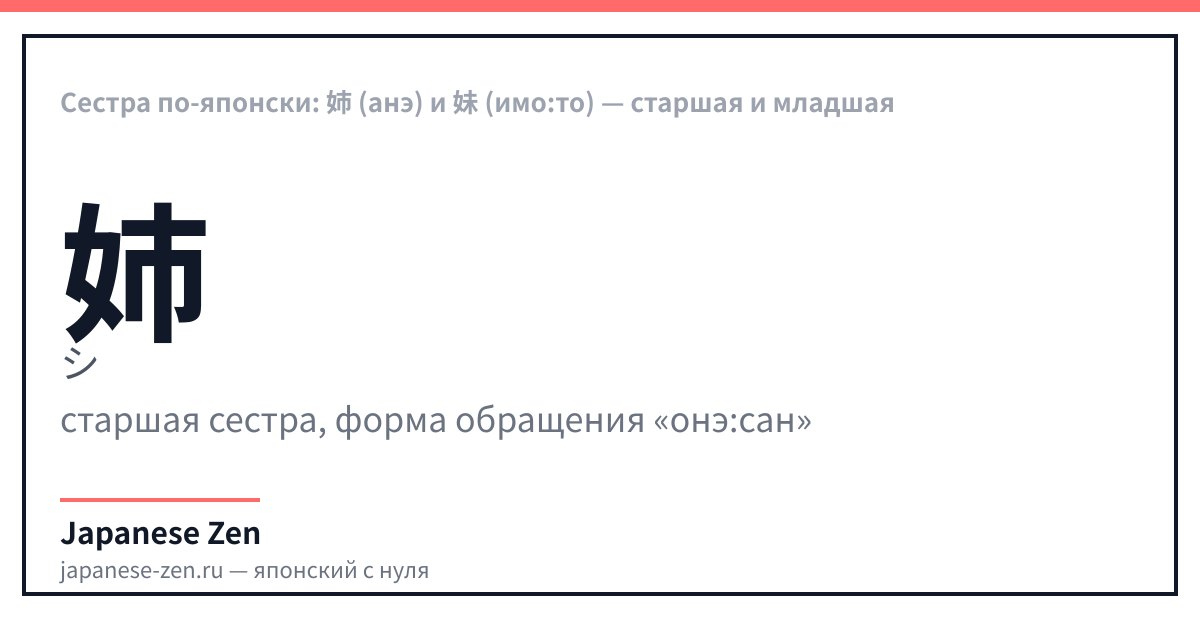
姉 — значение: older sister, the form of address "onēsan" — онъёми: シ — кунъёми: あね、はは — 8 штрих(ов). 8 strokes. Press "Show stroke order" — the strokes will appear as if written by hand.
Why the pair has two kanji at once
The character 姉 is made of two parts: on the left the radical 女 "woman", on the right 市, which here is responsible only for the reading "shi". The kun reading あね (ane) is used when talking about an older sister within one's own family; the on reading し is almost never used on its own, but appears in compound words. The younger sister has a completely different character and reading — 妹 (imōto); there is no common kanji for "sister" in general in the language.
Older, younger, and no other way
| Japanese | Reading | Translation |
|---|---|---|
| 姉 | ane · ane | Older sister (one's own, to outsiders) (used about one's own sister when speaking to outsiders) |
| お姉さん | onēsan · onēsan | Older sister (polite; someone else's) (polite, both about someone else's sister and when addressing one's own) |
| お姉ちゃん | onēchan · onēchan | Big sis (affectionate family address) (family, affectionate) |
| 妹 | imōto · imōto | Younger sister (one's own) (about one's own younger sister) |
| 妹さん | imōto-san · imōto-san | Younger sister (polite; someone else's) (polite, about someone else's younger sister) |
| 姉妹 | shimai · shimai | Sisters (collectively) |
One's own family and someone else's — different words
When talking about one's own older sister to outsiders, one says 姉, without polite additions — as modestly as about oneself. If it is someone else's sister or one is addressing her directly, the form changes to お姉さん, and within the family this same word softens to お姉ちゃん. The same goes for a younger sister: 妹 for one's own, 妹さん for someone else's. A detailed breakdown of in-group and out-group in polite speech is on the page about mother.
Write 姉 yourself
Trace the character along the guides — the system will evaluate each stroke.
FAQ
- How do you say sister in Japanese?
- There is no single translation: an older sister is 姉 (ane), a younger one is 妹 (imōto). The word "sister" in general simply does not exist in Japanese.
- Why can't you just say "sister" in Japanese?
- Japanese kinship vocabulary always encodes relative age: the same is true for brothers (兄 and 弟). This reflects a linguistic habit of marking hierarchy right away, not just kinship.
- How does 姉 differ from お姉さん?
- 姉 is the modest form used for one's own sister when speaking to outsiders. お姉さん is the polite form: it is used to address one's own sister directly or to talk about someone else's.
- What does the address お姉ちゃん mean?
- An affectionate family address to an older sister, with a touch of warmth and closeness — the suffix ちゃん softens the polite form さん. It is also sometimes used for an older girl in the family, not necessarily a blood relative.
- How do you say "sisters" in one word?
- 姉妹 (shimai) — sisters collectively, without specifying which one is older. The same word is used for groups of female performers or "sister" establishments like paired shops.
- How do you say "twin sister" in Japanese?
- 双子の姉 or 双子の妹 — "twin sister", older or younger. Even for twins, Japanese requires you to specify who was born first: 姉 goes to the one who came into the world first, even if only by a minute.
Sources
Updated: 2026-09-09