What does "desu" mean in Japanese
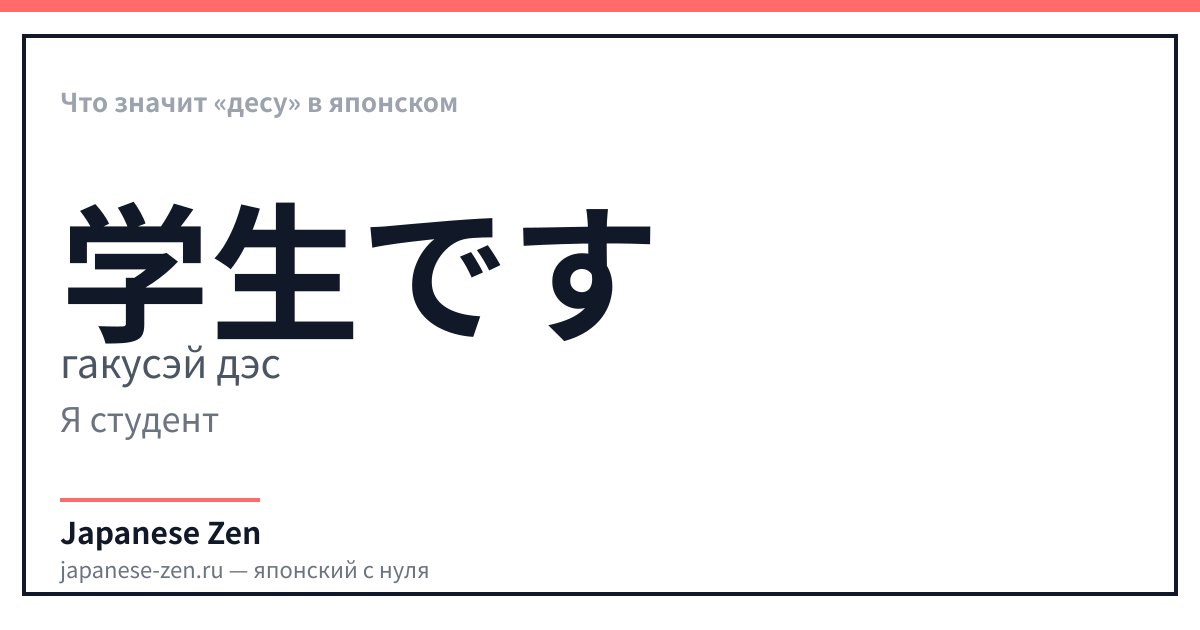
"Desu" (です) is a polite copula meaning "is, am, are" — the Japanese equivalent of the Russian dash in "I am a student": 学生です (gakusei desu). The word itself has no meaning; it sets a polite tone for the entire sentence. The simple colloquial form is だ (da), and questions are formed by adding か: ですか (desu ka). It is pronounced "des", the final "u" is barely audible.
In anime, "desu" is heard in every other phrase, and it is often mistaken for "please" or a cute particle. In reality, it is one of the two pillars of a Japanese sentence: until you understand how です works, any polite phrase will be assembled at random.
What does "desu" mean and how it works
です is placed at the end of a sentence after a noun or adjective. It is not translated as a word — it is translated as politeness: compare "student" and "I am a student, if you please."
| Japanese | Reading | Translation |
|---|---|---|
| 学生です | gakusei desu · gakusei desu | I am a student |
| 元気です | genki desu · genki desu | I'm fine |
| 学生ですか | gakusei desu ka · gakusei desu ka | Are you a student? (か turns the phrase into a question) |
| 学生でした | gakusei deshita · gakusei deshita | I was a student (past tense) |
| 学生ではありません | gakusei dewa arimasen · gakusei dewa arimasen | I am not a student (polite negation; colloquially じゃないです) |
| 学生だ | gakusei da · gakusei da | Student (plain, without politeness) (だ is the plain form of the same copula) |
Why you hear "des" instead of "desu"
Japanese "u" and "i" at the end of a word after voiceless consonants are reduced — that is, pronounced almost silently. Therefore です sounds like "des", ます like "mas", and でした like "deshita" with a very weak "i". Writing "desu" is correct, but pronouncing it with a full "u" is not.
Common mistakes with "desu"
- です is not used after verbs: "I eat" is 食べます (tabemasu), not 食べるです.
- With adjectives ending in -い, です is added but the word itself does not change: 寒いです (it's cold), not 寒いだです.
- You don't need to attach です to every phrase: among friends, the short form is more natural, otherwise speech sounds stiff.
- Adding です at the end of every word for "cuteness" is a trick of anime characters; in real life it looks strange.
- Negation is not formed with です, but with ではありません or colloquial じゃないです.
"Desu ka" — how to ask a question
The word order does not change in a question; only the particle か is added at the end: これは何ですか (kore wa nan desu ka) — "what is this?". Japanese people don't need a question mark; か itself plays that role. In casual speech, か is often omitted and only rising intonation is used.
Say the phrases aloud — the app will check if you are dragging out the final "u".
FAQ
- What does "desu" mean in Japanese?
- です is a polite copula meaning "is, am, are". It has no lexical meaning of its own: it makes the sentence polite.
- What does "desu ka" mean?
- It is a question. The particle か at the end turns a statement into a question: 学生ですか — "Are you a student?".
- How is "desu" different from "da"?
- They are the same copula at different levels of politeness: です is neutral-polite, だ is plain and colloquial.
- How do you write "desu" in Japanese?
- In hiragana: です. The copula has no kanji.
Updated: 2026-09-14