What does “banzai” mean in Japanese and what does it have to do with war
“Banzai” (万歳) in Japanese means “ten thousand years” — a wish for longevity, similar to “long live” or “hurrah.” In war, the expression became known from the cry 天皇陛下万歳 (“ten thousand years to the Emperor”) during attacks. Today, 万歳 is a common celebratory exclamation with raised arms.
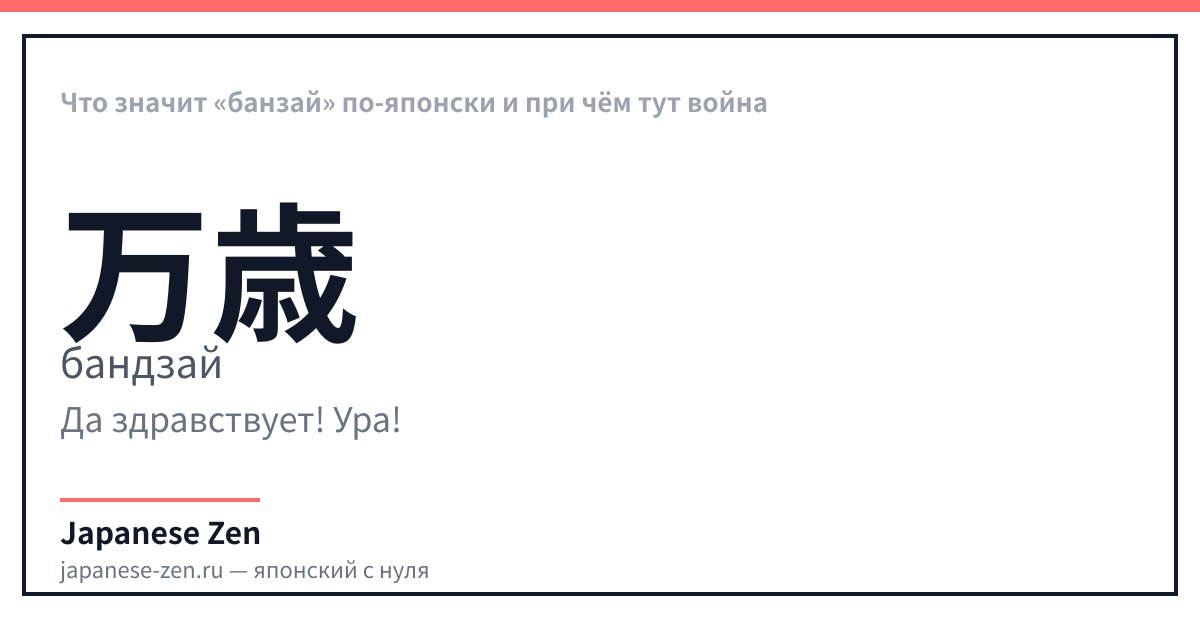
万歳 entered English through war chronicles and sounds to us like a battle cry. In Japan itself, it is what people shout at weddings and when receiving a diploma: three times, with raised arms. The meaning is “live ten thousand years.”
What “banzai” literally means
万 — “ten thousand,” 歳 — “year, years of age.” Together, 万歳 — “ten thousand years,” that is, a wish for a very long life. The expression came from Chinese and was used for centuries as a toast to the monarch, then became a general celebratory exclamation.
What it looks like today
At weddings, graduations, and corporate parties, 万歳 is shouted three times, raising arms up — the ritual is called 万歳三唱 (banzai sanshō). There is no warlike meaning in this: the closest English equivalent is a triple “hurrah.”
Why the word is associated with war
- During World War II, Japanese soldiers went into attack with the cry 天皇陛下万歳 — “ten thousand years to His Majesty the Emperor.”
- American military called such attacks “banzai charge,” and the word entered Western languages with a military connotation.
- In Japanese, the expression remained neutral: the meaning of “long years” has not gone anywhere.
- The same happened with 神風 (kamikaze) — “divine wind”: in Japan it refers primarily to the typhoon that scattered the Mongol fleet, while in the West it means only suicide pilots.
| Japanese | Reading | Translation |
|---|---|---|
| 万歳 | banzai · banzai | Long live! Hurrah! |
| 万歳三唱 | banzai sanshō · banzai sansho: | Triple “banzai” |
| 乾杯 | kanpai · kanpai | Cheers! (toast) |
| おめでとう | omedetō · omedeto: | Congratulations! |
| 頑張れ | ganbare · ganbare | Hang in there! Go for it! |
Say the exclamation out loud
“Banzai” — the “n” before “z” sounds nasal, unlike the ordinary “n” in English.
FAQ
- What does “banzai” mean in Japanese?
- 万歳 — “ten thousand years,” a wish for longevity. In meaning, it is “long live” or “hurrah,” not a battle cry.
- Why is “banzai” associated with war?
- During World War II, soldiers attacked with the cry 天皇陛下万歳 — “long live the Emperor.” Americans called this “banzai charge,” and the word entered Western languages with a military connotation.
- Do people say “banzai” now?
- Yes, at weddings, graduations, and holidays — three times with raised arms. The ritual is called 万歳三唱, and there is no warlike meaning in it.
- How is “banzai” different from “kanpai”?
- 乾杯 (kanpai) is a toast at the table, “bottoms up.” 万歳 is an exclamation of praise without a glass, with raised arms.
Updated: 2026-07-25