What does “nani” mean in Japanese
“Nani” (何) means “what.” 何ですか (nan des ka) — “what is this?”, 何をしていますか (nani o shite imas ka) — “what are you doing?”. The same character is read as “nan” before certain sounds: 何時 (nanji) — “what time is it?”. A sharp なに?! in anime is “what?!” with a challenge.
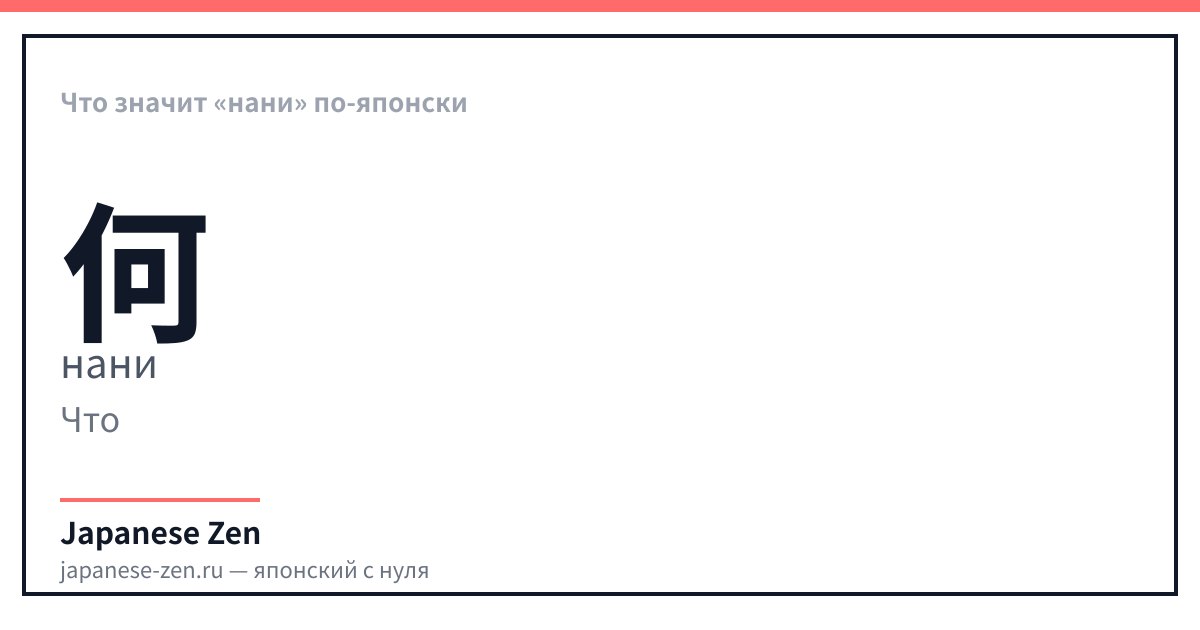
何 is an interrogative word that can change its reading on the fly: “nani” or “nan” depending on what follows. The rule sounds intimidating, but you’ll pick it up by ear within a week: the language naturally chooses whichever is easier to pronounce.
What “nani” means and how it’s read
何 — “what.” It’s read as なに (nani) before a pause and before most syllables, but becomes なん (nan) before the sounds d, t, n, and before counter suffixes: 何ですか (nan des ka), 何人 (nannin, how many people), 何時 (nanji, what time).
Nani or nan — how not to get confused
| Phrase | Reading | Translation |
|---|---|---|
| 何ですか | nan des ka | What is this? |
| 何をしますか | nani o shimas ka | What will you do? |
| 何時ですか | nanji des ka | What time is it? |
| 何人ですか | nannin des ka | How many people? |
| 何が好き | nani ga suki | What do you like? |
| 何度も | nando mo | Many times, again and again |
“Nani?!” from anime
| Japanese | Reading | Translation |
|---|---|---|
| 何 | nani · nani | What |
| 何それ | nani sore · nani sore | What is that? (with a hint of “what nonsense”) |
| 何で | nande · nande | Why, for what reason |
| 何とか | nantoka · nantoka | Somehow, in some way |
| なんでもない | nandemonai · nandemonai | Nothing, it’s nothing |
| 何だと | nan da to · nan da to | What did you say?! (that very indignant “what?!”) |
Why the hero shouts “nani” before an explosion
A sharp なに?! or 何だと?! — is a reaction to surprise: “what?!”, “what?!”. The meme “NANI?!” comes from “Fist of the North Star,” where the line is delivered exactly one second before the opponent realizes they’ve already lost.
Say the question out loud
Both syllables are even, the “i” at the end is not reduced: na-ni.
FAQ
- What does “nani” mean in Japanese?
- 何 (nani) — “what.” It’s a common interrogative word: 何ですか — “what is this?”, 何が好き — “what do you like?”.
- When is it “nani” and when is it “nan”?
- “Nan” — before the sounds d, t, n, and before counter words: 何ですか (nan des ka), 何時 (nanji). In other cases, “nani”.
- Where does the meme “NANI?!” come from?
- From “Fist of the North Star”: the line is shouted by the opponent upon hearing “you are already dead.” In the language itself, it’s just an indignant “what?!”.
- Is it rude to just say “nani”?
- A sharp なに? without a polite form sounds demanding. When talking to someone older, it’s better to use 何ですか (nan des ka) or 何でしょうか.
Updated: 2026-07-25