Angel in Japanese: 天使 (tenshi) — spelling, readings, and words
Angel in Japanese is 天使 (てんし, tenshi): "heaven" plus "messenger." The word is a calque of the Christian concept, entering the language along with translations of Christian texts, and Shinto has no angel of its own. The closest Japanese figure, 天女 (tennyo), a heavenly maiden, is not an angel but a separate character with her own story.
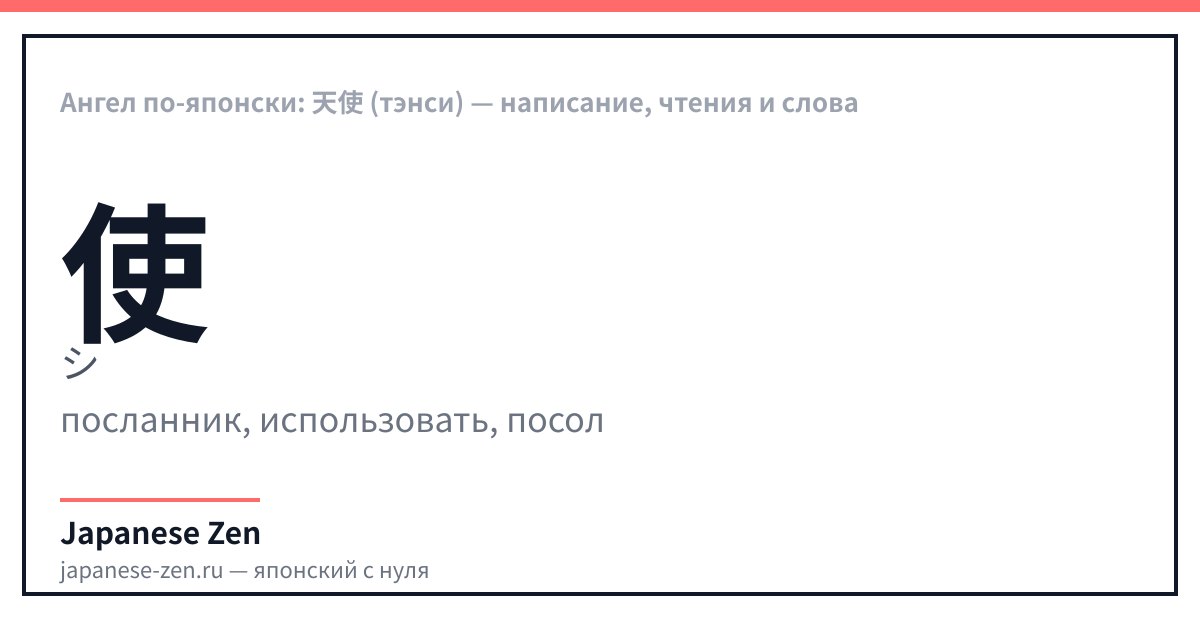
Japanese had no ready word for a being that never existed in its own mythology — it had to be assembled from two others: "heaven" and "one who is sent."
天使 in parts: "heaven" plus "messenger"
使 — значение: messenger, use, envoy — онъёми: シ — кунъёми: つか.う、つか.い、-つか.い、-づか.い — 8 штрих(ов).
How else the second character is read — 使 in other words
天 means "heaven," 使 means "messenger, one sent with an errand." Together 天使 is read "tenshi" and translates literally as "heavenly messenger": it was used to render the Greek "angelos," meaning "messenger" — the very word from which English "angel" also derives. The character 使 keeps the same core meaning in other combinations: 使者 (shisha) — courier, messenger; 大使 (taishi) — ambassador, literally "great messenger." The kun reading of the same character is the verb 使う (tsukau), "to use, to employ."
A calque that Shinto never had
| Japanese | Reading | Translation |
|---|---|---|
| 天使 | tenshi · tenshi | Angel |
| 天使のような | tenshi no yō na · tenshi no yō na | Angelic, like an angel (about a person's character or appearance) |
| 使者 | shisha · shisha | Courier, messenger |
| 大使 | taishi · taishi | Ambassador (literally "great messenger," same character 使) |
| 使う | tsukau · tsukau | To use, to employ (kun reading of the same character 使) |
| 天女 | tennyo · tennyo | Heavenly maiden (not an angel but a separate figure from Buddhist tradition) |
How 天女 differs from an angel
Shinto has no angel of its own — the word 天使 was needed only when Christian texts began to reach Japan and their figures had to be named somehow. The closest-sounding figure, 天女 (tennyo), "heavenly maiden," is neither a borrowing nor an angel: it is a figure from Buddhist and Daoist traditions, a woman with wings or flying on a cloud, known from the legend of the "Feather Robe." They should not be confused, though both fly through the sky.
Trace 使 along the guides
Trace 使 along the guides — the second character of 天使 in action.
FAQ
- How do you say "angel" in Japanese?
- 天使 (てんし, tenshi) — literally "heavenly messenger," a calque of the Christian concept. Shinto had no angel of its own.
- Does Shinto have its own angel?
- No. The word 天使 was needed only when Christian texts reached Japan, and it was assembled from the existing characters for "heaven" and "messenger" — there is no native equivalent in Shinto tradition.
- How does 天女 differ from an angel?
- 天女 (tennyo), "heavenly maiden," is a figure from Buddhist and Daoist traditions, known from the legend of the winged feather robe. Only flight through the sky brings her close to the Christian angel; their origin and role are different.
- How else is the second character of 天使 — 使 — read?
- Its kun reading "tsukau" is the ordinary verb "to use." In combinations with the same character, the on reading "shi" appears: 使者 (shisha, courier), 大使 (taishi, ambassador).
- What does "天使のような" mean?
- "Angelic, like an angel" — said of a kind character, a gentle smile, or a serene appearance, usually of a child.
- Who is 大使 and what does it have to do with "angel"?
- 大使 (taishi) is an ambassador, literally "great messenger." The word carries the same character 使 as 天使 — both describe someone "sent" on an errand, only one from heaven and the other from one country to another.
Sources
Updated: 2026-09-09