Snow in Japanese: 雪 (yuki) — writing, readings and words
Snow in Japanese is 雪 (yuki), a character with the 'rain' radical on top. The kun reading 'yuki' works as a standalone word and in everyday compounds like 雪だるま 'snowman', while the on reading 'setsu' lives in calendar and formal words like 積雪. A telling pair of homographs: 大雪 is read 'ōyuki' — 'heavy snowfall', and 'taisetsu' — the name of a season in the old calendar.
雪見 — 'snow viewing' — follows the same model as the famous hanami, only in winter and without crowds under the trees. The word regularly becomes a name: Yuki is given to both girls and boys.
The kanji 雪: what it is made of and how it is read
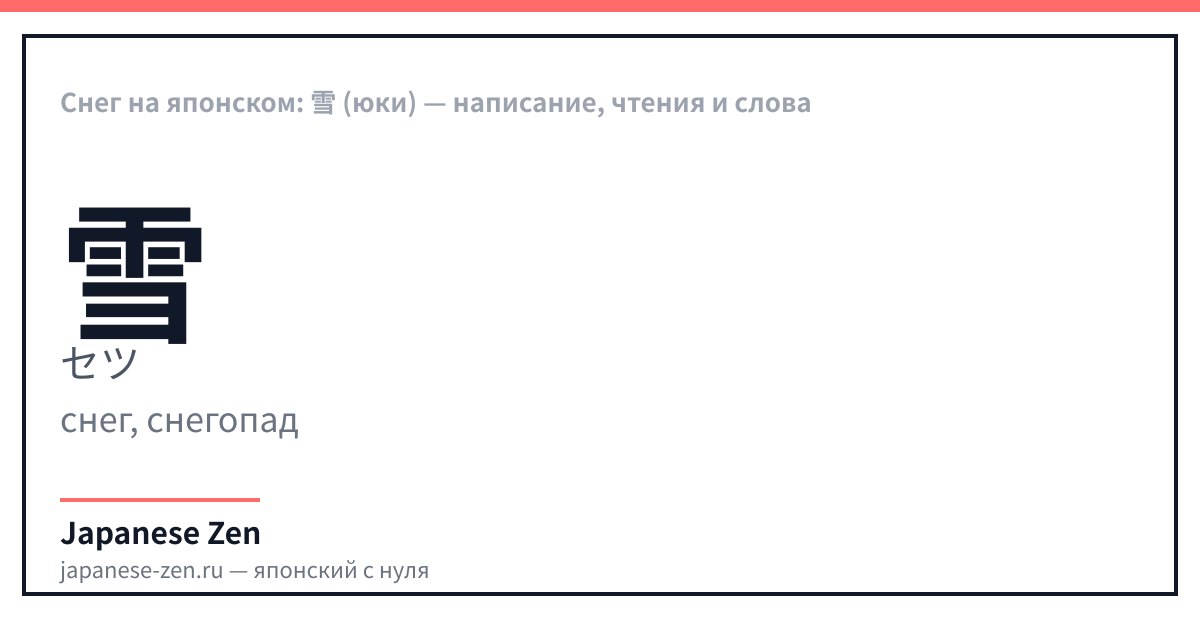
雪 — значение: snow, snowfall — онъёми: セツ — кунъёми: ゆき — 11 штрих(ов).
When it is 'yuki' and when it is 'setsu'
On top of the character stands the radical 雨 'rain', below is an element that in old writing was associated with a broom: in this logic, snow sweeps away rain with cold. The kun reading 'yuki' works as a standalone word and in everyday compounds: 雪だるま 'snowman', 初雪 'first snow'. The on reading 'setsu' appears in formal and calendar words, for example 積雪 'snow cover'. The difference is visible even in one spelling: 大雪 is read 'ōyuki' when it means heavy snowfall, and 'taisetsu' when it is a seasonal term of the old calendar.
雪 in names and the word 雪見, which continues the viewing tradition
| Japanese | Reading | Translation |
|---|---|---|
| 雪 | yuki · yuki | Snow |
| 初雪 | hatsuyuki · hatsuyuki | First snow of the season |
| 大雪 | ōyuki · ōyuki | Heavy snowfall (the same spelling 'taisetsu' names a calendar season, not the weather) |
| 雪だるま | yukidaruma · yukidaruma | Snowman (literally 'snow daruma') |
| 吹雪 | fubuki · fubuki | Snowstorm, blizzard (here 雪 is read not as 'yuki' but as 'buki') |
| 雪見 | yukimi · yukimi | Snow viewing (the same model as 花見 — hanami, only winter) |
| 雪女 | yukionna · yukionna | Snow spirit from folklore (here it is first of all a word — the story lives on a separate page) |
Why 雪見 is a relative of 花見, and not a coincidence
花見 'hanami' — to look at blooming cherry blossoms, 雪見 'yukimi' — to look at snow, often from a warm room or near a hot spring: the construction 'to look + name of phenomenon' works in Japanese for other seasons as well. In names, 雪 is read 'yuki' and is given to both girls and boys — the word itself is gender-neutral. About yuki-onna, the snow spirit from folklore, we will say only one thing here: it is a separate topic where 雪 plays a symbolic, not a linguistic, role.
Write 雪 yourself
Trace the character 雪 along the guides — the system will evaluate each stroke.
FAQ
- How do you say 'snow' in Japanese?
- 雪 (yuki). The character also has the on reading 'setsu' — it appears in calendar and compound words like 積雪 'snow cover', not in ordinary speech.
- How is the character 雪 read — 'yuki' or 'setsu'?
- The word 'snow' itself is 'yuki'. 'Setsu' appears only inside formal compounds; snow is not called that as a standalone word.
- What does 雪だるま mean and why does it have 'daruma' in its name?
- Literally 'snow daruma' — from the resemblance of the round snowman figure to the Japanese roly-poly doll daruma. A Japanese snowman usually has two balls, not three.
- What is 雪見 and how is it related to hanami?
- 雪見 — 'snow viewing', built on the same model 'to look + phenomenon' as 花見 'hanami' — cherry blossom viewing. The only difference is the season: winter instead of spring.
- Is it true that 大雪 can mean two different words?
- Yes. Read as 'ōyuki', it is 'heavy snowfall' as weather. Read as 'taisetsu', it is one of the 24 seasons of the old calendar, beginning in early December.
- Who is yuki-onna?
- 雪女 — a snow spirit from Japanese folklore. Here it is first of all a word: 雪 'snow' plus 女 'woman'. The legend itself is a topic for a separate page.
Sources
Updated: 2026-09-09