Sapporo — an Ainu name and the character 幌 that lives almost only here
Sapporo is the largest city on the island of Hokkaido: by population, Japan ranks it fourth in the country, after Yokohama, Osaka, and Nagoya. The name comes from the Ainu language: it is most often traced to "sat-poro-pet," "dry great river," but dictionaries also give the version "sari-poro-pet" — "river with a wide reedy floodplain." The characters 札幌 were chosen for their sound, not their meaning.
Let's look at two competing versions of the origin of the name "Sapporo" and see how the characters 札幌 simply represent the sound of a word unrelated to their meaning. Along the way, we'll learn why the city center uses numbers instead of street names, where the brewery and the 1972 Olympics come from, and how a modern law recognized the Ainu as the indigenous people of Hokkaido.
From "sat-poro-pet" to the ateji 札幌: two paths to one name
The name Sapporo comes from the Ainu language, not Japanese: the characters 札幌 themselves were chosen to match the sound of the word and do not carry its meaning — a classic case of ateji. The most common version traces the name to "sat-poro-pet," where sat means "dry," poro means "great," and pet means "river." This was apparently the name for the Toyohira River or one of its tributaries, which over the centuries alternately flooded and dried up.
Why there is more than one version
There is another reading of the same name — "sari-poro-pet," "river with a wide reedy floodplain": Japanese dictionaries list both versions as equally valid, and the dispute cannot be resolved because no written Ainu records of the name itself survive. The characters 札 "tag" and 幌 "canopy" were chosen only for their sound: looking for the meaning of the original name in them is pointless.
Similar names across Hokkaido
Ainu roots are easy to recognize in other cities on the island as well. Otaru (小樽), by one version, goes back to the Ainu "ota-oru-nai" — "river in a sandy shore," and Wakkanai (稚内), Japan's northernmost city, to "yamwakkanai," "stream with cold water." The endings -nai and -pet in such names are different Ainu words meaning "river, stream."
A city without street names: snow, beer, and the 1972 Olympics
Central Sapporo has no familiar street names. An address is made up of a "jo" number — counting from Odori Park to the south or north — and a "chome" number — counting from the Sosei River to the east or west. This grid was laid out when the city was founded, modeled on Kyoto's block layout.
The snow festival that schoolchildren started
The first Sapporo Snow Festival was held on February 18, 1950: high school students under the guidance of an art teacher built just six snow sculptures in Odori Park, and about 50,000 people came to see the event. Since then the festival has become an annual event and one of Japan's main winter attractions, though in its early years its scale was far more modest than today's.
Beer and the Winter Olympics
In 1876, a brewery of the Kaitakushi agency opened in Sapporo — the first brewery in the country built and managed by Japanese people; the Sapporo brand traces its history to it. And in 1972 the city hosted the Winter Olympics — the first Winter Games in history to be held on the Asian continent.
From the Kaitakushi agency to the recognition of the Ainu in 2019
In 1869, the Meiji government renamed the northern island of Ezo to Hokkaido and established an agency for its development — the Kaitakushi. The site for the future administrative center was chosen on the Ishikari Plain, by the Toyohira River: besides fertile land, they sought a stronghold in case of complications in relations with Russia over Sakhalin. The main Kaitakushi building in Sapporo was completed in 1873.
The Ainu — an indigenous people recognized in 2019
Before the arrival of Japanese settlers, Hokkaido was inhabited for centuries by the Ainu — the island's indigenous people with their own language and an economy based on hunting, fishing, and gathering. For a long time their status in Japan was not officially recognized, and only in 2019 did the country's parliament pass a law on policy toward the Ainu, for the first time explicitly calling them the indigenous people of the northern part of the country.
幌 — a canopy that barely exists outside the city's name
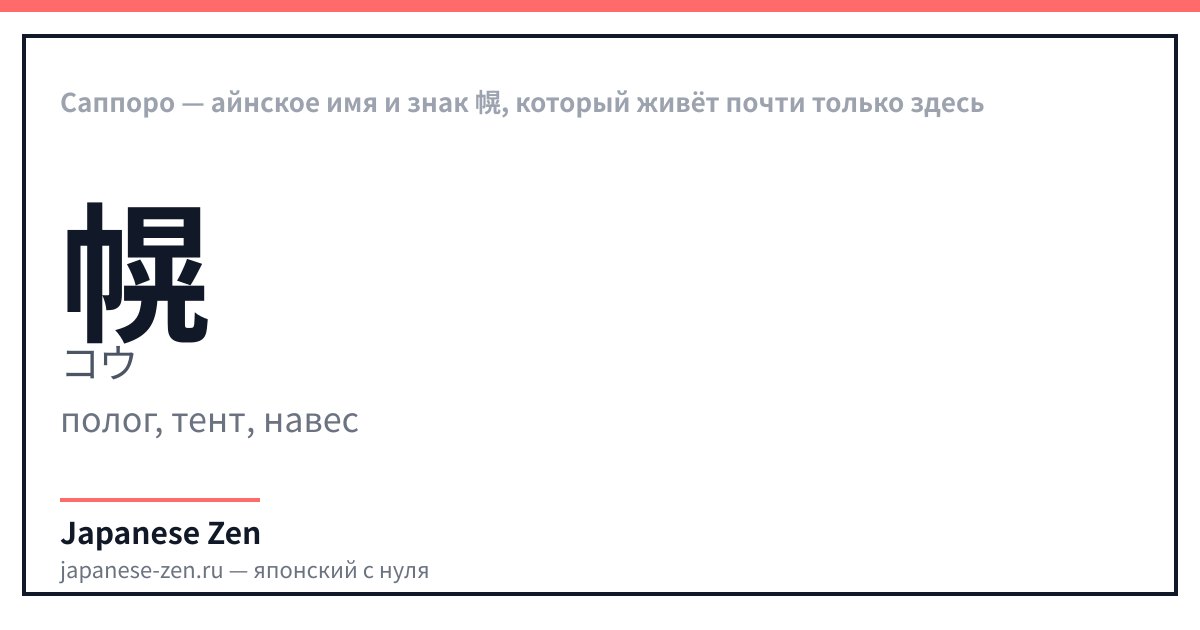
The on'yomi of 幌 is コウ (kō), the kun'yomi is ほろ (horo), and it means "canopy, awning, hood." In modern language this word almost never appears on its own, except in the name Sapporo and in the word 幌馬車, "covered wagon," that is, a wagon with a canopy. Neither the city's history nor its appearance is connected to the character's meaning — it is a pure coincidence of sound.
幌 — значение: canopy, awning, hood — онъёми: コウ — кунъёми: ほろ、とばり — 13 штрих(ов). 幌 — "canopy, awning": the word horo refers to the removable top of a wagon or vehicle, and 幌馬車 is a covered wagon. In the name Sapporo this character is part of an ateji: it was chosen for its sound, not its meaning.
The first character — 札, "tag," which is also irrelevant
The first character of the name, 札, on its own means "tag, label" and appears far more often in modern words — for example, in 千円札, "thousand-yen bill" — than 幌. But it too ended up in the name Sapporo only for its sound: there is no semantic connection between a "tag" and the Ainu "great river."
| Japanese | Reading | Translation |
|---|---|---|
| 札幌 | Sapporo · Sapporo | Sapporo — the city's name itself |
| 幌 | horo · horo | Canopy, awning — the same character as in the city's name |
| 幌馬車 | horobasha · horobasha | Covered wagon, literally "wagon with a canopy" |
| 札 | fuda · fuda | Tag, label — the first character in the city's name |
| 雪まつり | Yuki Matsuri · Yuki Matsuri | Snow Festival, held in Sapporo since 1950 |
| 開拓使 | Kaitakushi · Kaitakushi | Kaitakushi — the agency that developed Sapporo in the Meiji era |
Write 幌 along the guides — the character for "canopy," which in Japanese lives almost only in the name Sapporo.
FAQ
- Is Sapporo a "dry river" or a "river in the reeds"?
- The name comes from the Ainu language, not Japanese: the characters 札幌 merely represent its sound. The most common version traces the name to "sat-poro-pet" — "dry great river," probably referring to the Toyohira River. But dictionaries also give another variant, "sari-poro-pet" — "river in a reedy floodplain," and there is no consensus.
- What do the characters 札幌 mean?
- On their own, 札 means "tag" and 幌 means "canopy, awning," but in the city's name these meanings are irrelevant: the characters were chosen only for the sound of the Ainu word. This is called ateji — a way of writing in which characters are chosen for their reading, not their meaning.
- Since what year has the Snow Festival been held in Sapporo?
- The first Snow Festival was held on February 18, 1950: high school students under the supervision of an art teacher built six snow sculptures in Odori Park, and about 50,000 people came to see them. Today it is one of Japan's largest winter festivals, with giant ice and snow sculptures.
- Is it true that the Sapporo Winter Olympics were the first in Asia?
- Yes, the 1972 Winter Games in Sapporo were the first Winter Olympics held on the Asian continent. The competitions brought together 35 countries and a little over a thousand athletes — modest by today's standards, but for Japan at the time it was a huge event.
- Who are the Ainu and how are they recognized in Japan today?
- The Ainu are the indigenous people of Hokkaido and neighboring territories, with their own language, distinct from Japanese, and an economy based on hunting, fishing, and gathering. For a long time the state did not recognize their special status, and only in 2019 did Japan pass a law that for the first time officially called the Ainu the indigenous people of the northern part of the country.
- Why does Sapporo use numbers instead of street names?
- Central Sapporo was built from scratch in the Meiji era on a regular plan: modeled on Kyoto's block layout, the city was divided into regular rectangles. That is why an address is made up of "jo" and "chome" numbers — counting blocks from Odori Park and the Sosei River — rather than street names, as in most Japanese cities.
Sources
Updated: 2026-09-15