Yokohama: the port that opened the country
Yokohama is a major port city in the Kanto region on the shore of Tokyo Bay. The port here was opened on July 1, 1859 instead of neighboring Kanagawa, which was specified in the treaty. Today Yokohama is the second most populous city in Japan after Tokyo.
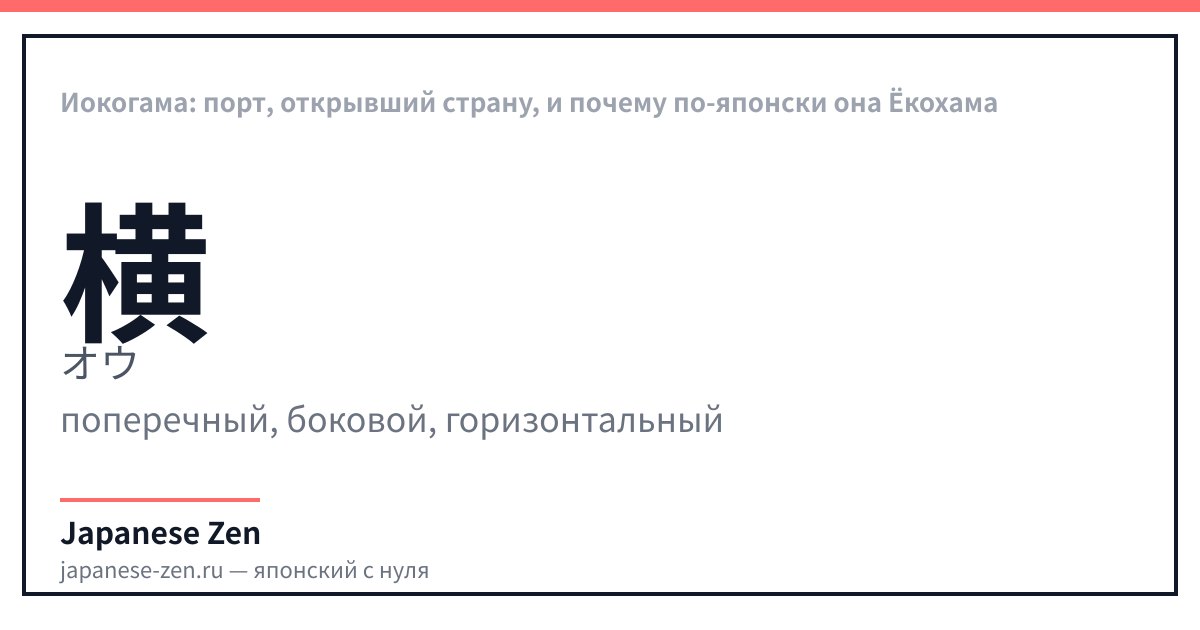
Let's examine what the characters 横浜 literally mean, why the port was opened not in Kanagawa, as agreed, but in a neighboring village, and how a fishing settlement grew into a city with the country's largest Chinatown.
横浜 means 'side shore'
横浜 is read よこはま (Yokohama) and is composed of 横 'transverse, side' and 浜 'shore, beach'. Even before the port opened, there was a fishing village on a sand spit that separated the inner bay from the open sea — hence the 'side shore' in the name.
How the name reached Europe
The name came to the West in the 19th century through European, mostly English-language, sources, where the city was written in Latin letters as Yokohama. This spelling follows the Japanese pronunciation よこはま syllable by syllable and has not changed since.
The yen took a different path
The currency's name is spelled less faithfully: in Japanese 円 is read えん, 'en', while Western languages write it yen — a spelling that took hold in the same 19th-century European sources. Both names reached Europe the same way, but only Yokohama is written the way it sounds in Japanese.
The port that overtook Osaka: Minato Mirai and the Chukagai district
According to the 2020 census, 3,777,491 people lived in Yokohama — among cities with 'shi' status, this is first place in the country, with a noticeable lead over Osaka and Nagoya. Tokyo formally does not count: it is not a city but a metropolitan district, so Yokohama is officially the most populous 'shi' in Japan, and in total population it is second only to Tokyo.
Minato Mirai on the site of an old shipyard
The Minato Mirai 21 district has been built since 1983 on reclaimed land and the territory of the former shipyard of the Yokohama Dock company, founded back in 1891. Today it is the city's business and tourist center with skyscrapers and a port park.
Chukagai — a Chinatown larger than any other in the country
Chukagai grew out of a settlement of Chinese translators and merchants who settled near the port immediately after it opened in 1859. Today it is the largest Chinatown in Japan and East Asia: it nearly disappeared twice — after the 1923 earthquake and after the war — and both times was rebuilt anew.
1859: how a fishing village became a gateway to the world instead of Kanagawa
The 1858 Treaty of Amity and Commerce between Japan and the United States stipulated opening a port in Kanagawa — a lively post town on the Tokaido road. But the shogunate chose instead the neighboring fishing village of Yokohama: it stood on a narrow spit, surrounded by water on almost all sides, and it was easier to isolate from the main road and keep foreigners separate from Japanese travelers.
Opening of the port and the foreign settlement
The port opened on July 1, 1859 — on the second day of the sixth month of the sixth year of Ansei according to the old calendar. Near the port, a settlement of foreign merchants arose, and with them came translators and traders from China, who over time founded Chukagai.
The 1923 earthquake and reconstruction
On September 1, 1923, the Great Kanto Earthquake with a magnitude of about 7.9 destroyed a significant part of Yokohama along with Tokyo. The city was rebuilt over several decades, and already in the post-war years the port regained its role as one of the main ones in Japan.
横 — 'transverse': a character that lives not only in the city's name
The on'yomi of 横 is オウ (ō), the kun'yomi is よこ (yoko), and it means 'transverse, side, horizontal'. Unlike many characters in city names, this one is the most ordinary: it appears in dozens of everyday words, not only in the name 横浜.
横 — значение: transverse, side, horizontal — онъёми: オウ — кунъёми: よこ — 15 штрих(ов). 横 — 'transverse, side': the same character is in the words 横断歩道 'pedestrian crossing' (a path that crosses the street transversely), 横書き 'horizontal writing' and 横顔 'profile of a face'. In the name Yokohama it points to the sand spit that lay across the bay.
The second character — 浜, 'shore', which in names is read 'hama'
浜 by itself means 'shore, beach, coast', and its on'yomi is ヒン (hin). But in names and place names it almost always sounds like hama — just as in 横浜: this same kun'yomi is found in the names of other coastal cities and towns in Japan.
| Japanese | Reading | Translation |
|---|---|---|
| 横浜 | Yokohama · Yokohama | Yokohama — the same city name in Japanese |
| 横断歩道 | ōdan hodō · ōdan hodō | Pedestrian crossing — a path crossing the street transversely |
| 横書き | yokogaki · yokogaki | Horizontal writing, left to right |
| 横顔 | yokogao · yokogao | Profile of a face, side view |
| 浜 | hama · hama | Shore, beach — a common Japanese word |
| 中華街 | Chūkagai · Chūkagai | Chukagai — Yokohama's Chinatown |
Write 横 along the guides — the character for 'side', from which the name Yokohama was formed.
FAQ
- What do the characters 横浜 literally mean?
- 横浜 is composed of 横 'transverse, side' and 浜 'shore'. Before the port opened, there was a fishing village on a sand spit that lay across the bay — hence the name. In Japanese the city is called Yokohama, which is an exact rendering of the reading よこはま.
- Is Yokohama spelled the same in English as in Japanese?
- Yes: the Latin spelling Yokohama follows the Japanese reading よこはま syllable by syllable. It reached the West in the 19th century through European, mostly English-language, sources. The currency is different: 円 is pronounced 'en' in Japanese but written yen in English.
- When was the port in Yokohama opened and why was it chosen?
- The port opened on July 1, 1859, although the treaty with the United States named neighboring Kanagawa. The shogunate replaced it with the fishing village of Yokohama: it stood on a spit surrounded by water, and it was easier to fence off from the Tokaido — the country's main road — and from contacts between foreigners and Japanese travelers.
- Is it true that Yokohama is the second most populous city in Japan?
- Yes, if Tokyo is counted as one city: then Yokohama is in second place in the country. Among cities with official 'shi' status — and Tokyo formally does not belong to them — Yokohama is first: according to the 2020 census, 3,777,491 people lived here, more than in Osaka or Nagoya.
- What is the Chinatown Chukagai in Yokohama?
- Chukagai arose almost immediately after the port opened in 1859, when Chinese translators and merchants settled near the foreign settlement. Today it is the largest Chinatown in Japan and East Asia, rebuilt twice — after the 1923 earthquake and after World War II.
- How did the 1923 earthquake affect Yokohama?
- The Great Kanto Earthquake on September 1, 1923, with a magnitude of about 7.9, destroyed a significant part of the city along with Tokyo, including the port and the foreign settlement. Reconstruction took decades, but by the middle of the 20th century Yokohama had regained its status as one of Japan's main ports.
Sources
Updated: 2026-09-15