Kobe — a port city, the "shrine's estate," and the beef that bears its name
Kobe is a major port city in the Kansai region and the capital of Hyogo Prefecture. The name 神戸 means "households attached to a shrine" — the term once referred to lands that supported the Ikuta Shinto shrine. Modern Kobe is known for its port, which opened to foreign trade in 1868, and for the marbled beef named after the city.
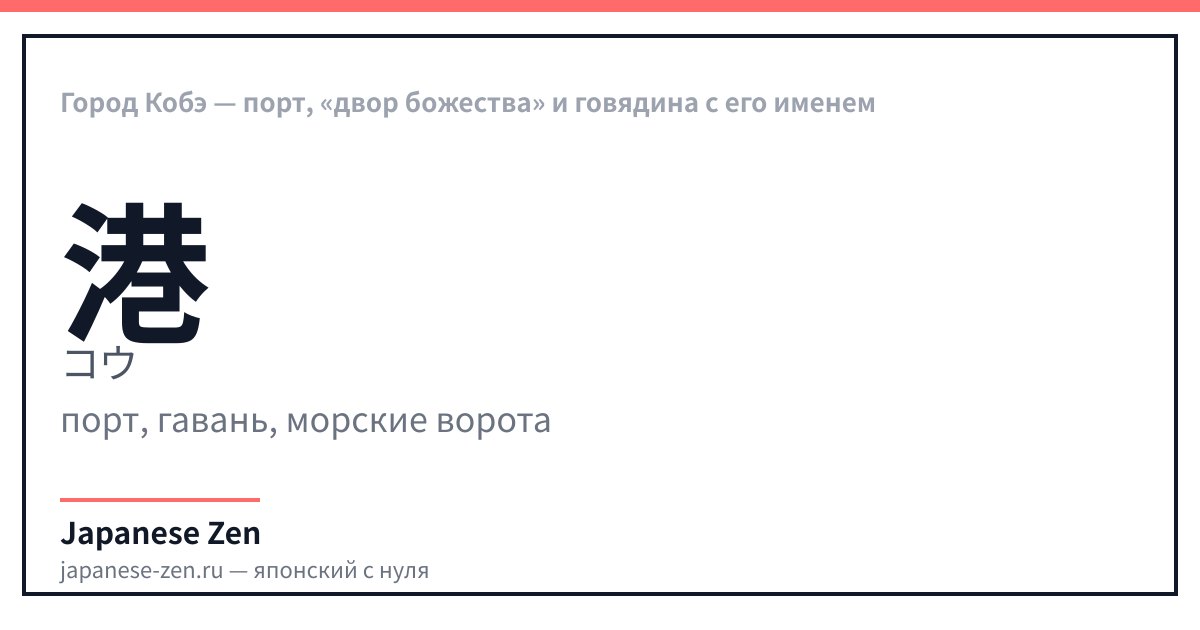
Let's look at where the word "shrine" comes from in the name Kobe, and what the port opening in 1868 and the foreign settlement have to do with it. We'll also see why the kanji chosen for study is not the one in the city's name but "port" — 港. And finally, what the "Kobe beef" brand really means and why it's not a cattle breed.
神戸 — the estates of Ikuta Shrine that gave the city its name
神戸 is read こうべ (Kōbe) and is made up of 神 "god, deity" and 戸 "household, house." In ancient Japan, there was a custom of attaching special households called kanbe to Shinto shrines — their residents paid tribute to the shrine instead of the state. The lands that supported Ikuta Shrine in what is now the city center were called exactly that, and "kanbe" eventually became "Kōbe."
Ikuta Shrine and its role in the city's name
Ikuta Shrine is one of the old Shinto shrines of the Kansai region, and it was its landholdings that gave the future city its name. The shrine still operates in central Kobe, a few minutes from the main stations.
1868: the port that opened before the settlement was finished
The Port of Kobe officially opened to foreign trade on January 1, 1868 — by the Japanese calendar, the seventh day of the twelfth month of the third year of Keiō. On the same day, according to the agreement, a settlement for foreign residents was also supposed to open, but due to the turmoil of the final months of the shogunate, construction dragged on, and lots were sold off as work proceeded.
The foreign settlement praised for its beauty
The foreign settlement was laid out in a narrow strip along the shore — with straight streets and European buildings unlike the Japanese architecture nearby. It is still often called a model foreign settlement in the East; on its site is the Kyūkyoryūchi business district, "the former settlement."
The "Kobe beef" brand and the earthquake the city survived
"Kobe beef" is not a cattle breed but a trademark with a certificate. The name applies to meat from castrated bulls and non-calving heifers of the Tajima breed from Hyogo Prefecture that have passed inspection for pedigree, marbling, and meat yield. The rules of the brand are managed by the industry council for the promotion of Kobe beef, and it is not the breed itself that grants the right to the name.
The 1995 earthquake and the port's recovery
On January 17, 1995, Kobe was struck by a major earthquake that destroyed part of the port infrastructure and urban buildings. The port and city districts were rebuilt in the following years, and today Kobe is once again one of Japan's main ports.
港 — port, not "household"
In the name 神戸 itself, the character 戸 "household, door" appears — it points to the history of kanbe, the households attached to the shrine. But the history of the modern city is better told by another character — 港 "port": it is not literally part of the city's name, but it appears in the name of the Port of Kobe (神戸港) and in all words about the city's maritime history.
港 — значение: port, harbor, sea gate — онъёми: コウ — кунъёми: みなと — 12 штрих(ов). 港 — "port, harbor": this character defines the city's fate more than the 戸 in its own name. It also appears in 空港 "airport" and 開港 "opening of a port."
The 戸 radical — "door" without sea or ships
戸 means "door, household, house" and in modern language appears most often in everyday words — for example, in the counter for houses. It was in this everyday sense that the character once appeared in the word "kanbe," not as a reference to water or ships: Kobe's connection to the sea was born much later, when the port was opened here.
| Japanese | Reading | Translation |
|---|---|---|
| 神戸 | Kōbe · Kōbe | Kobe — the city's name itself |
| 神戸港 | Kōbe-kō · Kōbe-kō | Port of Kobe |
| 港 | minato · minato | Port, harbor — a common Japanese word |
| 生田神社 | Ikuta Jinja · Ikuta Jinja | Ikuta Shrine, which gave the city its name |
| 開港 | kaikō · kaikō | Opening of a port to trade |
Write 港 along the guides — the character for "port," which shaped Kobe's fate more than the 戸 in its own name.
FAQ
- What does the name Kobe mean?
- 神戸 is made up of 神 "god, deity" and 戸 "household." In ancient times, this referred to kanbe households attached to a Shinto shrine — in this case, to Ikuta Shrine in the center of the present-day city. Over time, "kanbe" became the modern "Kōbe."
- When did the Port of Kobe open?
- January 1, 1868 — by the Japanese calendar, the seventh day of the twelfth month of the third year of Keiō. The foreign settlement was supposed to open at the same time, but due to the turmoil surrounding the fall of the shogunate, construction dragged on, and lots were sold off as work proceeded.
- What is "Kobe beef" — is it a cattle breed?
- No, it is a trademark: it is granted to meat from castrated bulls and non-calving heifers of the Tajima breed from Hyogo that have passed inspection for pedigree, marbling, and meat yield. The rules of the brand are managed by the industry council for the promotion of Kobe beef.
- What happened to Kobe in 1995?
- On January 17, 1995, the city was struck by a major earthquake that damaged the port and part of the urban buildings. In the following years, the port and districts were rebuilt, and Kobe regained its status as one of Japan's main ports.
- Why was the character 港 chosen for study rather than the 戸 in the name itself?
- The 戸 in the name Kobe simply means "household, house" and reflects the ancient history of kanbe. But for the city, the character 港 "port" turned out to be more important: it was the port that determined Kobe's fate after 1868 and it appears in its official name — 神戸港.
- What do the kanji in the name Kobe mean?
- 神戸, read こうべ. 神 means "god, deity," 戸 means "household, house": together — "shrine households." This was the name for the lands that in ancient times supported the Ikuta Shinto shrine in the center of the present-day city, and over time the reading "kanbe" was shortened to the modern "Kōbe."
Sources
Updated: 2026-09-15