Kirin — the benevolent beast of mythology: why the giraffe is named after it
Kirin (麒麟) is a benevolent beast of legend: the body of a deer, the head of a dragon, an ox tail, and a single soft horn, and it appears only under a wise ruler. Ancient Chinese mythology considers the kirin so gentle that it supposedly does not even step on grass or insects. In Japanese, the same word "kirin" has also been used for the giraffe since 1874 — because of its similar long neck and spotted coat.
The kirin is known twice over: as a beast-herald of good from Chinese legends, paired with the bird hoo, and as the most unexpected name for a long-necked African herbivore in a Tokyo zoo. Let's look at how classical texts describe the kirin, what Confucius and Oda Nobunaga's signature have to do with it, and why Kirin beer is named that way.
Kirin: the beast that spares even the grass underfoot
The kirin, in Chinese qilin (麒麟), is a benevolent beast of Far Eastern legends: its appearance signals a virtuous ruler or the imminent birth of a great sage. In classical Chinese descriptions, it has the body of a tall deer about five meters in height, the head of a dragon, an ox tail, horse hooves, and a single horn with a soft, non-bony tip. The kirin's back is covered with five-colored fur, and its body with yellow fur and scales.
The kirin is so gentle that, according to legend, it fears stepping even on an insect or a blade of grass and does not touch anything living — hence its fame as the most peaceable of mythical beasts. The famous story of Confucius is also connected with the kirin. The chronicle "Chunqiu," which he compiled, breaks off at the episode of the "capture of the qilin": the beast appeared in an era unworthy of its coming, people did not recognize it as a kirin, were frightened, and abandoned it. Shaken, Confucius then laid down his brush.
How the Japanese kirin differs from the Chinese one
There is almost no difference in appearance: Japan adopted the Chinese image of the qilin entirely, along with the name 麒麟. The words diverged: in Chinese, the kirin and the giraffe are called differently (麒麟 versus 长颈鹿, literally "long-necked deer"), while in Japanese and Korean the same word "kirin" names both the mythical beast and the real African animal. In the treatise "Liji," the kirin is counted among the "four benevolent creatures" (四霊) together with the phoenix-hoo, the wondrous turtle, and the dragon — all four foretell virtuous rule.
Kirin in shrine carvings and on Oda Nobunaga's seal
In Japan, the kirin has long been revered as a sign of virtuous rule. It was carved on the gates of temples and shrines and painted on utensils.
Oda Nobunaga used a personal signature-kao, into which the character 麟 — the second kanji of the word "kirin" — was incorporated. According to a common interpretation, Nobunaga, seeking to unify the country instead of the fading Ashikaga shogunate, was trying on the role of a ruler under whom benevolent beasts appear.
What a TV series and beer have to do with it
In 2020–2021, NHK aired the historical drama "Kirin ga Kuru" (麒麟がくる) about the life of Akechi Mitsuhide: the title directly refers to the legend of the beast that appears before a worthy ruler. Beer under the Kirin brand was first sold in Yokohama back in 1888, and since 1889 its label has featured the silhouette of that same beast.
Why the giraffe is called "kirin" in Japanese
The first live giraffes were brought to Japan only in 1907: they were purchased from the Hagenbeck Zoo in Hamburg and displayed at Tokyo's Ueno Zoo, where it became a real sensation. But the word "kirin" for the giraffe appeared before the animals themselves — in 1874, naturalist Tanaka Yoshio used it to translate the Latin name in a zoology textbook. He relied on an old Chinese tradition that a giraffe presented to the court of the Ming emperor was taken for a living qilin; how reliable that tradition is remains unclear.
A word broader than one beast
The same word is used for the giraffe not only in Japan: in Korean, it is also "kirin" (기린). And to praise not an animal but a gifted child, Japanese has the word 麒麟児 "kirin-child" — a prodigy destined for a great future.
Why a deer is hidden in 麒麟
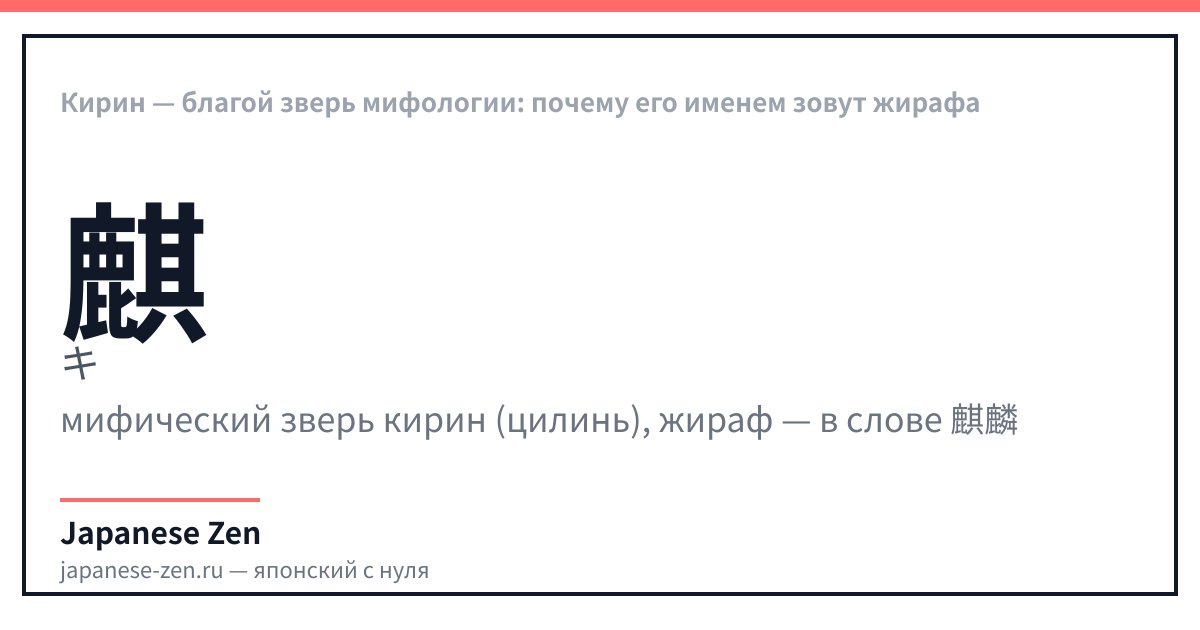
麒 — значение: mythical beast kirin (qilin), giraffe — in the word 麒麟 — онъёми: キ — 19 штрих(ов). 麒 — the first character of the word 麒麟: by one interpretation, the "male" of the pair, though more often both characters are written together, without gender distinction. The giraffe is called by the same word 麒麟 in Japanese.
麒麟 is read きりん: 麒 has the on-reading キ, 麟 has the on-reading リン. By one interpretation, 麒 is "male" and 麟 is "female," though more often both characters are written together as a single name, without gender distinction. Individually, these characters are almost never encountered, except in words like 麒麟児 "gifted child" and the official name of the brewery 麒麟麦酒.
The "deer" radical in both characters
Both characters, 麒 and 麟, are classified by kanji dictionaries under the same radical — 鹿 "deer" — rather than "beast" in general or "dragon," even though the mythical kirin itself combines features of several animals at once.
| Japanese | Reading | Translation |
|---|---|---|
| 麒麟 | kirin · kirin | Mythical benevolent beast; also the word for giraffe |
| 麒麟児 | kirinji · kirinji | Gifted child, prodigy |
| キリン | kirin · kirin | Giraffe — more often written in katakana |
| 鹿 | shika · shika | Deer — the radical of both characters in the word "kirin" |
| 四霊 | shirei · shirei | Four benevolent creatures: kirin, hoo, turtle, dragon |
| 麒麟がくる | Kirin ga Kuru · Kirin ga Kuru | NHK drama from 2020 about the kirin and a worthy ruler |
Write 麒 along the guides — the first character of the name of the benevolent beast kirin.
FAQ
- Who is the kirin in mythology?
- The kirin is a benevolent beast of Chinese origin: according to legend, it appears only under a virtuous ruler or before the birth of a great sage. In classical texts, it is described as a hybrid of several animals at once, and its temperament is said to be astonishingly gentle — to the point that it spares even the grass underfoot.
- Are the kirin and the qilin the same creature?
- Yes, it is the same beast: qilin is the Chinese name, and kirin is the same word in Japanese. Japan adopted the Chinese image almost unchanged, including the spelling 麒麟, and the differences appeared rather in the words: in China, the kirin and the giraffe are called differently, while in Japan and Korea they are called the same.
- Why is the giraffe called "kirin" in Japanese?
- The word was chosen in 1874 when translating the Latin name of the giraffe into Japanese, relying on an old Chinese tradition that a giraffe was once taken for a living qilin. The first live giraffes were brought to Japan later, in 1907, and displayed at Tokyo's Ueno Zoo.
- What does the kirin look like?
- In classical Chinese descriptions, the kirin has the body of a tall deer, the head of a dragon, an ox tail, horse hooves, and a single soft horn; its back is covered with five-colored fur, and its body with yellow fur and scales. Later depictions sometimes show it with two or three horns.
- Where does Kirin beer get its name?
- Beer under the Kirin brand began to be sold in Yokohama in 1888, and from 1889 the label featured an image of the beast itself. Thus the name of a benevolent mythical creature also became the brand of one of Japan's largest breweries.
- How is "kirin" written in kanji?
- 麒麟, read きりん: 麒 has the on-reading キ, 麟 has the on-reading リン. Both characters are classified by kanji dictionaries under the radical 鹿 "deer," and individually they are almost never encountered, except in words like 麒麟児 "gifted child."
Sources
Updated: 2026-09-15