Osaka Castle — Hideyoshi's Fortress: Who Built It, How Many Times It Burned, and Its Japanese Name
Osaka Castle (大阪城) was founded in 1583 by Toyotomi Hideyoshi on the site of the temple-fortress Ishiyama Hongan-ji, and after the 1615 siege and the fall of the Toyotomi house, the Tokugawa rebuilt it anew. The current tower is not the original: the tenshu burned down after a lightning strike in 1665, and the one standing now was built of reinforced concrete in 1931 with donations from citizens.
Osaka Castle is actually three different structures on one site: Hideyoshi's fortress, the rebuilt Tokugawa fortress, and a 20th-century museum-tower with an elevator inside. Let's look at where the spelling 大阪城 came from instead of the old 大坂城, what remains from Hideyoshi's era, and how the castle is shown in the series Shogun and other productions.
Osaka Castle: Three Fortresses on One Site
Osaka Castle (大阪城) is a fortress founded in 1583 by Toyotomi Hideyoshi on the site of the destroyed temple-fortress Ishiyama Hongan-ji: until 1580, followers of the Jodo Shinshu Buddhist school — the Ikko-ikki — defended it for almost ten years against Oda Nobunaga. After the fall of the Toyotomi house in 1615, the Tokugawa demolished Hideyoshi's buildings and erected their own, even larger fortress on the same spot. The current tower is already the third: the previous tenshu burned down after a lightning strike in 1665, and the modern one was built of reinforced concrete in 1931 with donations from the citizens of Osaka, and inside it is a historical museum.
| Year | Event |
|---|---|
| 1580 | The siege of the temple-fortress Ishiyama Hongan-ji ends — Oda Nobunaga gains the territory |
| 1583 | Toyotomi Hideyoshi begins construction of Osaka Castle |
| 1614–1615 | Siege of Osaka: the castle is taken by storm, the Toyotomi house is destroyed |
| 1620–1629 | The Tokugawa rebuild the fortress, hiding Hideyoshi's foundations under new walls |
| 1665 | The tenshu burns down after a lightning strike and is not restored for almost three centuries |
| 1931 | The current tenshu is built of reinforced concrete with donations from citizens |
What Remains of Hideyoshi's Fortress
Hideyoshi's fortress was not completely demolished but buried: the Tokugawa raised new walls higher and away from the previous ones. Archaeologists found the lower rows of stone masonry from Hideyoshi's era only in the 20th century under the ground of the modern park — that's how it became clear that the castle visible today almost entirely belongs to the Tokugawa era, not Hideyoshi's.
大阪城: "Great Slope" and the Old Spelling 大坂
大阪城 is read おおさかじょう (Ōsaka-jō): 大 — "great," 阪 — "slope, hillside," 城 — "castle." Before the Meiji era, the name was written differently — 大坂, with the same reading "Osaka" but a different second character. The old spelling lives on in historical names: the siege of 1614–1615 is still written in Japanese as 大坂の陣.
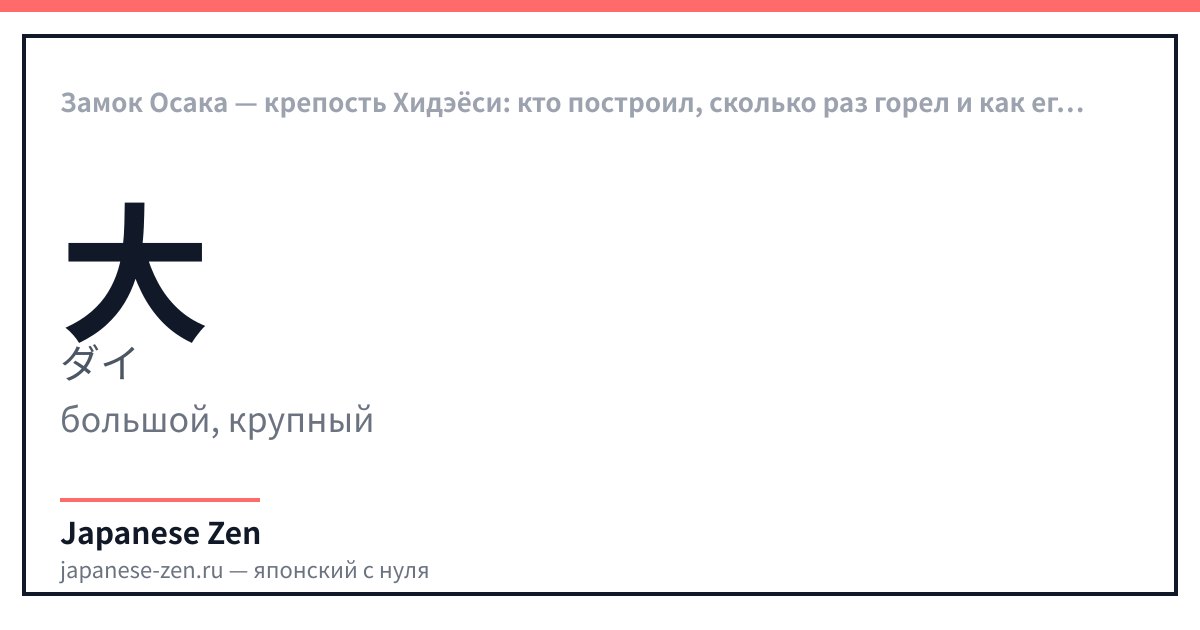
大 — значение: great, large — онъёми: ダイ、タイ — кунъёми: おお-、おお.きい、-おお.いに — 3 штрих(ов). 大 — "great": only 3 strokes, the first character in the name of the city and castle of Osaka.
| Japanese | Reading | Translation |
|---|---|---|
| 大阪城 | Ōsaka-jō · Ōsaka-jō | The name of the castle |
| 大坂城 | Ōsaka-jō · Ōsaka-jō | The old spelling of the same name, before the Meiji era |
| 天守閣 | tenshukaku · tenshukaku | The main tower with a museum inside |
| 金の鯱 | kin no shachihoko · kin no shachihoko | Golden shachihoko on the roof of the tenshu |
Why 坂 Was Replaced with 阪
The change of character is most often explained by superstition. 坂 consists of 土 "earth" and 反 "return, against," and it could be read as 土に反る — "return to the earth," that is, to die. And if one took 土 for the similar 士 "warrior," it came out as "the warrior rises." 大阪 was finally established in the Meiji era. All of these are common versions, not a documented reason.
Write 大 along the guides and study the stroke order.
What Stands in Osaka Castle Today: Museum, Walls, and Moat
The modern tenshu of Osaka Castle is not a military structure but a museum inside a historical shell: eight floors, an elevator to the fifth level, and an observation deck at the top. The facade was recreated from a famous folding screen depicting the summer siege of 1615, not from blueprints — they have not survived.
- Massive stone walls (ishigaki) from the Tokugawa era — some blocks weigh tens of tons
- The wide honmaru moat — what remains of the multi-level defense system
- Golden shachihoko — fish amulets against fire — on the ridge of the tenshu roof
- A park with several thousand cherry trees around the walls, laid out in the 20th century
How Hideyoshi's Castle Differed from the Current One
Hideyoshi's fortress was more lavish — with gilded tiles and gilded halls — and noticeably wider: it was encircled by an outer moat (sogamae), which was filled in after the winter campaign of 1614. In the 1620s, the Tokugawa rebuilt the inner part anew, raised the walls higher, and almost erased the visible traces of the former owners.
Osaka Castle on Screen and in Games
- Shogun (FX, 2024) — Osaka Castle here is recreated digitally and on sets built in Canada
- Samurai Warriors and Sengoku Basara — game series by Koei Tecmo and Capcom, where the castle is the scene of final battles
- Sanada Maru (NHK, 2016) — a taiga drama about Sanada Yukimura, whose path ends with the defense of Osaka Castle
- Assassin's Creed Shadows (Ubisoft, 2025) — in the game the castle is already being built in 1582, and you can climb its tenshu
What Games and Series Embellish
In Assassin's Creed Shadows, Osaka Castle is already under construction in 1582. According to sources, Hideyoshi founded it only in 1583, after Nobunaga's death, and the tenshu was completed by 1585 — the game places the tower several years earlier. Incidentally, no buildings from Hideyoshi's era have survived at all: both in the series Shogun and in games, artists have to imagine the castle's appearance from prints and folding screens, not from original blueprints.
FAQ
- What is Osaka Castle?
- Osaka Castle (大阪城) is a fortress founded in 1583 by Toyotomi Hideyoshi on the site of the temple-fortress Ishiyama Hongan-ji. After the fall of the Toyotomi house in 1615, the Tokugawa rebuilt it anew, and the current tower is a 1931 reinforced-concrete museum.
- Who built Osaka Castle?
- The first fortress on this site was founded in 1583 by Toyotomi Hideyoshi. After the siege of 1614–1615 and the death of his heirs, the Tokugawa demolished Hideyoshi's buildings and erected their own, larger fortress on top.
- How many times did Osaka Castle burn?
- Three major times. Hideyoshi's tenshu burned when the castle was taken in 1615, the Tokugawa tenshu burned from a lightning strike in 1665, and for almost three centuries there was no tower. In 1868, at the start of the Boshin War, a fire also destroyed many surviving buildings. The current reinforced-concrete tower was built in 1931.
- How is "Osaka Castle" written in Japanese, and why was it previously written 大坂?
- Today it is 大阪城 (おおさかじょう, Ōsaka-jō); before the Meiji era it was written 大坂城 with the same reading. The character 阪 finally replaced the old 坂 in the Meiji era, according to a common version — because of a bad omen in its composition. The old spelling is still found in the name of the 1614–1615 battle — the Siege of Osaka, 大坂の陣.
- Is it true that Osaka Castle is authentic?
- The main tower is not: it is a 1931 reinforced-concrete reconstruction with a museum inside. However, the stone walls and moats from the Tokugawa era and 13 buildings from the 17th–19th centuries remain authentic — the Otemon gate, yagura turrets, storehouses. They are protected as Important Cultural Properties.
- In which films and games is Osaka Castle shown?
- Osaka Castle is recreated in the series Shogun (FX, 2024), in the games Samurai Warriors and Sengoku Basara, and in the NHK taiga drama Sanada Maru (2016). It also appears in Assassin's Creed Shadows (2025), where it stands as early as 1582 — a year before its actual founding.
Sources
Updated: 2026-09-13