Osaka — City of Food and Trade: Why 大坂 Became 大阪
Osaka is a major trading city in the Kansai region, famous for its street food and the Kansai dialect. The name 大阪 means "large slope": before the Meiji era, Osaka was written 大坂, with the same reading おおさか but a different second character. Both variants coexisted for a long time, and it became uniformly 大阪 around 1887; the explanation involving a bad omen in the old character is a theory, not a documented fact.
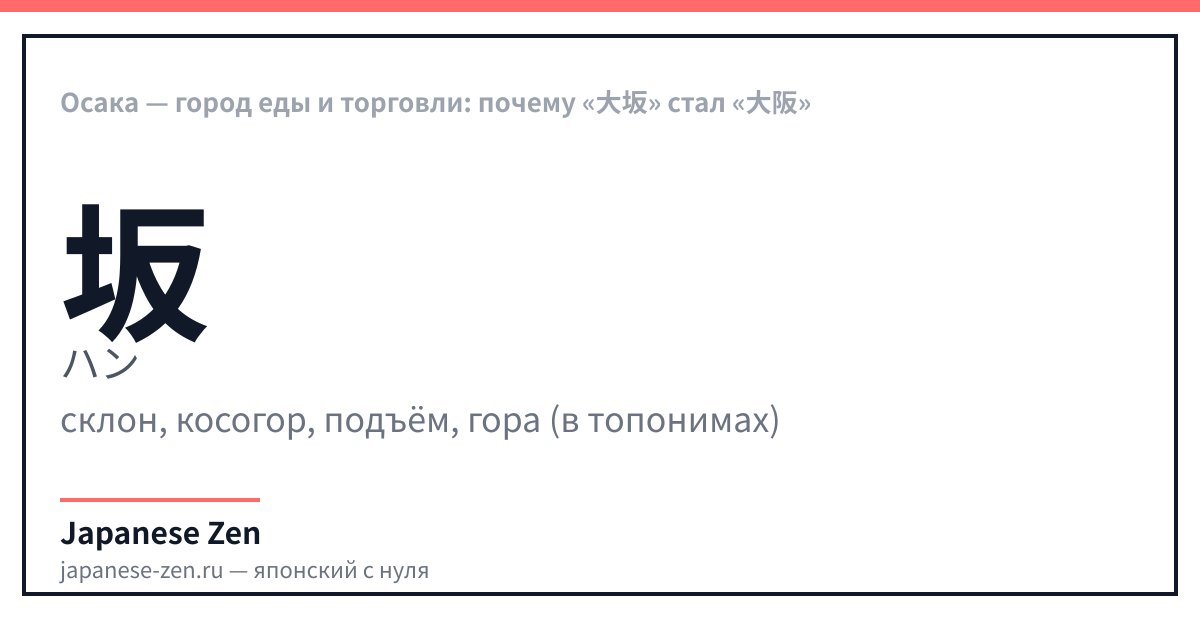
Let's trace how the name Osaka went from the letter of the Buddhist preacher Rennyo to today's sign 大阪, why the city was called "the nation's kitchen" for centuries, and what Kansai expressions like "okini" and "akan" have to do with it. And at the end — the character 阪 "slope" and how another Japanese city with a similar spelling history survived it.
From the Letter of the Preacher Rennyo to Today's 大阪
大阪 is read おおさか (Ōsaka) and is composed of 大 "large" and 阪 "slope". Before the Meiji era, the same word was written 大坂 — with the second character 坂, also "slope", and the reading did not change. The earliest known written mention of the name appears in a letter by the Buddhist preacher Rennyo, who founded a monastery here that grew into Ishiyama Hongan-ji temple — that is, long before Toyotomi Hideyoshi and his castle.
Why "坂" Was Eventually Replaced with "阪"
The change of character is often explained by a bad omen: 坂 is composed of 土 "earth" and 反 "return". As early as the end of the Edo period, the playwright Hamamatsu Utakuni recorded the opinion that such a character reads as "return to the earth", that is, to die. It cannot be proven that the name was changed for this reason. What is known is different: the spelling 阪 occasionally appears already in texts from the second half of the Edo period, and in 1868, according to reports, it appeared in print for the new Osaka Prefecture. But both variants still circulated in parallel for a long time — it became uniformly "大阪" only around 1887.
The Nation's Kitchen, "Ruined on Food", and the Kansai Dialect
Since the Tokugawa period, Osaka was called "the nation's kitchen", 天下の台所: rice and goods from all over Japan were brought here by canals, and then distributed further across the country. The city is also associated with the saying "Osaka-no kuidaore" — "ruined on food in Osaka": in Kyoto, according to the same saying, people were ruined on fine clothes. Today this is more a source of pride than a reproach: from takoyaki to okonomiyaki, the city competes in street food, not in silk kimonos.
Kansai Dialect: Not Quite the Japanese of Tokyo
- おおきに (okini) — "thank you", a warmer and more old-fashioned word than the standard ありがとう.
- ほんま (homma) — "really, truly", in place of the standard 本当.
- あかん (akan) — "no good, not allowed", the equivalent of the standard だめ.
From Hideyoshi's Castle to World Expositions
In 1583, Toyotomi Hideyoshi built a castle on this site, around which a trading town quickly grew. Osaka's economic importance outlived Hideyoshi himself, his castle, and even the transfer of the capital to Tokyo in 1868: the port and markets continued to operate regardless of who ruled the country.
The City That Hosted the Whole World Twice
In 1970, the Expo '70 world's fair was held on the Senri hills near Osaka — it was visited by about 64 million people from 77 countries, a record for world's fairs at the time. In 2025, the exposition returned to the city, now on the artificial island of Yumeshima in Osaka Bay, gathering participants from more than one and a half hundred countries and territories.
坂 — The Slope from Which the City's Name Grew
坂 is composed of the radical 土 "earth" and the phonetic 反, and means "slope, hillside": the old center of Osaka stands on the elongated Uemachi elevation, where the castle still towers today. The character 阪 is a variant of the same 坂 with the "hill" radical 阝 instead of "earth"; they have the same meaning, so the change of spelling changed neither the reading nor the meaning of the name.
坂 — значение: slope, hillside, ascent, hill (in place names) — онъёми: ハン — кунъёми: さか — 7 штрих(ов). 坂 — "slope": the old second character in the name of Osaka; by tradition it is preserved in the name of the 1614–1615 siege — "大坂の陣". The same character appears in the common word 坂道, "road uphill".
Why the Card Shows 坂, Not 大
The first character of the name, 大 "large", is one of the most common kanji, appearing in almost any text. The character 坂 tells more: it carries the relief of the place, and its history of replacement with 阪 explains why Osaka was written differently in different eras.
| Japanese | Reading | Translation |
|---|---|---|
| 大阪 | Ōsaka · Ōsaka | Osaka — the modern spelling of the name |
| 大坂 | Ōsaka · Ōsaka | Osaka — the old spelling of the same name, before the Meiji era |
| 大阪府 | Ōsaka-fu · Ōsaka-fu | Osaka Prefecture — the official name of the region |
| 坂道 | sakamichi · sakamichi | Road uphill, slope |
| 関西 | Kansai · Kansai | Kansai — the region centered on Osaka |
Write 坂 along the guides — the character for "slope" that underlies the name of Osaka.
FAQ
- What kind of city is Osaka and what is it famous for?
- Osaka is a major commercial and culinary center of the Kansai region in western Honshu. For centuries the city was the country's main market, and today it is known for street food like takoyaki and okonomiyaki, the Kansai dialect, and a sense of humor unlike Tokyo's.
- What does the name "Osaka" mean?
- 大阪 literally means "large slope": 大 — "large", 阪 — "slope, hillside". The name describes the terrain: the old city center stands on an elevation where the castle still towers today. Before the Meiji era, the same name was written with a different second character — 坂, with the same meaning and reading.
- Why was Osaka formerly written as "大坂"?
- That was the original spelling: the character 坂 "slope" has been in the name since the first records of the late 15th century. The variant 阪 with the same reading and meaning appeared already in the Edo period, both spellings coexisted for a long time, and it became uniformly "大阪" around 1887. The theory about a bad omen — that "坂 breaks down into 'return to the earth'" — is popular but not confirmed by documents.
- Why is Osaka called "the nation's kitchen"?
- Under the Tokugawa, rice and goods from all over Japan were brought to Osaka by canals and then distributed further — hence the nickname 天下の台所, "the nation's kitchen". The same image lives on in the saying about a city that would rather "be ruined on food" than on fine clothes, like neighboring Kyoto.
- How does the Kansai dialect differ from Tokyo speech?
- In Osaka people speak the Kansai dialect — with different intonation and its own words: おおきに instead of ありがとう "thank you", ほんま instead of 本当 "really". There is also the characteristic あかん — "no good, not allowed", the equivalent of the standard だめ. It all sounds softer and more melodic than the literary Tokyo standard.
- How is "Osaka" written in kanji?
- 大阪, read おおさか. 大 means "large", 阪 — "slope". Before the Meiji era, it was usually written 大坂 — with the same reading but a different variant of the second character, 坂. Both characters mean "slope", the only difference is the radical: "hill" versus "earth".
Sources
Updated: 2026-09-15