Cities of Japan: the largest cities, what they are called, and what their names mean
The cities of Japan are 792 municipalities with the status of "shi" (市). Tokyo itself is not among them: it is a metropolitan district (都), and its center is 23 special wards, not a single city. The largest city in the country in the administrative sense is Yokohama, with almost 3.8 million residents according to the 2020 census; it is followed by Osaka, Nagoya, and Sapporo.
Let's look at how many official cities there are in Japan and how a "city" differs from a prefecture and the Tokyo metropolitan district, what the names Kyoto, Osaka, Sapporo, and other cities mean by their kanji, and which of them were once capitals. And at the end — anime that show real Japanese cities, not fictional ones.
The largest cities of Japan and what 市 is
Officially there are 792 cities in Japan, but the most recognizable name — Tokyo — is not on that list. Tokyo has a special status of to (都), "metropolitan district": instead of a single city government, there are 23 special wards with their own city halls and another 26 cities in the Tama area. The largest city in the country in the usual sense of the word is Yokohama with a population of almost 3.8 million people, followed by Osaka, Nagoya, and Sapporo.
| City | Writing | Literally | Prefecture | Population (2020) |
|---|---|---|---|---|
| Tokyo — 23 wards | 東京都 | "eastern capital" | Tokyo | 9,733,276 |
| Yokohama | 横浜市 | "crosswise shore" | Kanagawa | 3,777,491 |
| Osaka | 大阪市 | "large slope" | Osaka | 2,752,412 |
| Nagoya | 名古屋市 | written by sound, disputed | Aichi | 2,332,176 |
| Sapporo | 札幌市 | from Ainu, versions | Hokkaido | 1,973,395 |
| Fukuoka | 福岡市 | "hill of fortune" | Fukuoka | 1,612,392 |
| Kawasaki | 川崎市 | "river cape" | Kanagawa | 1,538,262 |
| Kobe | 神戸市 | "courts of the deity" | Hyogo | 1,525,152 |
| Kyoto | 京都市 | "capital city" | Kyoto | 1,463,723 |
| Saitama | さいたま市 | hiragana, from old 埼玉 | Saitama | 1,324,025 |
| Hiroshima | 広島市 | "wide island" | Hiroshima | 1,200,754 |
| Sendai | 仙台市 | "hermit's terrace" | Miyagi | 1,096,704 |
| Chiba | 千葉市 | "thousand leaves" | Chiba | 974,951 |
| Kitakyushu | 北九州市 | "northern Kyushu" | Fukuoka | 939,029 |
| Sakai | 堺市 | "border, boundary" | Osaka | 826,161 |
| Hamamatsu | 浜松市 | "pines on the shore" | Shizuoka | 790,718 |
| Niigata | 新潟市 | "new lagoon" | Niigata | 789,275 |
| Kumamoto | 熊本市 | "bear base", formerly 隈本 | Kumamoto | 738,865 |
| Sagamihara | 相模原市 | "Sagami plain" | Kanagawa | 725,493 |
| Okayama | 岡山市 | "hill-mountain" | Okayama | 724,691 |
How many cities there are in Japan
There are 792 cities (市) in Japan — that number was reached in October 2018. Twenty of the largest are singled out: these are "cities designated by government ordinance" (政令指定都市), from Sapporo and Sendai to Fukuoka and Kitakyushu. The law requires them to have at least half a million residents, and they handle many affairs that are usually handled by the prefecture. Tokyo is neither among the 792 nor in the top twenty: formally it is not a city but a metropolitan district (都).
What city names mean
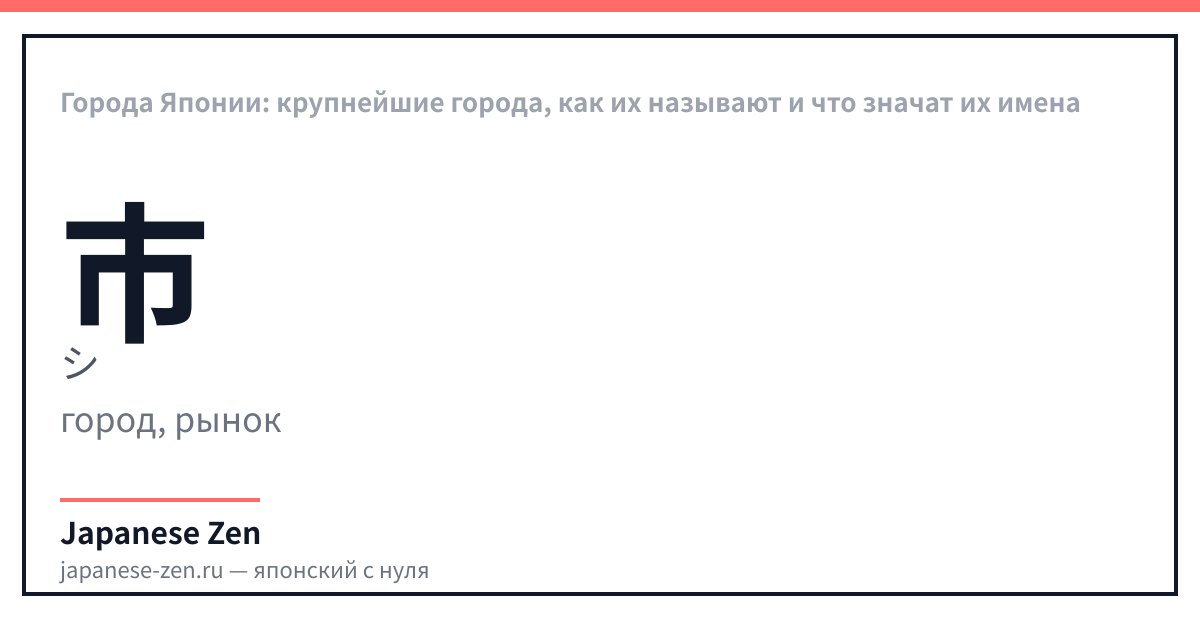
市 — значение: city, market — онъёми: シ — кунъёми: いち — 5 штрих(ов). 市 — "city; market": almost every official name of a Japanese city ends with this character — 横浜市, 大阪市, 名古屋市.
| Japanese | Reading | Translation |
|---|---|---|
| 市 | shi · shi | City — the basic administrative unit |
| 都 | to · to | Metropolitan district — the status of Tokyo alone |
| 府 | fu · fu | Urban prefecture — the status of Osaka and Kyoto |
| 県 | ken · ken | Prefecture — the status of 43 of the country's 47 regions |
| 区 | ku · ku | Ward — a division unit of large cities |
| 町 | machi · machi | Town, quarter — a unit smaller than a city |
Write 市 along the guides — the character that appears in almost every name of a Japanese city.
How Kyoto and Osaka are written in Japanese
Kyoto is written 京都市 (きょうとし) — the same character "capital" as in the name Tokyo, only without the qualifier "eastern". Osaka is written 大阪市 (おおさかし): 大 "large" and 阪 "slope". Previously it was usually written 大坂 — with the same reading and the character 坂, also "slope"; the variant 阪 became established in the Meiji era.
Next — the etymology of ten cities: where the name reads literally, and where the characters were chosen by sound or are tied to a disputed version.
| City | Writing | What it means |
|---|---|---|
| Kyoto | 京都 | "capital city" — both characters refer to the capital |
| Osaka | 大阪 | "large slope" |
| Nagoya | 名古屋 | the characters were probably chosen by sound; the old spellings — 那古野 and 名護屋 — did not match, the etymology is disputed |
| Sapporo | 札幌 | from Ainu: "sat-poro-pet" — "dry large river" or "sari-poro-pet" — "large river in the reeds"; the characters were chosen by sound |
| Yokohama | 横浜 | "crosswise shore" |
| Hiroshima | 広島 | "wide island" |
| Nagasaki | 長崎 | "long cape" |
| Kobe | 神戸 | "courts of the deity": these lands were kanbe — courts that supported the Ikuta shrine |
| Fukuoka | 福岡 | "hill of fortune" |
| Nara | 奈良 | disputed: according to the Nihon Shoki — from "fuminarasu", "to trample" (an army trampled the grass on a hill); there is also a version about the Korean "nara" — "country" |
How Japan is organized: prefectures and capitals
Japan is divided into 47 regions, and their collective name 都道府県 is made up of four statuses: one to (都, Tokyo), one do (道, Hokkaido), two fu (府, Osaka and Kyoto), and 43 ken (県). The grid goes back to 1871: then the feudal domains-han were abolished and replaced by prefectures (廃藩置県), and after consolidations by the end of the 19th century, almost the current borders took shape. The name 東京都 appeared later than all — in 1943.
Former capitals of Japan
Before Tokyo, the imperial court changed more than one capital. In the 7th century it often moved — Asuka, Naniwa, Fujiwara-kyo. In 710–784 the capital was Nara (Heijo-kyo), then for ten years — Nagaoka. From 794 the court lived in Kyoto (Heian-kyo) and remained there until the move to Tokyo in 1868–1869. Kamakura from 1185 to 1333 was the seat of the first shogunate, but the emperor did not leave Kyoto, so it was not a capital in the strict sense. Japanese law has no definition of a capital at all: Tokyo is the capital de facto, not by law.
Cities of Japan in anime
- "Your Name" (2016, directed by Makoto Shinkai) — part of the events take place in a recognizable Tokyo: the Yotsuya district and the stairs at the Sugaya-jinja shrine became a pilgrimage site for viewers after the premiere.
- "Suzume" (2022, Makoto Shinkai) — the heroine travels through real regions of the country: from Kyushu through Ehime and Kobe to Tokyo and Tohoku, and almost every stop is a real city.
- "Hyouka" (2012, Kyoto Animation) — the action unfolds in the fictional city of Kamiyama, modeled on the real Takayama in Gifu Prefecture: the streets and the festival in the anime are recognizable almost one-to-one.
- "Your Lie in April" (2014, A-1 Pictures) — the story takes place in Tokyo's Nerima ward with its real streets and stations.
FAQ
- How many cities are there in Japan?
- Currently there are 792 cities (市) in Japan: the last time their number changed was in October 2018. Tokyo itself is not included in this count — it has the status of a metropolitan district (都), not a city. However, 26 cities in the western part of the district, in the Tama area, are ordinary 市, and they are counted among the 792.
- Which city in Japan is the largest?
- According to the 2020 census, the largest city in the country in the administrative sense is Yokohama, with almost 3.8 million residents. If, however, all 23 special wards of Tokyo are counted as a single whole, their combined population is almost 9.7 million people, but formally it is not a single city.
- What is a "city designated by government ordinance" (政令指定都市)?
- This is a special status for the largest cities of Japan; currently there are 20: Sapporo, Sendai, Yokohama, Osaka, Fukuoka, and others. By law, they need at least half a million residents. Such a city handles many affairs that are usually handled by the prefecture, and is divided into wards-ku with their own offices.
- Which cities were capitals of Japan before Tokyo?
- In 710–784 the capital was Nara, and from 794 — Kyoto: the imperial court lived there for more than a thousand years, until the move to Tokyo in 1868–1869. Even earlier the court often moved — Asuka, Naniwa, Fujiwara-kyo. Kamakura from 1185 to 1333 was the seat of the shogunate, but the emperor remained in Kyoto, so it was not formally a capital.
- How are the names of Japanese cities translated?
- In different ways: some names are transparent, like 広島 "wide island" or 福岡 "hill of fortune", others are disputed, like 名古屋 or 奈良, and some, like 札幌, came from the Ainu language altogether and are written with characters simply by sound.
- Which anime show real Japanese cities?
- Tokyo — in "Your Name" and "Your Lie in April", a real route through several regions of the country — in "Suzume", and the city of Takayama in Gifu Prefecture is copied almost one-to-one in the anime "Hyouka".
Sources
Updated: 2026-09-13