Nagoya — City of the Golden Shachihoko: Where the Name Comes From and What It's Famous For
Nagoya is a major industrial city in central Japan and the capital of Aichi Prefecture. The origin of the name 名古屋 is not definitively established: a place with a similar sound is mentioned as early as Heian-era documents, and the characters themselves were probably chosen for their sound rather than their meaning. The city grew around the castle of the Owari branch of the Tokugawa clan, and the golden shachihoko fish on the roof of the main keep became its symbol.
Let's look at why the etymology of Nagoya's name remains disputed even among specialists. We'll also find out how in the 1610s the entire former Kiyosu moved to the new city — with its temples, merchants, and bridge names. And we'll break down the character 尾 "tail" from the name of Owari Province at the end. And finally, a few dishes that in Japan are simply called "Nagoya meshi."
A Name Without a Single Solution: 名古屋 and the Old 那古野
名古屋 is read なごや (Nagoya). There is no single explanation for the name: a place with a similar sound is mentioned as early as Heian-era documents under the spelling 那古野. The characters themselves — 名 "name," 古 "ancient," and 屋 "house" — were most likely chosen for their sound rather than their meaning, the usual fate of old Japanese place names.
Three Spellings of One Name
The first reliable mention is the 那古野庄 estate in documents from the late Heian period. When the Tokugawa built a castle here, the city was written sometimes as 名古屋, sometimes as 名護屋, and only in 1870 did the authorities decree the current 名古屋. What the sound "Nagoya" itself meant is unknown: historians avoid a direct translation of the characters.
Kiyosu-goshi: The City That Moved Together with Its Residents
In 1610, Tokugawa Ieyasu began building a castle in Nagoya for his nine-year-old son Yoshinao, the founder of the Owari branch. At the same time, almost the entire former castle town of Kiyosu was moved here, several kilometers away: this relocation is called kiyosu-goshi.
What Exactly Moved Along with the City
From Kiyosu to Nagoya they moved not only samurai, merchants, and monks with their temples, but also the very names of streets, blocks, and even bridges. So the city gained a new territory but almost entirely preserved its former urban fabric. The Owari house ruled here throughout the Edo period and was considered one of the three main branches of the Tokugawa clan, along with Kii and Mito.
The Automotive Capital and Nagoya Meshi
Today Nagoya and the entire Aichi Prefecture are the industrial heart of central Japan: historically, textile and ceramic production developed here, and in the 20th century the automotive industry was added. The headquarters of one of the world's largest automakers is in the city of Toyota in the same prefecture: in 1959 it was renamed in honor of the company.
Nagoya Meshi: The Food People Travel to This City For
- Hitsumabushi — grilled eel on rice, which by local custom is eaten in three stages: first as is, then with condiments, and finally with dashi broth poured over it.
- Miso katsu — a fried pork cutlet with a thick sauce based on dark miso paste.
- Tebasaki — deep-fried chicken wings in a sweet-and-spicy glaze with pepper and sesame.
尾 — The Character of the Province Where Nagoya Stands
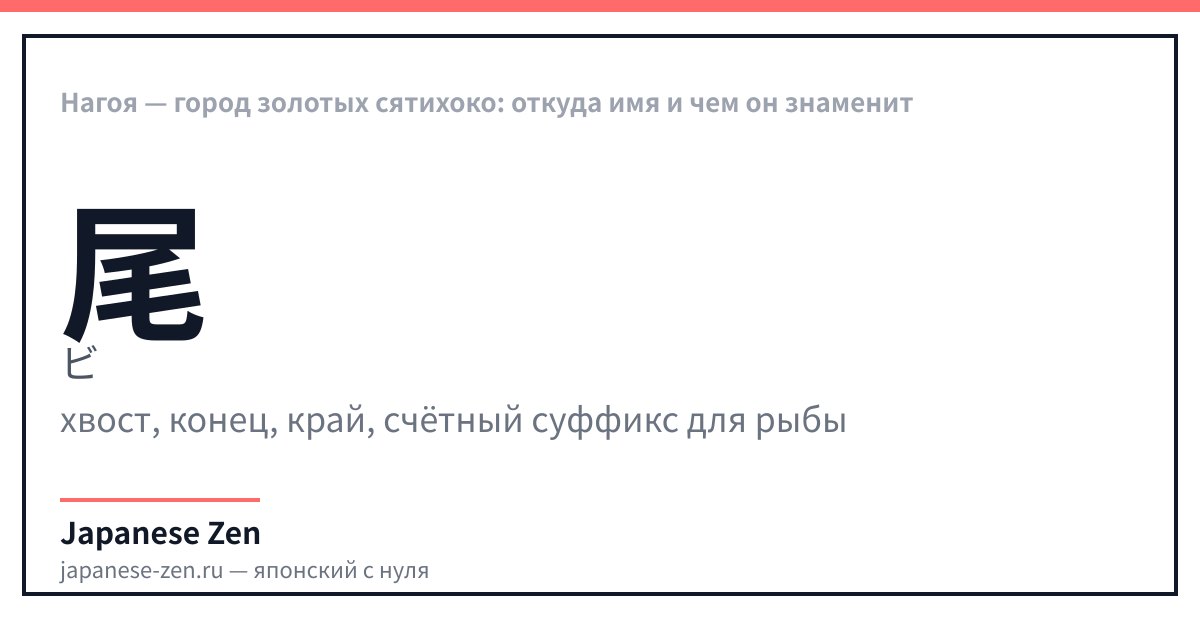
尾 means "tail": the character is composed of 尸 "body" and a shortened 毛 "fur" — together they depict a tail sticking out from an animal's body. Nagoya stands on the lands of the former Owari Province (尾張), and this same character 尾 is the first in its name.
尾 — значение: tail, end, edge, counter suffix for fish — онъёми: ビ — кунъёми: お — 7 штрих(ов). 尾 — "tail": the first character in the name of Owari Province, on whose lands Nagoya stands. The characters of the name itself, 名古屋, were chosen for their sound, while 尾 links the city to history.
Owari: The Old Province and the Princely House
The characters of the name itself, 名古屋, do not lend themselves to a clear analysis, so the card shows the character of the province. Where the name 尾張 came from is also disputed: there are theories about "edge" or "end" of lands, and about a phonetic spelling. Today Owari lives on primarily in the name of the Tokugawa branch that ruled Nagoya for two and a half centuries.
| Japanese | Reading | Translation |
|---|---|---|
| 名古屋 | Nagoya · Nagoya | Nagoya — the name of the city itself |
| 尾張 | Owari · Owari | Owari — the old province on whose lands Nagoya stands |
| 尾 | o · o | Tail — the meaning of the character being analyzed |
| 尻尾 | shippo · shippo | Tail — the everyday word with the same root |
| 金鯱 | kinshachi · kinshachi | The golden shachihoko fish on the castle roof |
Write 尾 along the guides — the character for "tail," with which the name of Owari Province begins.
FAQ
- Where does Nagoya get its name?
- There is no exact answer. The place under the name 那古野 is known from the late Heian period, later it was written both 名古屋 and 名護屋, and the current spelling was fixed in 1870. The characters "name," "ancient," and "house" were chosen for their sound, so a literal translation explains nothing.
- Where did the castle and the golden shachihoko in Nagoya come from?
- The castle was built in the 1610s by order of Tokugawa Ieyasu for his nine-year-old son Yoshinao, the founder of the Owari branch. The roof of the main keep was decorated with a pair of golden shachihoko fish: they became the city's recognizable symbol.
- What is kiyosu-goshi?
- That is the name for the relocation of the entire city of Kiyosu to the new Nagoya in the 1610s — along with samurai, merchants, temples, and even the names of streets and bridges. A rare case when a city was not built from scratch but literally moved to a new location.
- What is modern Nagoya famous for?
- Industry and food: the city and the entire Aichi Prefecture are the center of Japan's automotive industry, and at the table they serve their own dishes — hitsumabushi, miso katsu, and tebasaki, which together are called "Nagoya meshi."
- Which province stood on the site of modern Nagoya?
- Owari (尾張) — the historical province that gave its name to the Tokugawa branch that ruled Nagoya throughout the Edo period. Its first character 尾 means "tail," but historians dispute where the province's name itself came from.
- Which kanji are used to write the name of the city of Nagoya?
- 名古屋, read なごや. The characters 名 "name," 古 "ancient," and 屋 "house" are understandable individually, but together they convey sound, not meaning. Old documents contain the spellings 那古野 and 名護屋; the unified 名古屋 was established in 1870.
Sources
Updated: 2026-09-15