What the Toyota logo means and the names of other Japanese brands
The Toyota logo doesn't literally mean anything — it's the katakana トヨタ: in 1936, at a logo contest, the founder's surname Toyoda was rewritten this way. In this spelling there are exactly eight strokes — a lucky number in Japan, as the company itself explains. The three-oval emblem appeared in 1989: according to Toyota, the ovals are the hearts of the customer and the company within the world that surrounds them.
Let's look at why Japanese car brands almost never write their names in kanji, what Toyota, Mazda, and Subaru officially say about their logos, and why Nissan, Honda, and Mitsubishi have names that are real Japanese words with history. We'll also look at the character 昴 — a rare case where a brand name turns out to be an ordinary Japanese word written with a single kanji.
From the surname Toyoda to the katakana トヨタ: 1936 and eight strokes
In July 1936, the automobile department of Toyoda Automatic Loom Works announced an open contest for a new logo: about 27,000 entries came in from all over Japan. The winning work was by Nakajima Taneo: the name was written in katakana and enclosed in an oval, and from September 25 of that year the new spelling went into use. The spelling itself was changed: instead of トヨダ (Toyoda), they chose トヨタ (Toyota).
Why exactly eight strokes
The difference between トヨダ and トヨタ is the dakuten (゛), which adds two extra strokes to the syllable "ta" and turns it into "da." Without that mark, the word トヨタ has exactly eight strokes, and with it, トヨダ has ten. The company itself explains the choice with three reasons: the spelling looked more elegant, eight strokes are considered a lucky number in Japan, and the company was also moving away from the family surname to a name that no longer belonged to the family alone. The trademark トヨタ was registered in April 1937, and a few months later, on August 28, 1937, the Toyota Motor Company was officially established.
The three ovals of the emblem: what the company itself says
The current three-oval symbol is not the same age as the katakana トヨタ: it was only introduced in October 1989, for the company's fiftieth anniversary. Toyota explains the design this way: the two perpendicular ovals inside represent the heart of the customer and the heart of the company, and the large oval outside represents the whole world that surrounds them. This is Toyota's own version, not a proven fact: the logo has no single correct interpretation, only an official explanation.
Mazda, Subaru, Nissan, Honda, Mitsubishi: what's behind the names
| Brand | In Japanese | What the name means |
|---|---|---|
| Mazda | マツダ (Matsuda) | Katakana instead of the kanji of the founder's surname, Matsuda Jujiro; the company itself adds that the name is also linked to Ahura Mazda — the Zoroastrian deity of wisdom. |
| Subaru | スバル (Subaru) | The Japanese name for the Pleiades star cluster, literally "gathered together": the six stars visible to the naked eye symbolize the five companies and Fuji Heavy Industries itself, which merged in 1953. |
| Nissan | 日産 (Nissan) | An abbreviation of 日本産業 — "Japanese industry," the name of the holding company; under this abbreviation the holding was known on the stock exchange, and in 1934 the name passed to the automobile company. |
| Honda | 本田 (Honda) | The real Japanese surname of the founder, Honda Soichiro: 本 "origin, base" plus 田 "rice field." |
| Mitsubishi | 三菱 (Mitsubishi) | "Three diamonds": the symbol has been known since 1870. The design was formed from two family crests: the three-tiered diamond of the Iwasaki family and the three-leaf crest of the Yamauchi princes, under whose flag the ships of the Tosa domain sailed. |
The company's version is not a proven etymology
Mazda's explanation about Ahura Mazda and Subaru's about the merger of companies are what the firms themselves tell about their logos in official materials. For marketing, it's a nice and effective story, but it's not the same as a confirmed origin of the word. And the Mitsubishi symbol is older than automobiles: the three diamonds were raised on ship flags back in the early 1870s, long before the company's first car.
Katakana, kanji, and 株式会社: how brand names are structured
The myth that all Japanese car brands are written in katakana rather than kanji is inaccurate: only some companies decided to do this. Toyota (トヨタ), Mazda (マツダ), and Subaru (スバル) preferred katakana, although the kanji spelling of their names (豊田, 松田, 昴) exists and is easily read. But Nissan (日産), Honda (本田), and Mitsubishi (三菱) still use real kanji in their official names.
Why 株式会社 appears in the full name
In the official names of Japanese companies, 株式会社 (kabushiki gaisha) often appears — "joint-stock company." 株 means "share, stock," 式 means "type, system," and 会社 means "company, corporation." The full legal name of the auto giant is トヨタ自動車株式会社 — "Toyota Motor Corporation."
Why "Mazda" is マツダ in Japanese
マツダ is read "Matsuda" — exactly like the real surname of the company's founder, 松田 (Matsuda Jujiro), only written in katakana instead of kanji. The resemblance to Ahura Mazda works primarily for English-speaking ears: a Japanese person reading マツダ hears first and foremost the surname, not the name of the Zoroastrian deity.
昴: the only brand that is actually a Japanese word
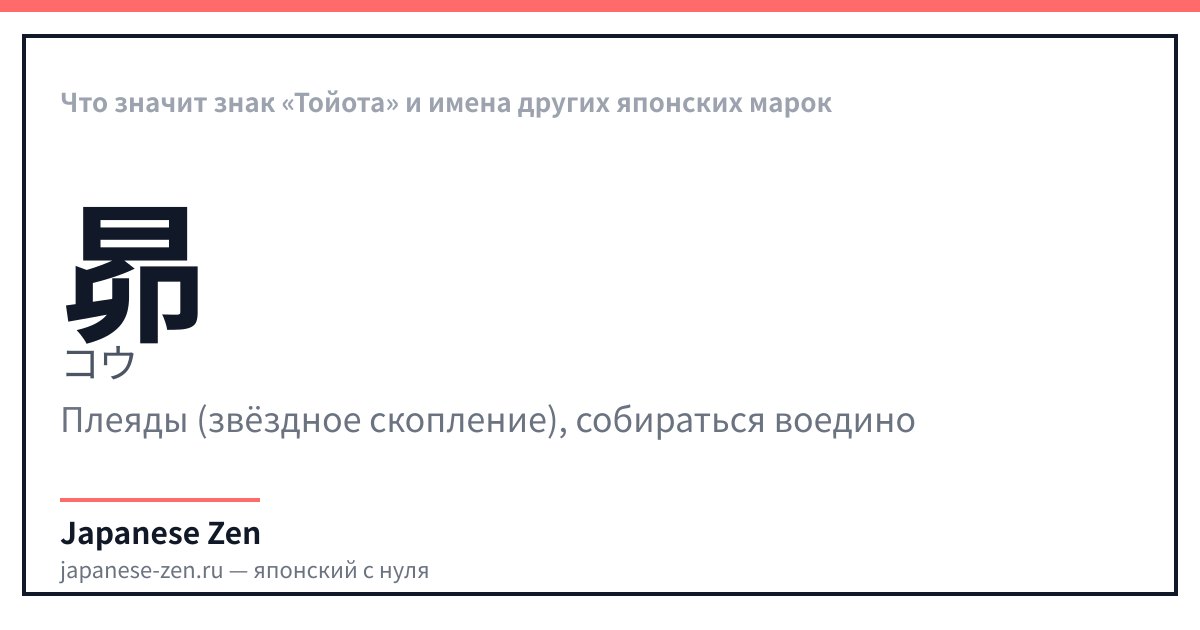
昴 — значение: Pleiades (star cluster), to gather together — онъёми: コウ、ボウ — кунъёми: すばる — 9 штрих(ов). 昴 — the kanji used in Japanese to write the Pleiades star cluster. The brand name "Subaru" is not a marketing invention but a direct Japanese word すばる, which denotes exactly this constellation.
Readings of 昴: ボウ and すばる
The on'yomi reading of the character is ボウ; it appears almost exclusively in this very word and in a couple of astronomical terms. The kun'yomi reading is すばる, and that is exactly what the car brand chose for itself. According to dictionaries of Japanese etymology, すばる goes back to the verb 統ばる (subaru) — "to gather into one, to unite": that is what they called the star cluster that looks from Earth like a single dense clump of light.
車 and 自動車: from "cart" to "self-moving machine"
The usual word for a car is 自動車 (jidōsha), and it is made up of three characters: 自 "self," 動 "to move," and the already familiar 車 "cart, vehicle." Literally it comes out as "self-moving cart" — a logical name for something that used to be harnessed to a horse and now is started with a key. The character 車 appears in all words about the automotive world: 自動車会社 "automobile company," 中古車 "used car."
| Japanese | Reading | Translation |
|---|---|---|
| 自動車 | jidōsha · jidōsha | Automobile |
| 車 | kuruma · kuruma | Car, cart |
| 昴 | subaru · subaru | Pleiades; the brand name "Subaru" |
| 株式会社 | kabushiki gaisha · kabushiki gaisha | Joint-stock company |
| メーカー | mēkā · mēkā | Manufacturer, brand |
Write 昴 along the guides — the character for the Pleiades, which underlies the name of the brand "Subaru."
FAQ
- What does the Toyota logo mean?
- By itself it doesn't literally mean anything: トヨタ is katakana, a spelling of the founder's surname Toyoda, chosen at a logo contest in 1936. It has eight strokes, and eight is considered a lucky number in Japan — that's how the company itself explains the choice.
- Why was the brand named "Toyota" and not "Toyoda"?
- The difference is just one diacritic mark, the dakuten (゛), which turns "ta" into "da" and adds two strokes. Without it, the word has exactly eight strokes instead of ten, and eight is associated with prosperity in Japanese tradition. This spelling was chosen at the 1936 logo contest.
- What do the three ovals on the Toyota emblem mean?
- The emblem was introduced in October 1989, half a century after the company was founded. According to Toyota's official explanation, the two perpendicular ovals inside symbolize the heart of the customer and the heart of the company, and the outer oval represents the whole world that surrounds them.
- What does the name "Mazda" mean?
- マツダ is read the same as the real surname of the company's founder — Matsuda Jujiro — only written in katakana instead of kanji. Mazda itself adds another explanation: the resemblance to Ahura Mazda, the Zoroastrian deity of wisdom and harmony.
- Where does the brand "Subaru" get its name?
- Subaru (昴) is the Japanese name for the Pleiades star cluster, and the word すばる itself goes back to the verb "to unite." The six stars on the emblem refer to 1953, when five companies merged into a single Fuji Heavy Industries.
- Why are Japanese car brands written in katakana and not kanji?
- Not all of them: Toyota, Mazda, and Subaru did choose katakana, although the kanji spelling of their names exists. But Nissan (日産), Honda (本田), and Mitsubishi (三菱) still use real kanji in their official names — it's more a decision of each individual company than a general rule.
Sources
Updated: 2026-09-15