Kei car: what keijidōsha are and why they are smaller than ordinary cars
A kei car (keijidōsha, 軽自動車) is a Japanese class of cars with strict limits on size and engine: today no longer than 3.4 meters, no wider than 1.48 meters, and engine displacement up to 660 cc. The current dimensions have been in force since October 1998. Power is unofficially capped at 64 horsepower — this is not a law but an agreement among the manufacturers themselves.
A kei car is not just a "small Japanese car" but a separate legal category with its own plates, taxes, and a history of disputes over dimensions. Let's look at the current keijidōsha standards, why this class was created, and why it has held on in Japan for more than seventy years, as well as the character 軽, which appears both in the word itself and in dozens of other words about "lightness."
Keijidōsha: current dimensions and engine
軽自動車 (keijidōsha), literally "light automobile," is a separate class of cars that Japanese road vehicle law restricts by four parameters at once: length, width, height, and engine displacement. Exceed even one standard, and the car is no longer a kei car but an ordinary small car with its own taxes and plates.
| Parameter | Standard | Since |
|---|---|---|
| Length | no more than 3.40 m | October 1998 |
| Width | no more than 1.48 m | October 1998 |
| Height | no more than 2.00 m | October 1998 |
| Engine displacement | no more than 660 cc | January 1990 |
| Power | about 64 hp | industry agreement since the late 1980s |
64 hp is not a law but the manufacturers' word
Unlike dimensions and engine displacement, the power limit is not written anywhere as a mandatory standard. In the late 1980s, when turbocharging boosted kei car power, Japanese automakers agreed among themselves not to exceed 64 horsepower — to avoid an arms race within their own class. The ceiling was set at the most powerful kei car of the time. Since then it has been a gentlemen's agreement, not a clause in the law.
Why Japan created a separate class of small cars
The class appeared in 1949, in war-devastated Japan: the authorities wanted to give people an affordable alternative to a motorcycle and to push local manufacturers to build simple cars rather than spare parts for foreign armies. Since then the standards have changed many times, but the general idea has not: a small car means less tax and fewer parking requirements.
- 1949 — the first standards: length up to 2.8 m, engine displacement up to 150 cc for four-stroke engines and up to 100 for two-stroke; not a single car was ever built to this standard.
- 1976 — dimensions grew to 3.2 × 1.4 m, and engine displacement to 550 cc.
- 1990 — engine displacement was increased to today's 660 cc.
- 1998 — length and width were brought to today's 3.40 × 1.48 m so that more safety features could fit in the body.
Tax and parking are the main reasons to stick with the class
A kei car owner pays a lower annual vehicle tax than the owner of an ordinary car of the same purpose, and in some cities they do not have to prove they have their own parking space — that requirement usually applies to larger cars. For many Japanese families outside big cities, this is the main reason to choose this class rather than cabin size.
Yellow plates, kei trucks, and the class's share on the roads
Kei cars are easy to spot on the street by their license plates: since 1975, cars of this class have a separate color scheme — black digits on a yellow background for private use and yellow digits on a black background for commercial use. Ordinary cars do not get such plates.
- Kei sedans and kei vans are the most recognizable: a high roof and an almost square silhouette are needed to squeeze the maximum cabin out of the strict dimensions.
- Kei trucks are open or covered small trucks on the same base: farmers and small workshops keep them, and they have been used on construction sites for decades.
- Kei sports cars in the spirit of the 1990s Honda Beat or Suzuki Cappuccino are a rare exception: almost the entire class relies on family and work practicality, not speed.
How large is the kei car share of sales
According to industry statistics, about 1.67 million new kei cars were sold in Japan in 2025 — roughly 36.5% of all new passenger cars in the country that year. The share fluctuates from year to year, but for more than a decade it has held at about every third or fourth car sold.
軽: the character of "lightness" in cars, food, and conversation
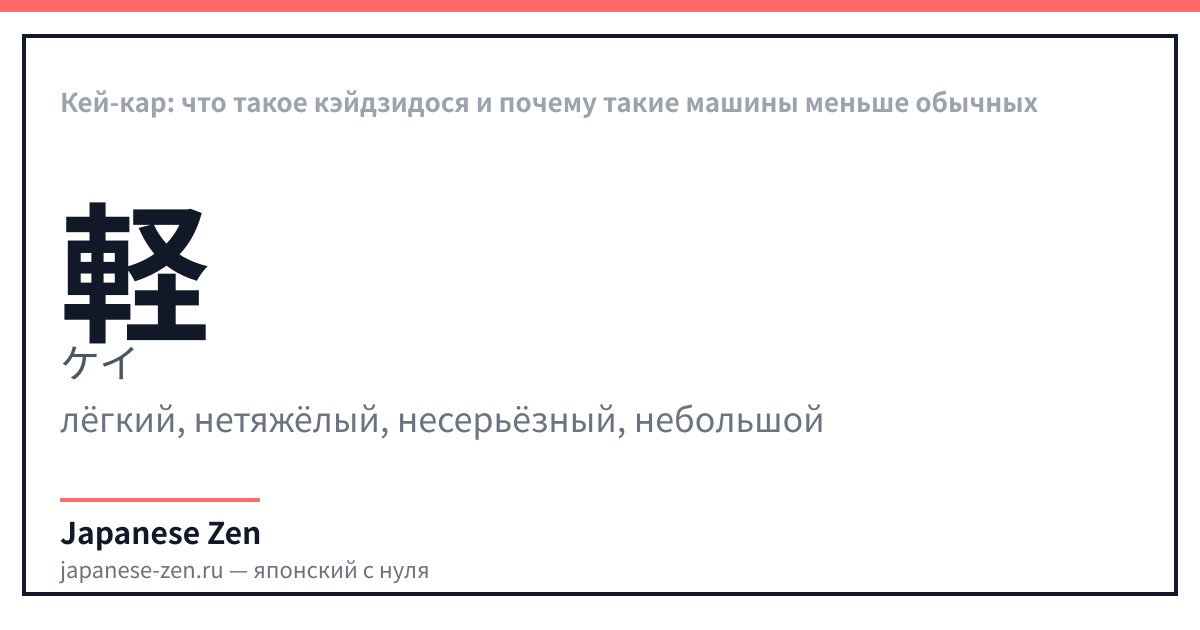
軽 — значение: light, not heavy, not serious, small — онъёми: ケイ、キョウ、キン — кунъёми: かる.い、かろ.やか、かろ.んじる — 12 штрих(ов). 軽 — "light": the same character as in the word 軽自動車 itself appears in 軽い "light in weight," 軽食 "light snack," and 気軽 "casually, without ceremony."
Readings of 軽: ケイ and かる.い
The on'yomi ケイ appears in compound words like 軽自動車 (keijidōsha) and 軽減 (keigen) "reduction, alleviation." The kun'yomi かるい is the ordinary conversational adjective "light": 軽い荷物 means "light luggage." There are also figurative meanings: 軽食 (keishoku) is a "light snack," and 気軽 (kigaru) means "casually, without ceremony," literally "light feeling."
自動車 by its characters: "self-moving carriage"
自動車 (jidōsha) is made up of three characters: 自 "self," 動 "move," and 車 "carriage." The result is literally "self-moving carriage" — the ordinary Japanese word for an automobile of any class. 軽自動車 simply adds "light" in front: "light self-moving carriage."
| Japanese | Reading | Translation |
|---|---|---|
| 軽自動車 | keijidōsha · keijidōsha | Kei car, light-class car |
| 軽い | karui · karui | Light (in weight) |
| 軽食 | keishoku · keishoku | Light snack |
| 気軽 | kigaru · kigaru | Casually, without ceremony |
| 黄色いナンバー | kiiroi nanbā · kiiroi nanbā | Yellow plate — the mark of a kei car |
Write 軽 along the guides — the character of "lightness" that gave its name to an entire class of Japanese cars.
FAQ
- What is a kei car?
- A kei car (keijidōsha, 軽自動車) is a Japanese class of cars with legally fixed limits on length, width, height, and engine displacement. Today it is no longer than 3.4 meters and has an engine no larger than 660 cc — such limits bring a reduced tax and other benefits.
- What are the current keijidōsha standards?
- Length up to 3.40 m, width up to 1.48 m, height up to 2.00 m, and engine displacement up to 660 cc — these dimensions have been in force since October 1998, and engine displacement has not changed since 1990. Power around 64 hp is not a law but a voluntary agreement among manufacturers.
- Why is kei car power limited to exactly 64 horsepower?
- It is an unofficial ceiling that Japanese automakers agreed on among themselves in 1990, when turbo engines began to boost power within the class. There is no official law about such power — it is a gentlemen's agreement, not a line in the standards.
- Why did the kei car class appear in Japan in the first place?
- The class was introduced in 1949 to give the population of a war-devastated country an affordable alternative to a motorcycle and to support local manufacturers of simple cars. Later, a reduced tax and simplified parking requirements were added.
- What share of car sales in Japan do kei cars account for?
- In 2025, about 1.67 million new kei cars were sold in Japan — roughly 36.5% of all new passenger cars for the year. The share changes from year to year, but for more than a decade it has held at about a third to a quarter of the entire market.
- Why do kei cars have yellow plates?
- Since 1975, cars of this class have a separate license plate system: black digits on a yellow background for private use, yellow digits on a black background for commercial use. By the color of the plate, a kei car can be recognized from afar without examining the body itself.
Sources
Updated: 2026-09-15