Shinobi — who they are and why they are not the same as the "ninja" from anime
Who are shinobi in Japan? They were scouts and saboteurs in the service of Sengoku warlords (15th–16th centuries), not fighters in black cloaks: they gathered information about the enemy, delivered secret messages, set fires, and infiltrated enemy castles. "Ninja" is the same word, just in a Sino-Japanese reading, and it only came into common use in the 20th century; in documents of the era they wrote "shinobi".
Popular culture portrays shinobi as superhumans in all-black suits — an image largely invented by 20th-century cinema and manga. Let's look at what scouts actually did according to Edo-period documents, where the word "ninja" got its Sino-Japanese reading, and how the same character 忍 means both "to endure" and "to hide".
Who shinobi were and how they made a living
Shinobi (忍び) were scouts and saboteurs hired by Sengoku warlords for reconnaissance and secret missions in the 15th–16th centuries. Most such families lived in the provinces of Iga and Koga: in peacetime they cultivated the land, and when hired they took on tasks beyond the reach of an ordinary samurai. They usually operated alone or in small groups under cover of night, not in units of hundreds or in open formation. What was valued was not strength and the sword, but stealth, knowledge of the terrain, and the ability to pass as a simple peasant, merchant, or wandering monk.
- Reconnaissance — counting enemy troops, scouting roads and fortifications before a campaign.
- Communication — delivering secret messages between allies and within a single house.
- Sabotage and arson — destroying supplies, burning warehouses and watchtowers before an assault.
- Infiltration — secretly entering a castle or camp disguised as a merchant, monk, or traveling actor.
- Daily life — between assignments, these same people plowed the land or kept a shop, rather than lying in ambush.
How one became a shinobi and why it did not interfere with ordinary life
The craft was passed down within the family and the neighboring community: children from the farming clans of Iga and Koga learned stealth and the handling of poison and fire from their elders from an early age. There was no separate school for outsiders — one could not buy a scout's place; people were born into this trade. The head of the clan chose the employer, and the same household could well serve one daimyo today and, years later, his opponent.
One character 忍 — two words: shinobi and ninja
"Shinobi" and "ninja" are not two different trades, but one word in two readings: the character 忍 is common to both. The only difference is which reading was taken — the native Japanese one or the one that came from China. Hence the confusion that persists to this day.
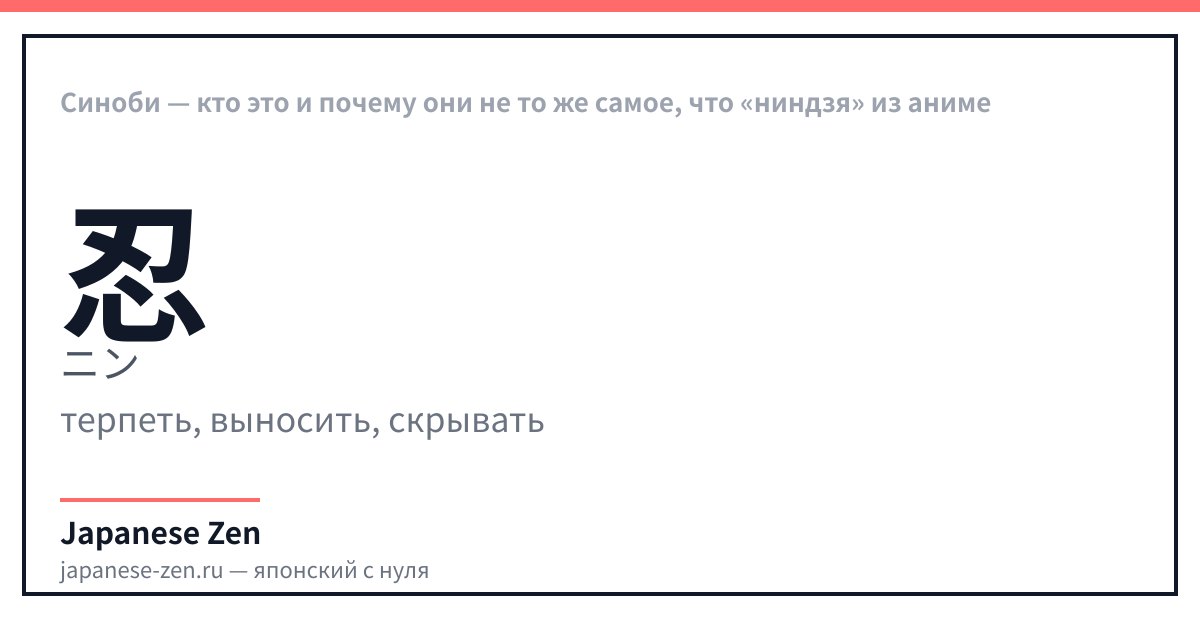
忍 — значение: to endure, to bear, to hide — онъёми: ニン — кунъёми: しの.ぶ、しの.ばせる — 7 штрих(ов). 忍 — "to endure", "to hide": one character, two fates. In Japanese (kun reading) it gives the word "shinobi"; following the Chinese model (on reading) it begins the word "ninja".
What the character 忍 itself means
The traditional interpretation of the character 忍 is "a blade 刃 over the heart 心": a point that must be endured without flinching. Strictly speaking, 刃 here is also a hint at the reading "nin", while the meaning is carried by "heart". The character's meanings are "to endure", "to bear", "to hide": exactly what was required of a scout — not to give oneself away through pain, fear, or an extra word.
The kun, native Japanese reading of the character gives the word "shinobi" (忍び) — that is what scouts were called in Sengoku documents. The on reading, which came from the Chinese "nin", together with the character 者 ("person") gives "ninja" (忍者). This word became common only in the second half of the 1950s and the 1960s, through postwar novels and cinema. Before that they wrote "shinobi", "shinobi-no-mono", and in chronicles one finds "rappa", "suppa", and even "kusa" — "grass".
| Japanese | Reading | Translation |
|---|---|---|
| 忍び | shinobi · shinobi | A scout conducting reconnaissance and sabotage — an old word |
| 忍者 | ninja · ninja | The same trade, just with a later, more familiar word |
| 忍術 | ninjutsu · ninjutsu | The art of reconnaissance and sabotage, not a secret society |
| 素破 | suppa · suppa | An old nickname for a scout from Sengoku chronicles |
| 間者 | kanja · kanja | A secret agent — another old synonym for "shinobi" |
Listen to how shinobi, ninja, and the old words for a scout sound, and repeat them aloud.
Shinobi in film, games, and manga
- "Shinobi no Mono" (忍びの者, 1962, director Yamamoto Satsuo, Daiei studio) — a film about the young scout Ishikawa Goemon in the service of Momochi Sandayu; the film stays closer to the real Iga clans than later adaptations.
- "Tenchu: Stealth Assassins" (1998, Acquire studio) — the playable shinobi Rikimaru and Ayame carry out assignments for Lord Gohda in a fictional Sengoku-era Japan by stealth, not in open battle.
- "Sekiro: Shadows Die Twice" (2019, FromSoftware) — the protagonist nicknamed Wolf, a shinobi in the service of a young lord, operates in a reimagined late 16th-century Japan.
- "Naruto" (manga — since 1999, by Masashi Kishimoto) — an entire world of "hidden villages", where the very word 忍 is in the series title, though the combat techniques there are fantasy, not documentary ninjutsu.
What film and anime added on their own
The idea of the all-black shinobi shozoku suit came from kabuki theater: on stage, those whom the audience was supposed to "not notice" — the stagehands — were dressed in black. This convention took shape as early as the Edo period, and 20th-century cinema and manga merely cemented it and spread it around the world. No documents about a uniform black outfit for scouts have survived. Shuriken as the main weapon, running up sheer walls, and fire techniques are also more the contribution of directors and manga artists than of archives.
FAQ
- Who are shinobi in Japan?
- Shinobi (忍び) were scouts and saboteurs hired by Sengoku warlords (15th–16th centuries) for reconnaissance and secret missions. Most such families were in the provinces of Iga and Koga: in peacetime they cultivated the land, and when hired they took on tasks beyond the reach of an ordinary samurai. Sword duels were a rarity in their work, not an everyday affair.
- How do shinobi differ from ninja?
- Essentially not at all — it is the same trade, called by different names. "Shinobi" is the native Japanese reading of the character 忍, used in Sengoku documents. "Ninja" is the Sino-Japanese reading of the same character plus the character for "person"; the word became common only in the 20th century, not in the time of the scouts themselves.
- What did shinobi actually do?
- First of all, reconnaissance: counting enemy troops, studying roads and fortifications. Then — delivering secret messages, burning warehouses and watchtowers before an assault, secretly infiltrating a castle disguised as a merchant or monk. Direct duels and killings were a rare extreme, not everyday work.
- How is the word "shinobi" written in Japanese and what does the character 忍 mean?
- Shinobi is written as 忍び, ninja as 忍者; both words share the character 忍. By traditional interpretation it is composed of "blade" 刃 over "heart" 心, and means "to endure", "to bear", "to hide" — the very qualities required of a scout.
- Do shinobi still exist today?
- As a trade — no: it disappeared along with the Sengoku wars, and treatises like the Bansenshukai were written down already in the peaceful Edo period, when there was almost no one to fight. What remains is memory: a museum in the city of Iga and the International Ninja Research Center at Mie University, where ninjutsu is studied academically, up to a master's program.
Sources
Updated: 2026-09-12